


74.9 x 103.2 cm - oil, canvas
Signed l.d.: Zygmunt Ajdukiewicz | 1891
Provenance:
- The painting was purchased in 1924 by Alexander Ehrmann (1879-1965), a Croatian industrialist, philanthropist and diplomat in Vienna, at an auction at Leo Schidlof's Kunstauktionshaus.
- Alexander Ehrmann's heirs.
Reproduced image:
- [cat.] Leo Schidlof's Kunstauktionshaus, Gemälde, vorwiegend Meister des 19. Jahrhdts.: darunter Nachlass Wilhelm Richter, Wien, 17. und 18. November 1924 (Liebe in Schnee).
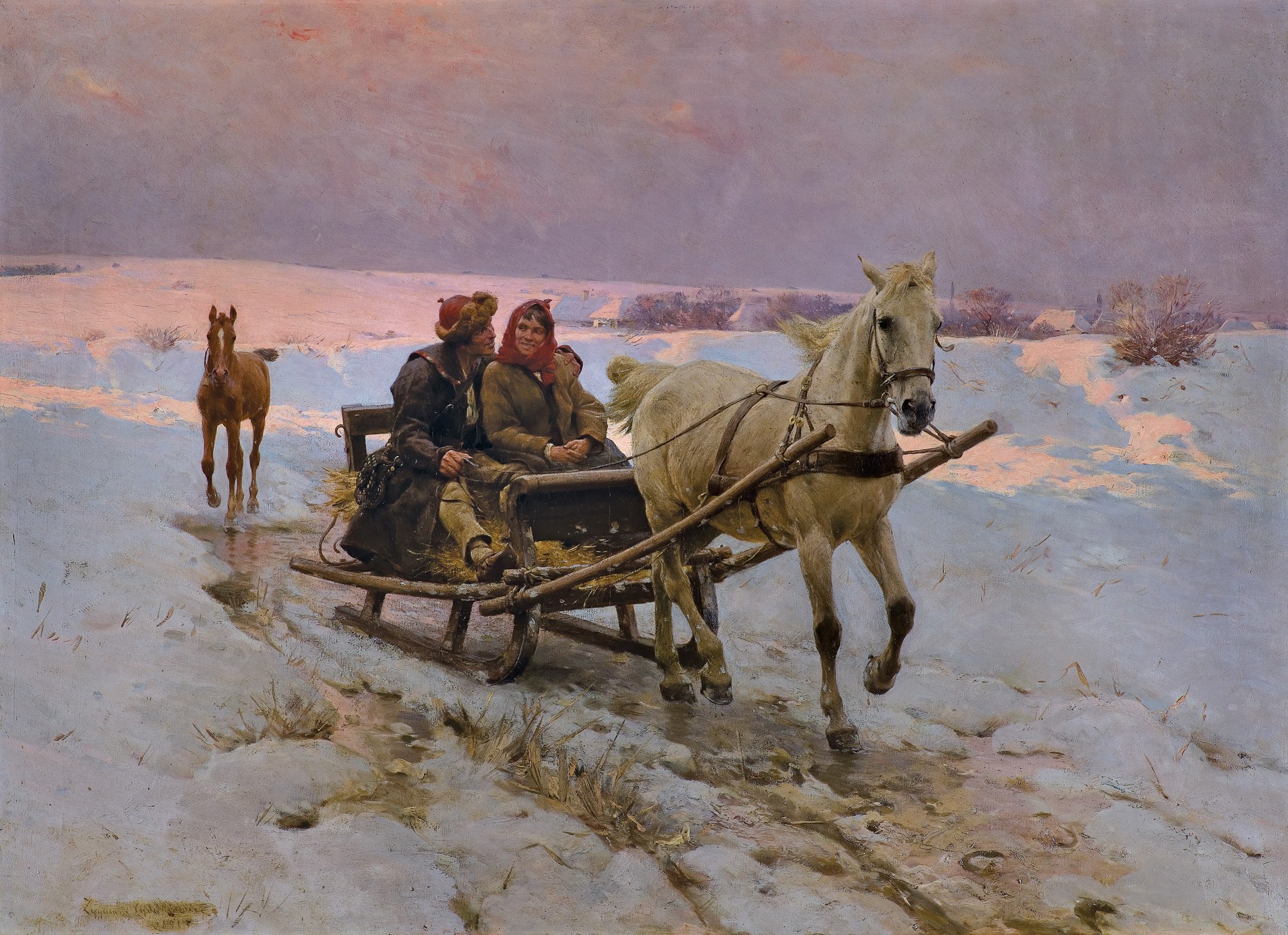
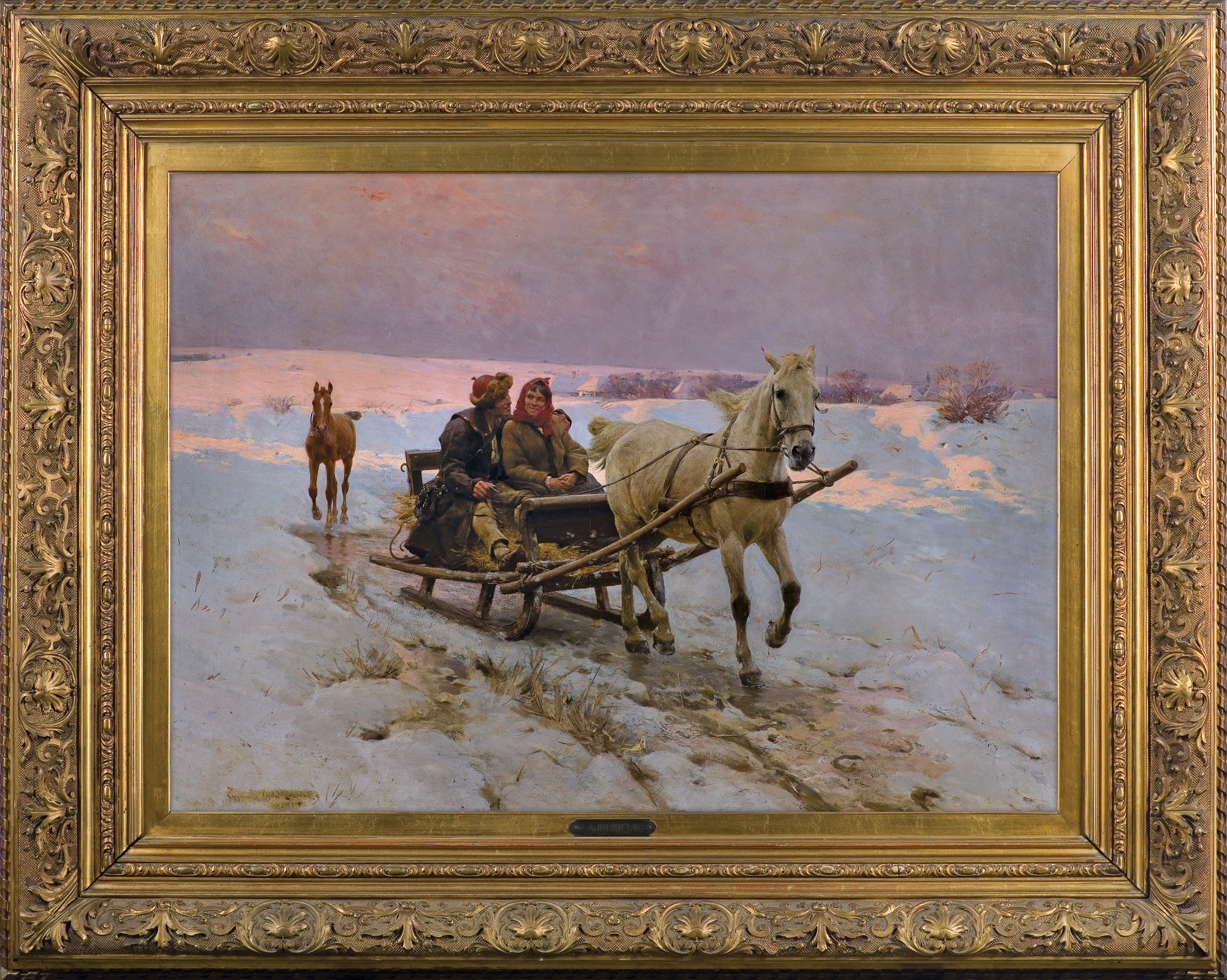
Courtship is a striking, highly decorative work by Zygmunt Ajdukiewicz created during the artist's stay in Vienna. Both the manner of painting and the subject matter of the painting indicate the influence of Munich painting, with which the artist had contact in 1883-1885, when he studied at the Academy of Fine Arts there. The scene echoes the work of Alfred Wierusz-Kowalski, a compatriot extremely popular in the Bavarian capital. His - of great interest to collectors and marchands - winter sledges, wolf attacks depicted in a vast landscape, or quiet winter nocturnes, could not have been without influence on Ajdukiewicz's painting. The painting is painted with confidence, with great care in rendering the smallest details. Undoubtedly, the hand of a mature artist can be seen here.
The winter landscape, in which the artist set the scene, gives him the opportunity for striking luministic and coloristic solutions. The foreground is illuminated by the glow of a winter sunset, from which the snows covering the hills take on a pink hue. In nature, the color white shimmers with the colors of the entire environment, especially the sun and sky. The artist studies colors and their reactions to varying light. He boldly juxtaposes the first, heavily shaded foreground, where the main scene of the entire composition takes place, with the second bathed in the soft glow of the setting sun, which emphasizes the depth and boundlessness of the landscape.
The serene scene, set on a frosty day, reveals the artist's extraordinary mastery in rendering even the smallest details and the depth and spaciousness of the winter landscape. Ajdukiewicz exposed and brilliantly captured the details of the scene unfolding in the foreground. On a straw-lined sleigh, we see a man wearing a hat lined with soft wool, with a leather bag, decorated with shiny studs, slung over his shoulder. He embraces and hugs a woman clad in a sheepskin coat and red shawl. The artist has perfectly captured their passionate gazes and smiles. The sled, to which a white mare is harnessed, is accompanied by a foal with a bell around its neck. The entire idyllic composition is an excellent example of Zygmunt Ajdukiewicz's masterful hand
Zygmunt Ajdukiewicz (Witkowice near Tarnobrzeg 1861 - Vienna 1917) began his study of painting at the School of Fine Arts in Cracow. He then studied at the Academy of Fine Arts in Vienna (1880-1882) and the Academy in Munich (1883-1885), including under Johann C. Herterich. After his studies, he lived permanently in Vienna, from where he left for Paris in 1893. Like his cousin, Tadeusz Ajdukiewicz, he was a painter of court and aristocratic circles. He painted portraits, as well as historical and genre paintings; military, fair or hunting scenes, in which "certain historical-step customs from the borderlands of old Poland" were reflected. Described by a contemporary reviewer as a "horseman-landscape artist," he had "a lot of ideas that were broad and supremely graceful." For the imperial palace in Vienna he made a series of paintings illustrating the story of the Golden Fleece, and in 1891 he painted a series of 12 paintings with scenes from the life of Tadeusz Kosciuszko (published as an album by F. Bondy in Vienna in 1892). He was also involved in book illustration; among other things, he illustrated Sienkiewicz's The Deluge. He exhibited from 1882; at TPSP in Cracow, TZSP and Krywult Salon in Warsaw, Lviv, Vienna, Berlin, Munich, Prague. His paintings were awarded medals, including a grand gold medal at the Vienna exhibition in 1891 and a second-class gold medal in Berlin, a second-class gold medal in Vienna in !898 and a silver medal in Lviv in 1894. Today, the artist's works are in the collections of numerous Polish museums, including the National Museums of Warsaw, Cracow and Wroclaw, the State Art Collections in Wawel and the Upper Silesian Museum in Bytom.













Viimeksi katsotut
Kirjaudu sisään nähdäksesi kohdeluettelon
Suosikit
Kirjaudu sisään nähdäksesi kohdeluettelon