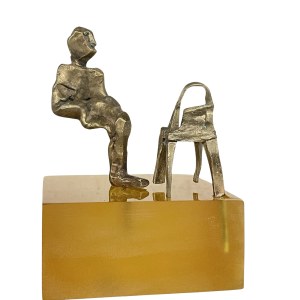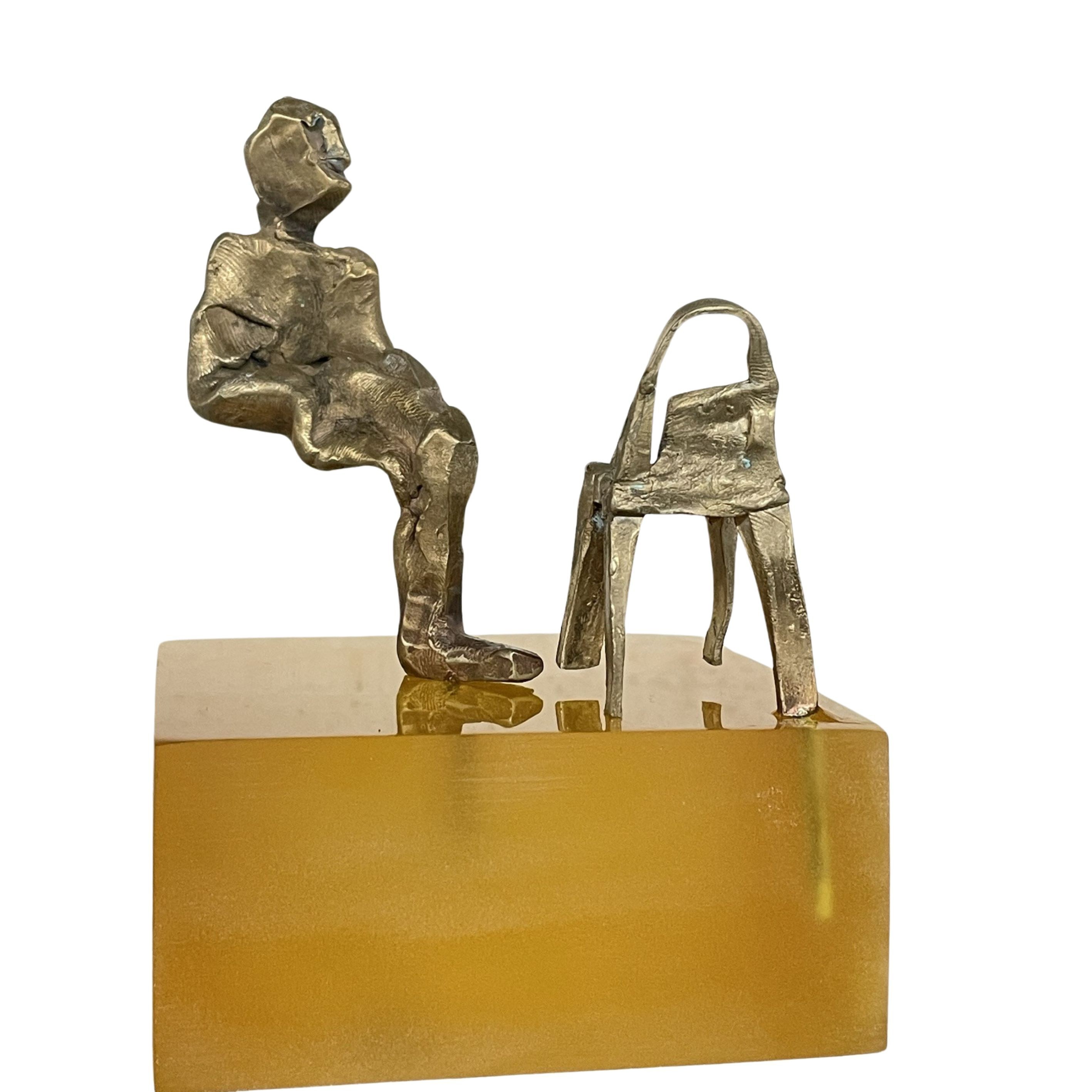
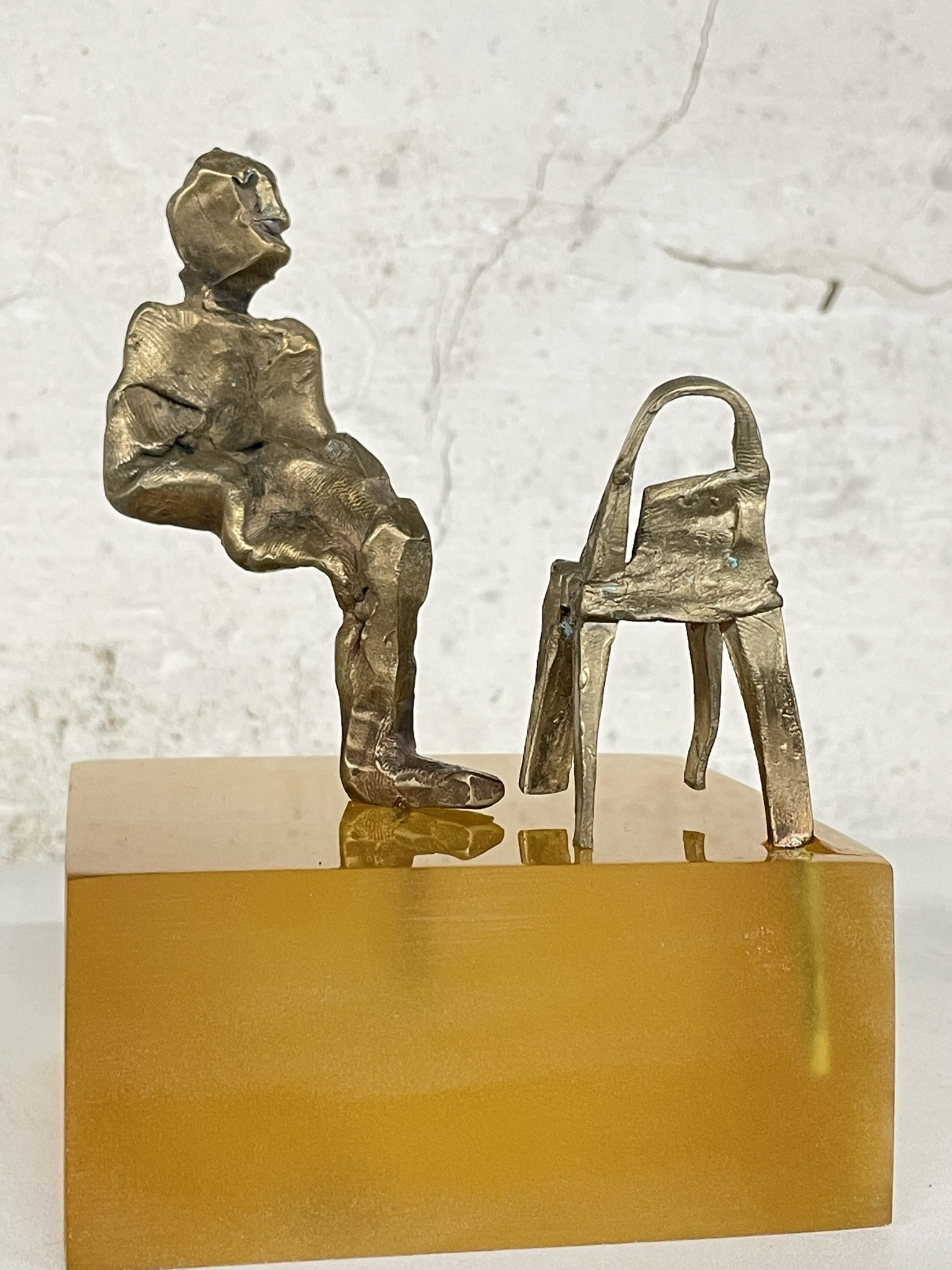
Artur Majka (b. 1967), *Homoanonymus*, 2022
Patinated bronze on an aqua resin base, 25 x 25 x 40 cm.
One-of-a-kind piece.
Purchased directly from the artist.
*
Artur Majka was born in 1967 in Tarnów. He has lived and worked in Paris since 1992. He graduated with a degree in architecture from the Kraków University of Technology and completed his art studies at the École Nationale Supérieure des Beaux-Arts in Paris. This well-rounded education is reflected in his art, both through the use of various techniques—including acrylic painting, photography, and screen printing (among others)—and in the diversity of his professional experiences. Indeed, Artur Majka is not only a painter and photographer but also works as a graphic artist: he creates illustrations for various publications and is the author of numerous posters. Furthermore, he often combines several techniques and styles in a single work, which allows him to achieve an original effect and lends his works a new artistic dimension. At the same time, the artist remains true to his training: regardless of the technique used, the line is always the foundation of the composition in all his works. It serves as both the starting point and an integral part of the final result, including—and perhaps above all—in works that straddle the line between figuration and abstraction. Artur Majka regularly exhibits his works in Poland, the U.S., and France.
**
The “Homoanonymus” project was conceived in 1997. It was in that very year that the first dated drawing was created, which would later become the beginning of a rich collection of works and a well-thought-out artistic philosophy—the Homoanonymus project as it exists today. The name itself was first used publicly during an exhibition at the Roi Dore art gallery in Paris in 2010. Over time, the project has been enriched with new meanings, interpretations, and forms. In 2022, on the 25th anniversary of the project’s inception, Homoanonymus ventured out into the wider world in a form straddling the boundaries of sculpture, street art, and performance art, and also gained a new, virtual identity.
Homoanonymus combines two elements characteristic of Artur Majka’s work: the role of the line as the foundation of each work’s composition and the central role of the human being, who serves as a constant source of inspiration for the artist. Majka is a highly versatile artist who creates acrylic and oil paintings on canvas and wood, drawings, collages, prints, and photographs, as well as large-scale metal sculptures and small-scale spatial structures made of wood or metal. She often combines various techniques and sources of inspiration within a single work. At the same time, the line—energetic, more or less regular, “cardiographic”—remains a key element of his work, serving as both the foundation of the composition, the starting point, and an integral part of the whole. Homoanonymus is also a deeply humanistic project, as it is the human being who invariably remains at the center of Artur Majka’s interest. The origins of the Homoanonymus collection lie in a gallery of drawn figures that the artist began creating upon his arrival in Paris. These quickly sketched silhouettes of people observed in the metro or on the street became the starting point for his artistic explorations—their stylized forms can be found in his paintings, sculptures, and applied art (e.g., jewelry) —but also for his philosophical explorations. As Majka writes in his artistic manifesto: “Homoanonymus was born in the Paris metro. There, amid the throng of faces and figures, I sought—and continue to seek—the justification for its abstract final form. (…) It was not the time for an in-depth psychological portrait, but only for a fleeting, sketched note of a passing person, an anonymous person. (…) And ultimately, to the realization that people are always the same, regardless of skin color, hairstyle, facial expressions, or psychology.”
The Homoanonymus project currently consists of drawings, paintings, sculptures, and jewelry, but also less conventional forms resulting from the artist’s explorations and experiences, such as art books.