


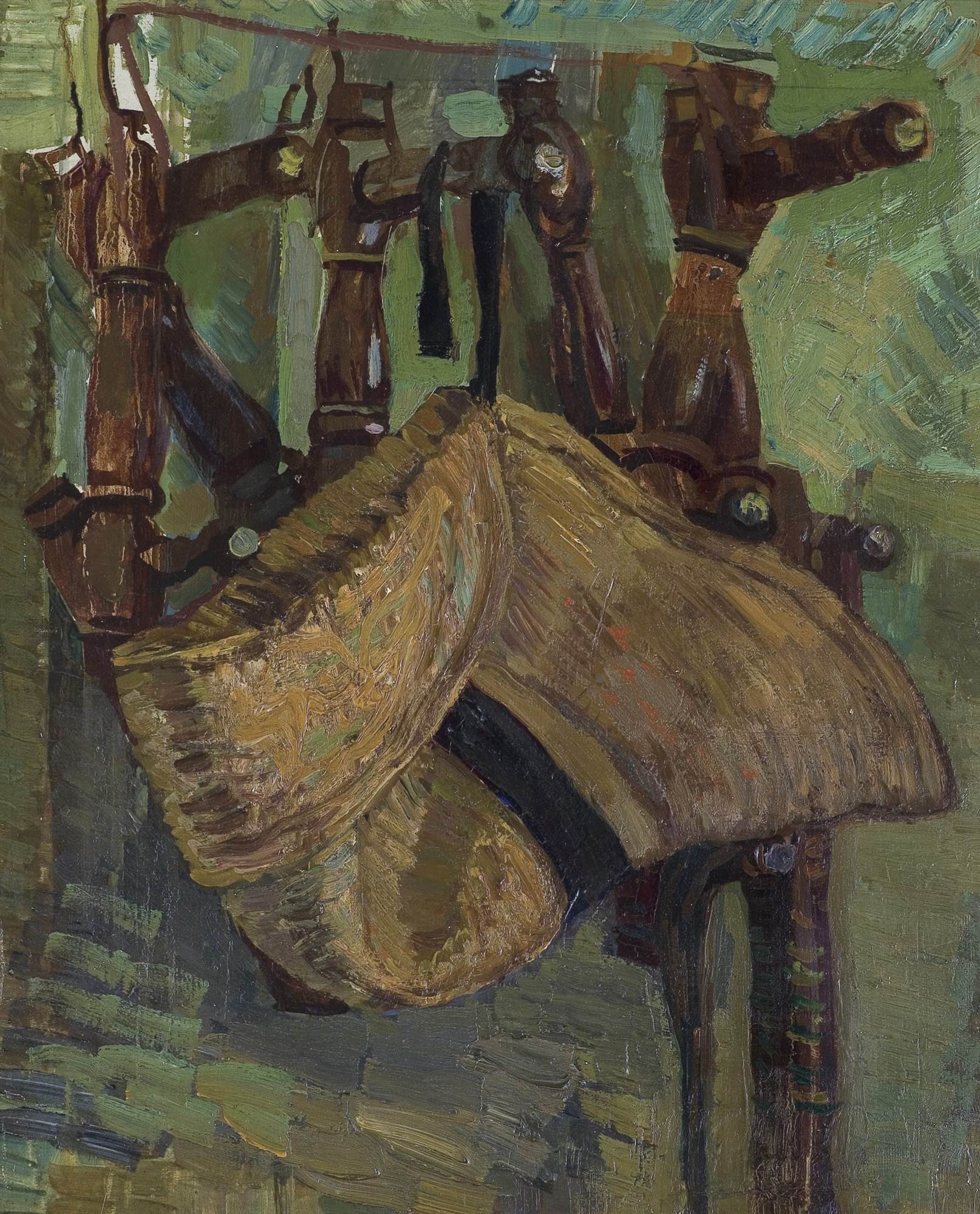
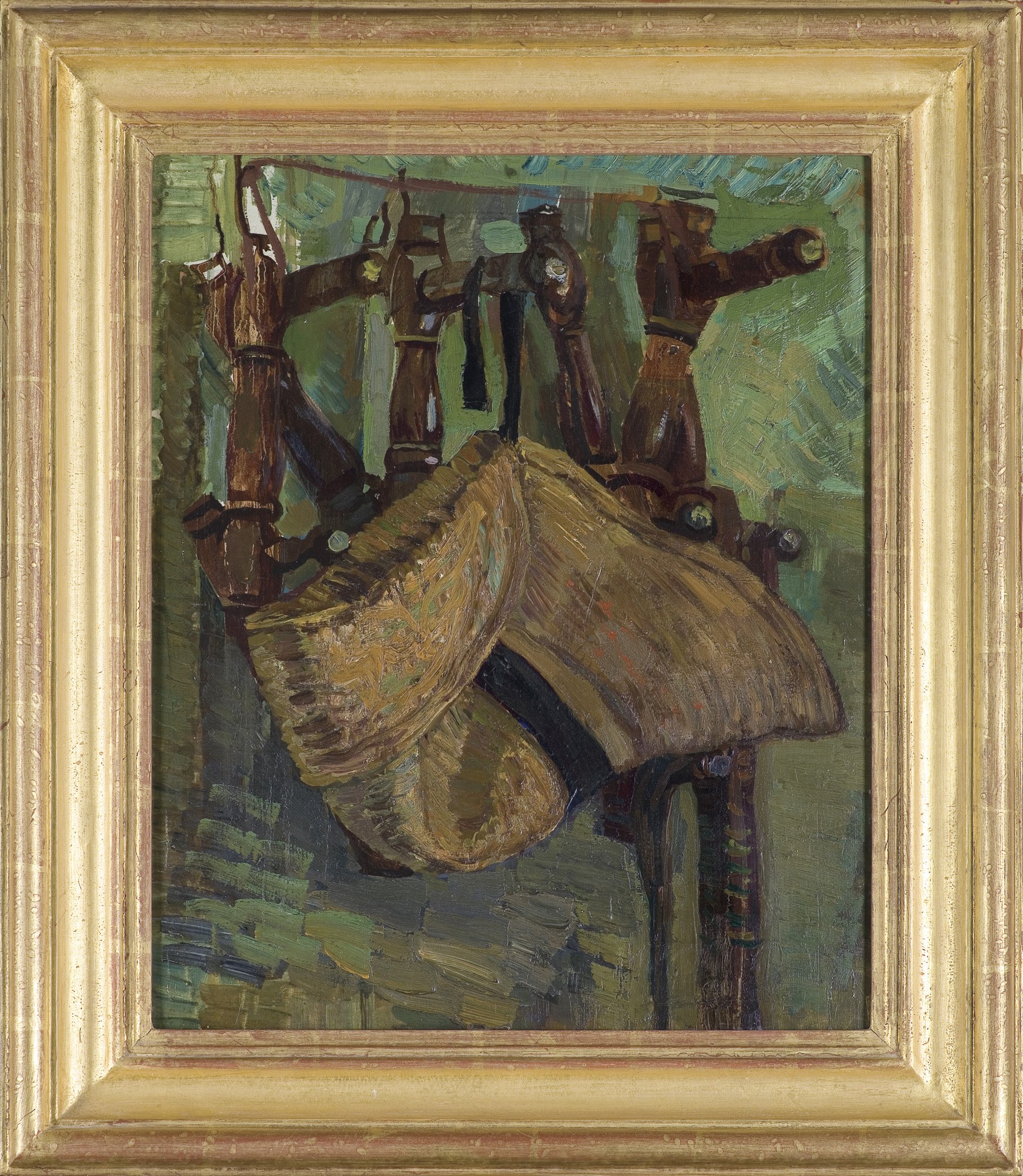
46.0 x 38.0cm - oil, cardboard On the reverse a stamp with no. 8 (referring to the size of the sub-painting); along the d. edge an inscription: Waliszewski; on the so-called "back" owner's sticker with a description of the painting.
Provenance:
- Collection of Józef Czapski (1896-1993).
- Private collection, USA.
The painting comes from the collection of Jozef Czapski, who was friends with Zygmunt Waliszewski. They were united by their studies at the Academy of Fine Arts in Cracow. Both attended the studio of Prof. Jozef Pankiewicz. In 1924, they both traveled as members of the Paris Committee to the French capital, where in the Louvre Waliszewski copied and painted variations on the works of both the old masters and the French Impressionists. The still life with hat on display is clearly maintained a la maniera de van Gogh, as the artist himself was in the habit of saying. The canvas is painted with vigorous impastos, giving a rich texture. Both the colors and the long, swirling brushstrokes are reminiscent of the Dutch painter's paintings.
Zygmunt Waliszewski (St. Petersburg 1897 - Krakow 1936) painter, stage designer, illustrator. Showing great artistic talent from childhood, he began his artistic education at an early age at the Painting and Drawing Courses conducted by Nikolai Sklifasovsky and Boris Fogel, first in Batumi and then in Tiflis. As a 13-year-old boy he had his first exhibition entitled. "Miracle Child." During the First World War he joined the army and fought on the northern front. From the front came a number of drawing sketches and portraits of soldiers, now in the collection of the MNW. Wounded, he underwent a period of convalescence in Moscow, developing friendships with the art bohemia there. He returned to Tbilisi and when Georgia proclaimed independence in 1918, Valiszewski was active among a group of Futurists gathered in the so-called "University 41." At that time he made a formally avant-garde curtain for the State Opera Theater in Tbilisi. The Bolshevik threat caused the artist to leave for Poland, where in 1921 he entered the Krakow Academy of Fine Arts in the studio of Wojciech Weiss and then Jozef Pankiewicz. He established contact with the Krakow avant-garde, wrote theoretical treatises, designed scenery and costumes for plays, and made the painting decorations of the Futurists' club room "Nutmeg." In 1924 he left with a group of students forming the so-called "Paris Committee" for further study in Paris, where Prof. J. Pankiewicz organized a branch of the Cracow university. The problem of color dominated his works and Waliszewski became one of the most prominent representatives of this trend in Polish art of the 20-year interwar period. Heavily ill, having had his legs amputated, he returned to Poland in 1930. Here he created large compositions such as Island of Love, a series of Feasts inspired by the work of Veronese, numerous landscapes and still lifes counted among his most valuable works. He is the author of the Wawel Castle plafond in Kurza Stopka. In addition, he created caricatures, humorous scenes and designed posters. He presented his works at exhibitions at home and abroad, including in Paris (1930), Geneva (1931), Krakow (1932), Warsaw (1930, 1933) and at the International Biennale in Venice (1934). His works are held by, among others, National Museums in Warsaw, Cracow, Poznan, Szczecin, the Pushkin Museum in Moscow, the Hermitage in St. Petersburg. A large group of drawings and watercolors is in the Museum of Georgian Art in Tbilisi and in private collections there. In 1999, the National Museum in Warsaw hosted his monographic exhibition








Viimeksi katsotut
Kirjaudu sisään nähdäksesi kohdeluettelon
Suosikit
Kirjaudu sisään nähdäksesi kohdeluettelon