


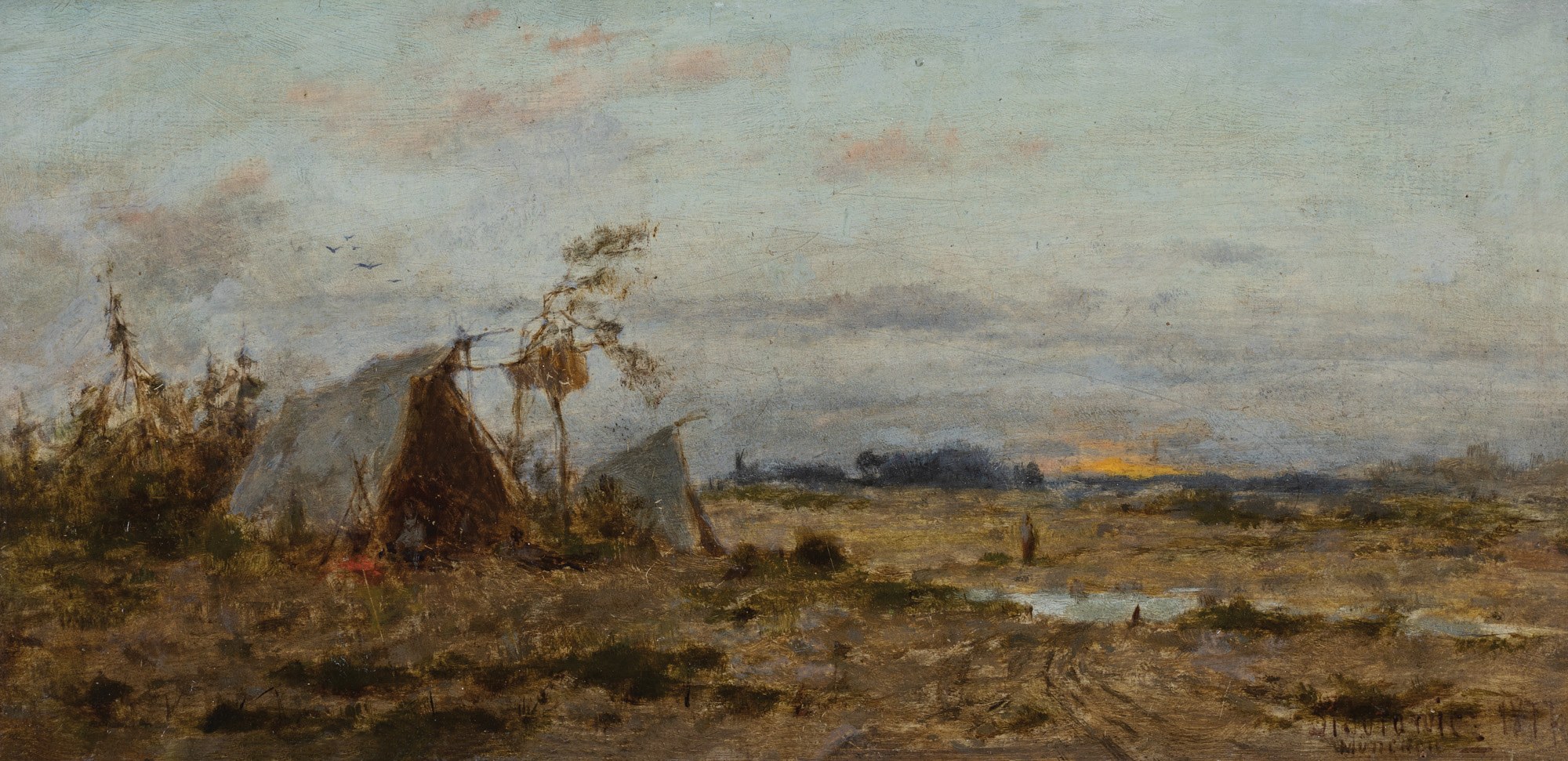
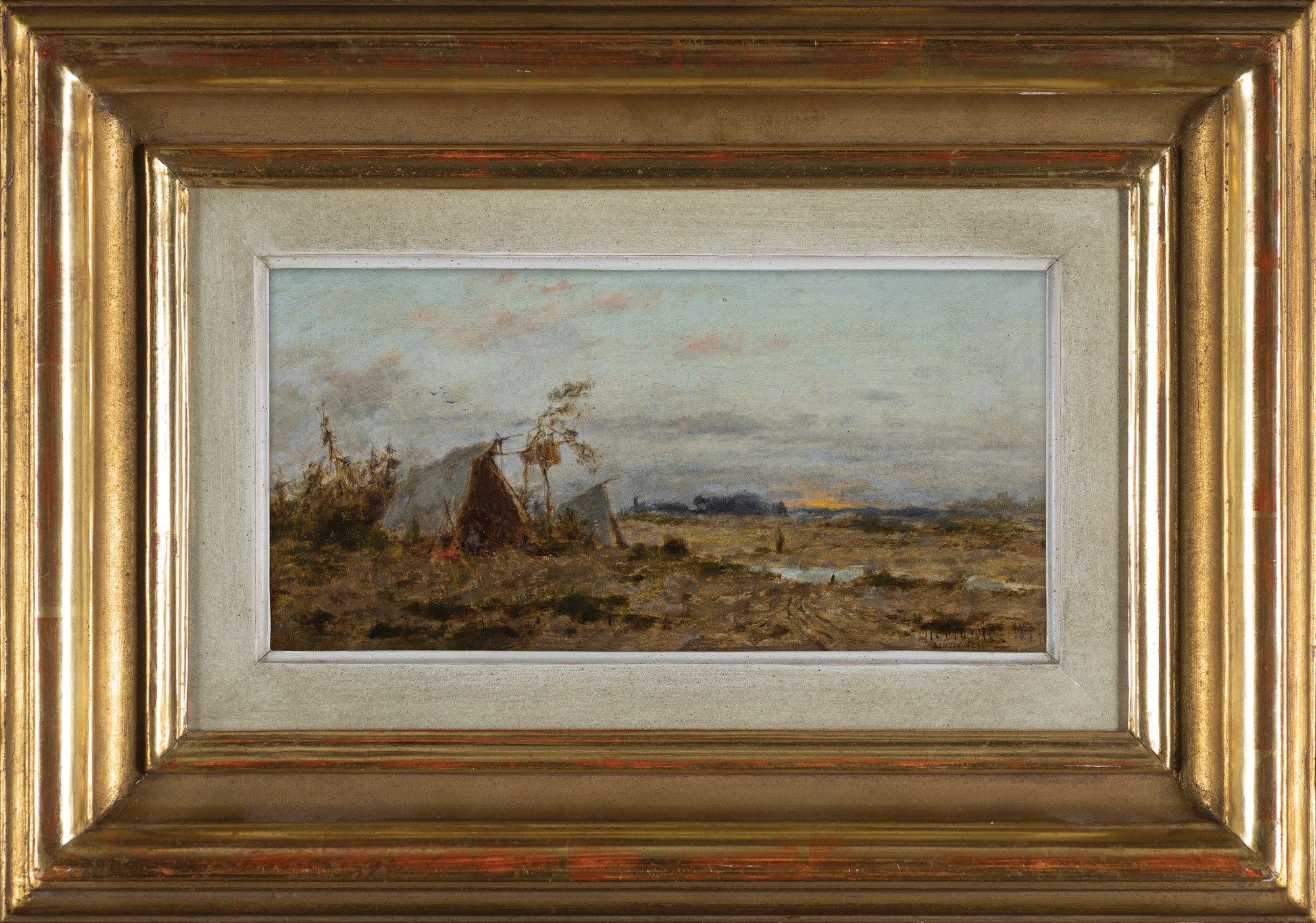

12,8 x 26,1 cm - oil, board
Signed p.d.: Sidorowicz 1877 | MÜNCHEN
On the reverse, no. (in black paint): 300; below, stamp of the factory of painting utensils: [...] & Farben Fabrik | von | Richard Wurm | München; also on the frame embossed round stamp: J.P. LARSON | 1940 | STOCKHOLM
Sidorowicz left his native Lviv for Munich around 1874, where he came under the strong influence of Walery Brochocki and Aleksandr Kotsis, with whom he shared a studio and under whose influence he became interested in landscape painting. The first work of this new kind for him, it immediately bore the characteristics found in all subsequent works, a highly poetic mood, evoked by not great means. The poetic nature of Sidorowicz's landscapes lies mostly in color. He initially painted his small paintings in his studio from memory - then he only began to search for appropriate motifs in nature - but he always adapted nature to his inner needs. (...) He enchanted his inner sadness into the frames of his small paintings; they are impressive because they are the product of a soul that felt a lot (H. Piątkowski, Album of Polish Art (retrospective exhibition in Warsaw 1898), Warsaw 1901, p. 20).
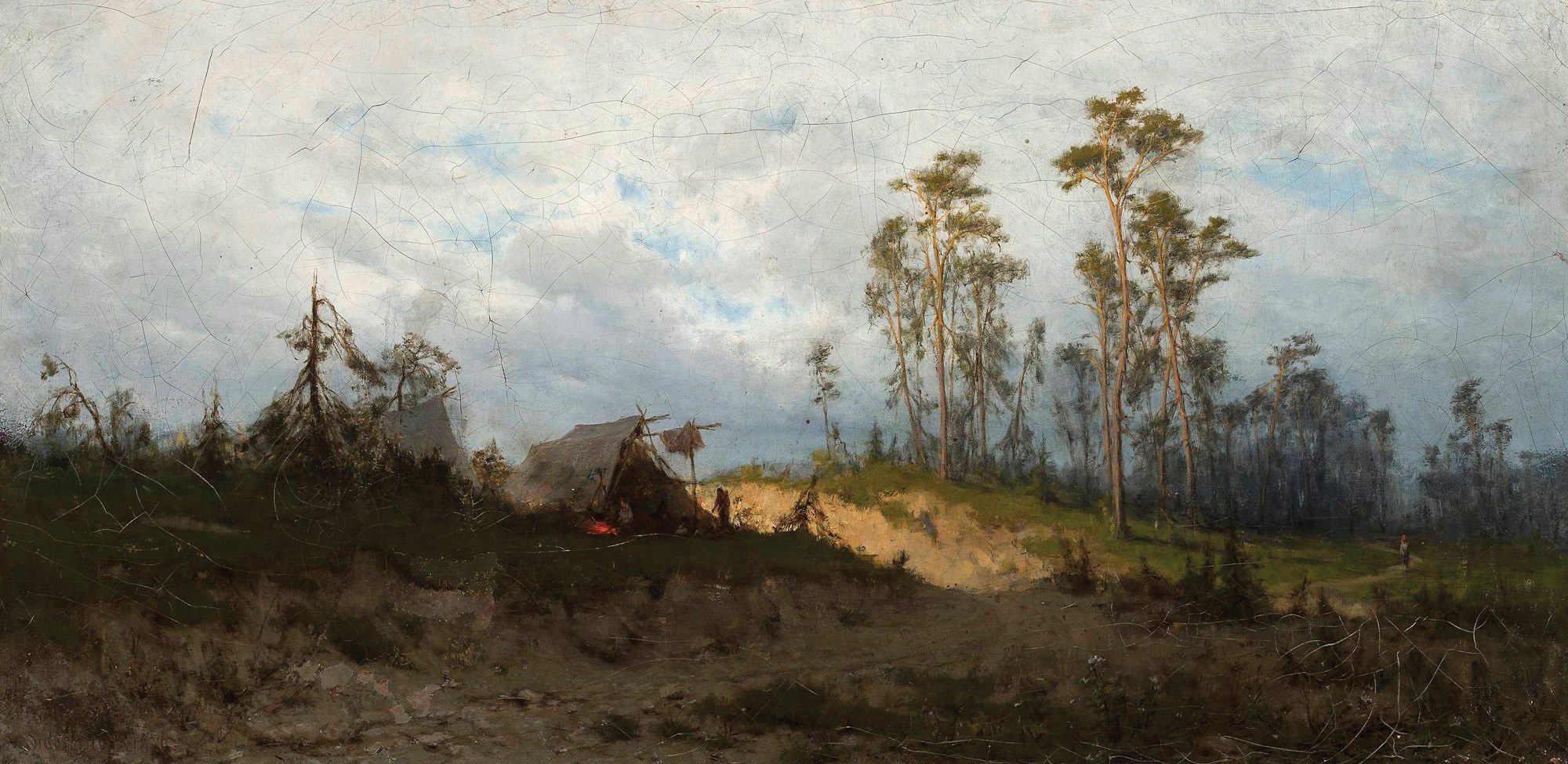
Sidorowicz often returned to the motif of gypsy encampments, camped among tall pines or shown at dusk. This favorite subject appears repeatedly in his paintings from the 1870s. An example is a work from 1876, in the collection of the National Museum in Warsaw (see sidebar).
Zygmunt Sidorowicz (Lviv 1846 - Vienna 1881), after graduating from Lviv Polytechnic, went to Lviv, where he studied at the Academy of Fine Arts from 1864 to 1867, thanks to a scholarship. In 1867 he held an exhibition of his works in Lviv. In 1873 he went to Munich for several years, where he revolved in the circle of painters associated with Jozef Brandt. He had a joint studio with Aleksandr Kotsis and Walery Brochocki. In 1878 he moved permanently to Vienna. He painted portraits and genre scenes, but above all atmospheric landscapes, sensitively capturing the atmosphere and light of dusk or early morning - painted "more from a feeling for nature than from study" where "in every touch of the brush one knows how [the author] knows how to exquisitely translate nature [as] he knows how to be faithful by capturing [its] true character." The artist also made copies of works by old masters and drawings for magazines.













Viimeksi katsotut
Kirjaudu sisään nähdäksesi kohdeluettelon
Suosikit
Kirjaudu sisään nähdäksesi kohdeluettelon