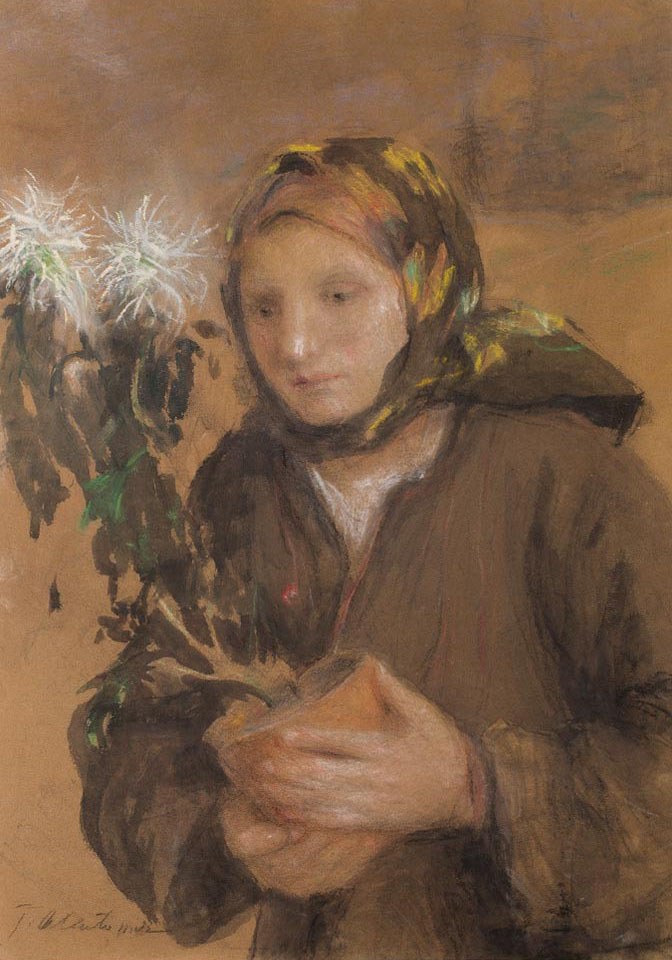
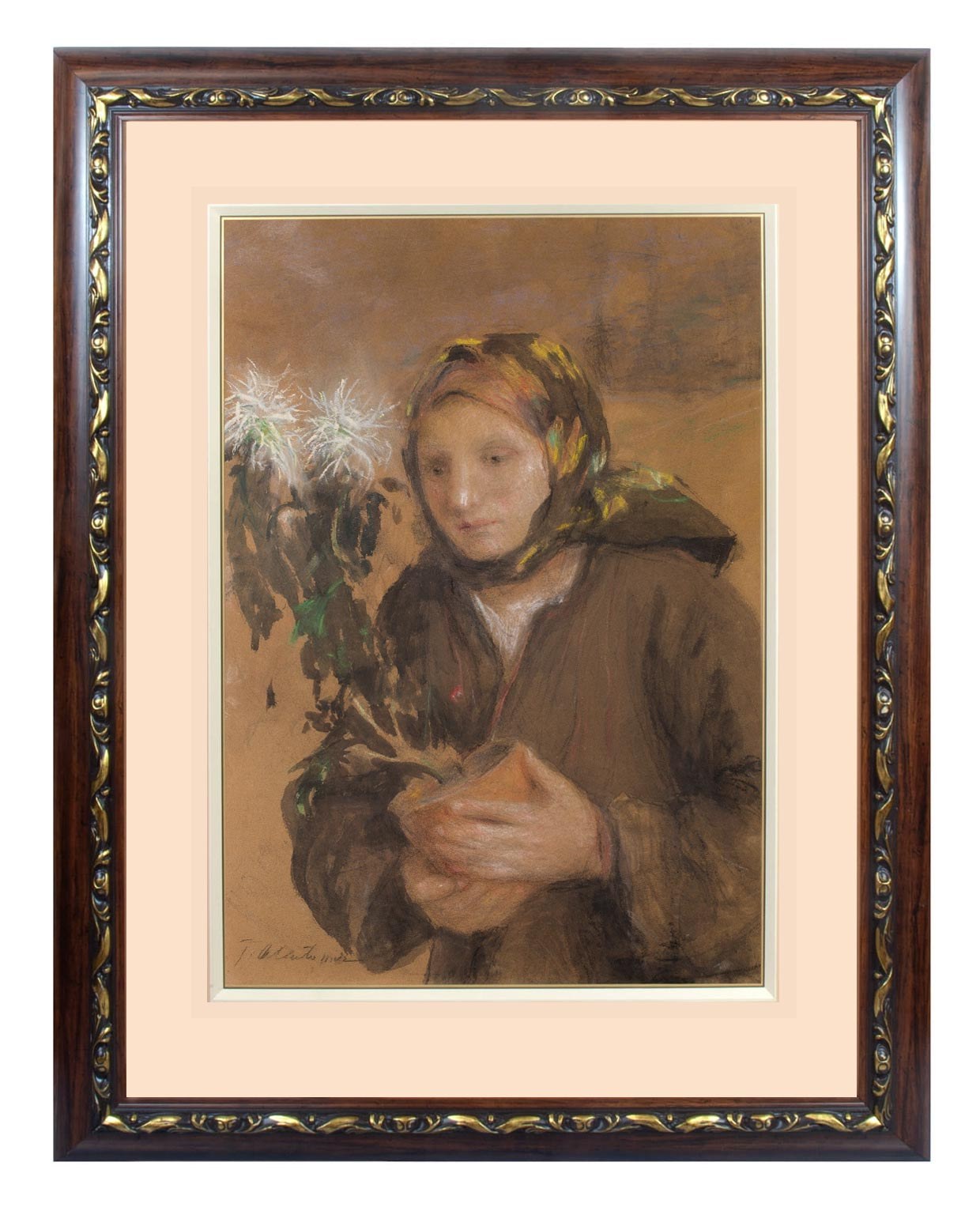
Pastel on paper, signed lower left “T. Axentowicz”.
Dimensions in frame: 100x79 cm (70x50 cm)
Teodor Axentowicz (Brașov 1859 – 1938 Kraków) was a Polish painter, draftsman, and printmaker of Armenian descent, as well as a professor and rector of the Academy of Fine Arts in Kraków. From 1878 to 1882, he attended the Academy of Fine Arts in Munich, where he studied under Gabriel Hackl, Alexander Waguer, and Gyula Benczur. In 1882, he traveled to Venice and Paris, where he studied under E.A. Carolus-Duran. He remained in Paris until 1895, working there as an illustrator and copying works by the old masters. From 1895 to 1934, he was a professor at the State School of Fine Arts in Kraków; he was appointed to this position by Julian Fałat. He was also a co-founder of the “Sztuka” Society of Polish Artists. He traveled extensively, visiting, among other places, London, Italy, and the United States. In 1897, he founded a painting school for women. He was granted membership in the Société Nationale des Beaux-Arts for his portrait of Wiktor Osławski (1890). He painted primarily in oils, but beginning in 1890, he began using pastels. The influence of Art Nouveau and Symbolism can be seen in his work. He was a co-creator of the Racławice Panorama. Axentowicz gained recognition as a portraitist and painter of beautiful women (including *Portrait of a Lady in a Black Dress* (1906)) and as the creator of genre scenes depicting the rituals and customs of the Hutsuls (notable works: *Hutsul Funeral* (1882), The Feast of the Jordan (1893), and The Kolomyia Dance (1895).