


63,9 x 49,3cm - pastel, paper glued on cardboard
pastel, beige paper pasted on cardboard
Signed l.d.: Witkacy 1933 1 | IV (T. Bs); lower right: NP | NΠ
The painting has an expert opinion by Dr. Anna Żakiewicz dated February 2022.
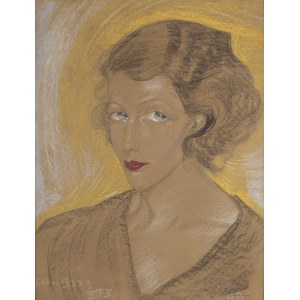
In March and April 1933, the artist stayed in Zakopane. He hiked in the mountains, organized articles and wrote a summary of his main philosophical work Concepts and Theorems Resulting from the Concept of Existence, which he published the following year. In addition, he made a number of portraits, in which Eugenia Bundykowa, the wife of a Polish Army officer he met in March, who was staying at a military sanatorium in Koscielisko on the southern slope of Gubalowka at the time, was extremely helpful. Not only did she herself commission two portraits of herself from the artist, but also urged other ladies resting in the same sanatorium to do the same, about which Witkacy gratefully wrote to his wife: This Bundykova is a wonderful person [...] (she's an angel) delivered the 5th (in the words of Pioneer!) hobo from the San[atorium] Wojsk[owego] (see S.I. Witkiewicz, Letters to his wife (1932-1935), ed. J. Degler, Warsaw 2010, pp. 94, 96, 100; letters dated 23 and 30 March and 3 April 1933). In all likelihood, the portrait taken on April 1, 1933 depicts one of these five ladies, who unfortunately remains anonymous to date.
The addition of a lowercase "s" to the portrait type (T.Bs) means "special." The idea was to distinguish it from average images. It could have been about either the above-average beauty of the model or the above-described method of acquiring a client. The portrait also bears an annotation stating that she refrained from smoking and drinking alcohol (NP/NΠ) on the day of the job.
The beauty of the model and the way she is portrayed makes it one of the most beautiful female images in Witkacy's work, and as a portrait of a Polish Army officer's wife spending a period of early spring in a Zakopane sanatorium, it is a testimony to a world that ended with the outbreak of World War II in September 1939.
With expert opinion by Dr. Anna Żakiewicz
Bibliography:
- Stanisław Ignacy Witkiewicz (1885-1939). Catalog of paintings, compiled by. I. Jakimowicz with the cooperation of A. Żakiewicz, National Museum, Warsaw 1990, item I 1740.
Stanisław Ignacy Witkiewicz (Warsaw 1885 - Jeziory in Volhynia 1939) studied at home under his father, Stanisław Witkiewicz. In 1903 he passed his high school diploma in Lviv. In 1904 he began traveling, including to Vienna, Italy, Munich, Paris and London. Between 1904 and 1910 he studied at the Academy of Fine Arts in Cracow with Prof. Jozef Mehoffer, interrupted by periods of study with Władysław Ślewiński. In 1914 he left with Bronislaw Malinowski's expedition to Australia, and from there went directly to St. Petersburg, where he enlisted in the Russian army after the outbreak of WWI. In Russia, he witnessed the Bolshevik Revolution.
After returning to the country in 1918, he became a member of the "Formists" group, with which he exhibited from 1918 to 1922. In the painting of this period, he came closest to putting into practice his own theory of Pure Form, formulated during the war (it also applied to drama). Along with Leon Chwistek, he was the main theoretician of the grouping. After 1924, he operated as a one-man "Portrait Company of S. I. Witkiewicz'' making custom portraits. At the same time, he continued his literary (dramas, novels) and philosophical work, but above all he practiced the "art of living" that united all forms of his activity, appreciated only at the end of the 20th century. He committed suicide at the beginning of World War II, the day after the Soviet aggression against Poland.













Viimeksi katsotut
Kirjaudu sisään nähdäksesi kohdeluettelon
Suosikit
Kirjaudu sisään nähdäksesi kohdeluettelon