


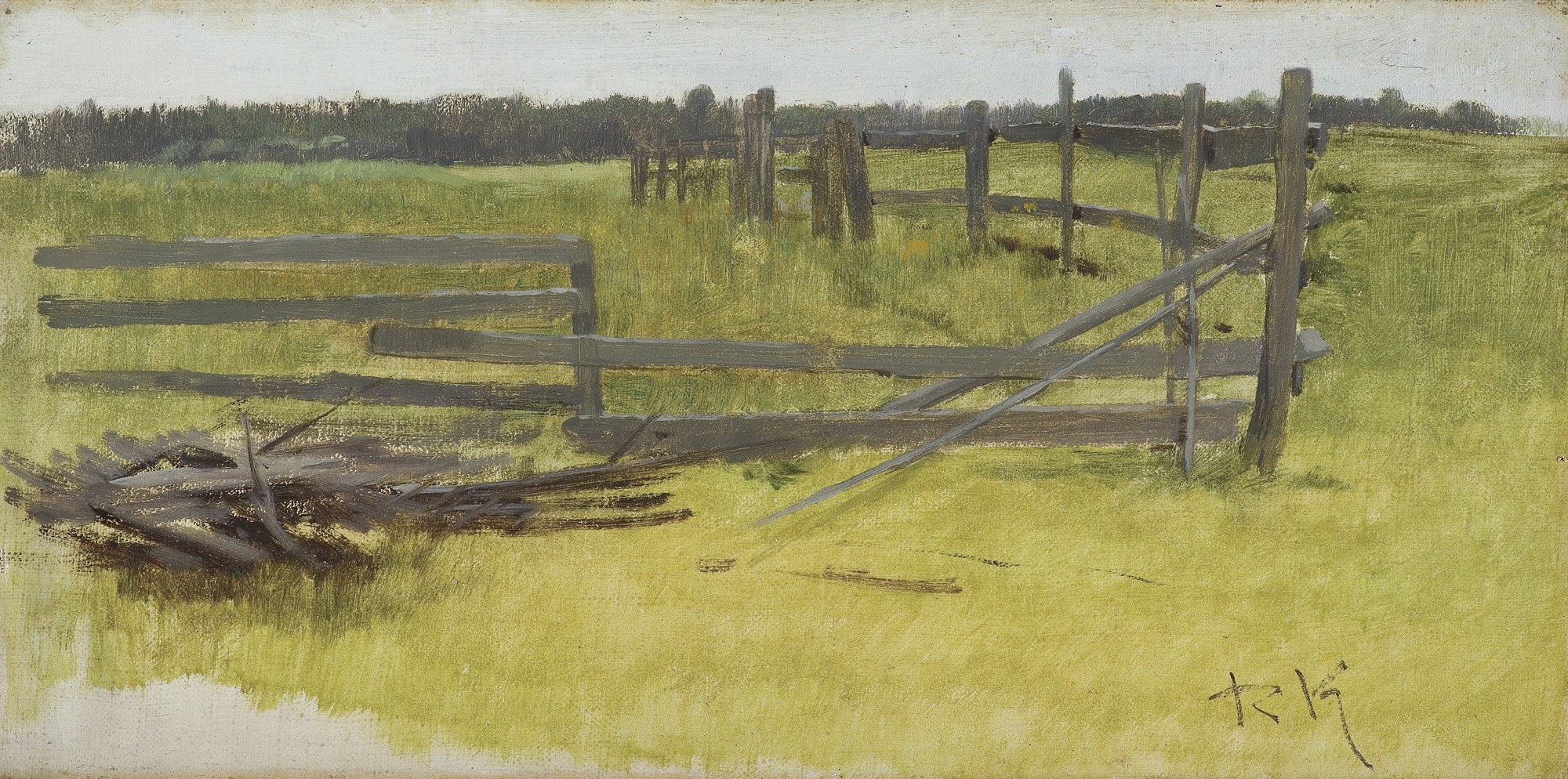
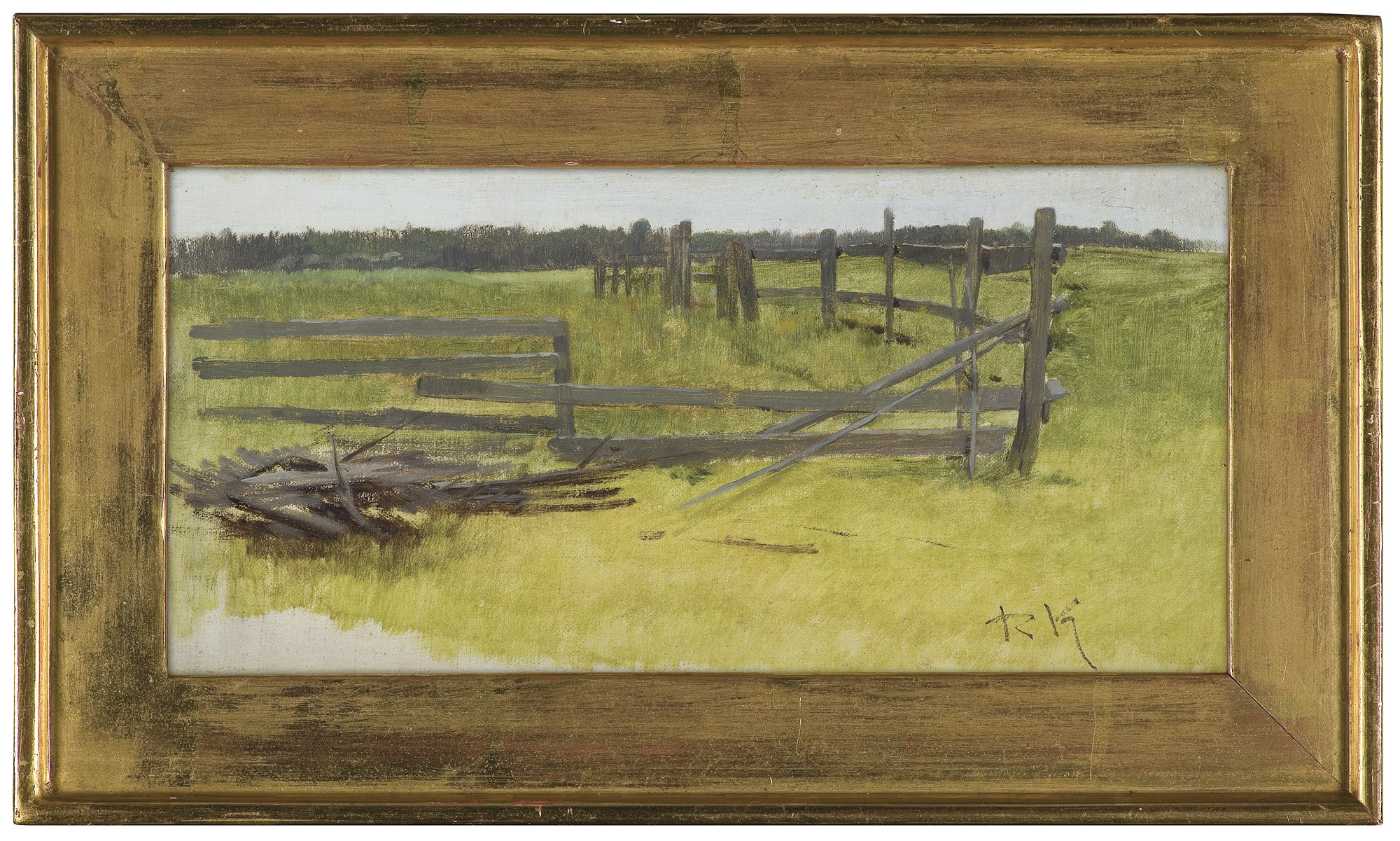
14.8 x 28.6cm - oil, canvas signed p.d.: R K
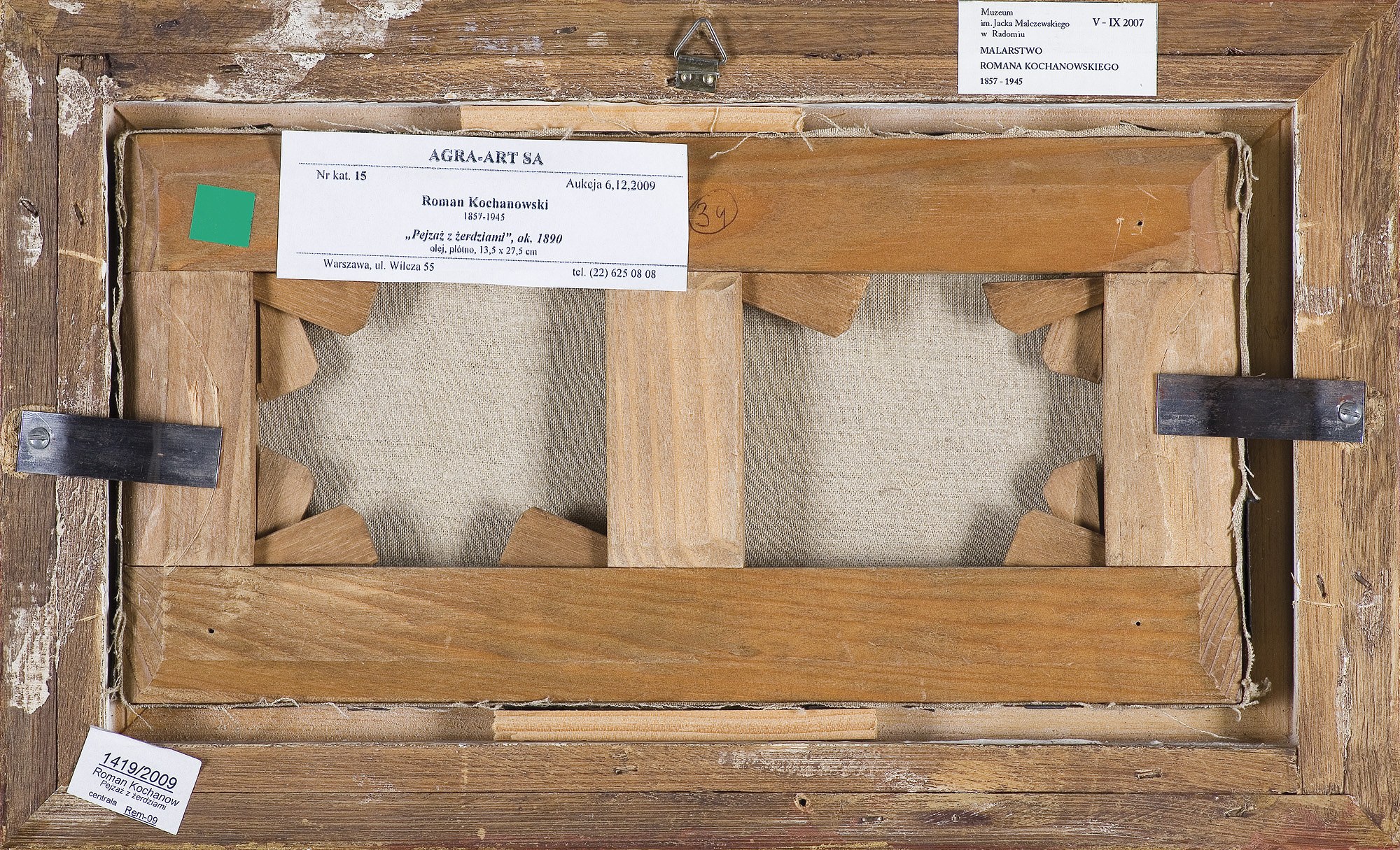
On the reverse, on the upper loom strip, number (in pen): 39 [in circle]; next to it, auction sticker Agra-Art, 2009;
in addition, on the upper frame strip, sticker (print): Museum | Jacek Malczewski V-IX 2007 | in Radom | PAINTING | ROMAN KOCHANOWSKI | 1857-1945.
Provenance:
The painting comes from the Munich collection of Barbara and Tadeusz Lewkowicz. In 2007 it was shown at a monographic exhibition of Kochanowski arranged at the Jacek Malczewski Museum in Radom, subsequently also exhibited in Katowice, Sandomierz, Szczecin, Gdansk, Piotrkow. This exhibition was accompanied by a richly illustrated catalog, which is a compendium of knowledge about the artist.
The landscape with poles was created during one of Kochanowski's frequent visits to Chobienice in Greater Poland, which the artist enjoyed visiting at the invitation of Maciej Mielżyński in 1890-1900. He felt good there, and this joyful, "holiday" mood found expression in the paintings he painted in Chobienice - cheerful, light-drenched landscapes, with dominant bright tones of green combined with bleached grays, ochres, blues. "Green" Chobienice landscapes are something unique in the artist's work, a special expression of sensitivity, admiration and the gift of seeing beauty in the seemingly ordinary landscape.
Paintings described and reproduced in:
- Roman Kochanowski (1857-1945). On the 150th anniversary of his birth, cat. ed. Z. K. Posiadała, Jacek Malczewski Museum in Radom, Radom 2007, p. 228, cat. no. 33, il. s. 106.
Roman Kochanowski (Krakow 1857 - Freising k. Munich 1945) - painter and graphic artist - was one of the Polish artists settled and permanently active in Munich. He began his studies in painting in Cracow; initially in the private studio of Maksymilian Cerch, and in 1873- 1875 at the School of Fine Arts under Władysław Łuszczkiewicz and landscape painter Henryk Grabiński. For the next two years he still studied at the landscape department of the Vienna Academy. In 1881 he moved to Munich, where he had his own studio and soon started a family. However, he often came to Cracow, visited Poznan, traveled through Galicia and Podolia, drawing landscapes and views of cities, which were later included in an album published in Vienna in 1898. The artist belonged to the Munich Kunstverein, participated in many exhibitions in Germany, Vienna, London; he also sent his works to national shows. He painted mainly landscapes and only rarely flowers and portraits. A constant and favorite motif of his paintings was the Polish landscape near Krakow, with people's figures woven into it. The artist's paintings, often painted on small boards and devoid of an anecdotal layer, are characterized by unusual painterly qualities, color harmony and a lyrical mood. Noted and awarded at numerous exhibitions, they were also highly valued in the art market. In 1892, after an exhibition in Vienna, one of Kochanowski's paintings was purchased for his collection by Emperor Franz Joseph; two others were acquired by members of the imperial family. Karol Joseph Luitpold, Prince Regent of Bavaria, was an admirer of his paintings. The artist's great sensitivity to landscape and nature is also evident in his drawings and etchings.
Kochanowski's work was recently recalled by a monographic exhibition of his works organized at the Jacek Malczewski Museum in Radom in 2007. The exhibition - also shown in Katowice, Sandomierz, Szczecin, Gdansk, Piotrków Trybunalski - was accompanied by a richly illustrated catalog, which is a compendium of knowledge about the artist (see: Roman Kochanowski [1857-1945]. On the 150th anniversary of his birth, [edited and compiled by Z. K. Posiadała], Jacek Malczewski Museum in Radom, Radom 2007).













Viimeksi katsotut
Kirjaudu sisään nähdäksesi kohdeluettelon
Suosikit
Kirjaudu sisään nähdäksesi kohdeluettelon