


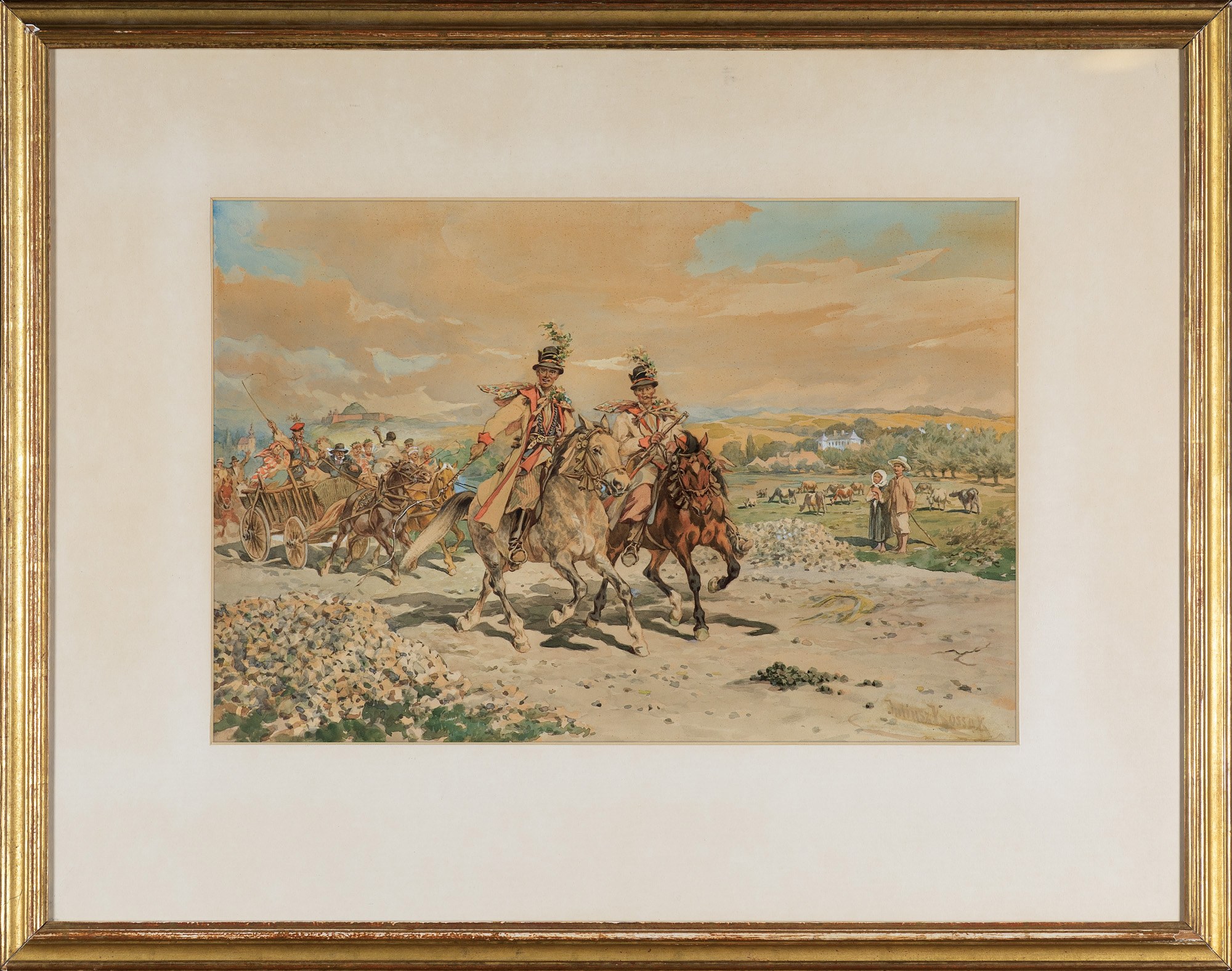

43.5 x 60.6cm - watercolor, gouache, paper
Signed p.d.: Juliusz Kossak
This elaborate watercolor shows a vast rural landscape with Kosciuszko Mound visible on the horizon. In the foreground, the artist has depicted a wedding procession, headed by two best men riding on horseback. Extremely colorful and rich Krakow costumes were a frequent inspiration and creative theme for Juliusz Kossak.
Cracovian costumes aroused the artists' admiration primarily by the juxtaposition of colors. In addition to the dominant white and red, referring to the national colors, Krakowians wore richly embroidered kaftans and a variety of accessories and ornaments that added picturesqueness to their costumes.
Krakow embroideries, which adorned women's blouses, aprons, scarves and, in the mid-19th century, also elegant men's shirts, were among the finest examples of folk arts and crafts. Embroidery was intended to decorate the outfits of rural women, who took great care of their physical appearance, devoting a lot of time to it. For example, embroidered kerchiefs were pinned in a very fancy way, using pins of various shapes, usually depicting flowers. The beauty of traditional attire, its rich embellishments, was revealed during Sundays, holidays, but especially during weddings, where newlyweds, best men and wedding guests presented themselves in full splendor, related to their property status and the role they played during the ceremony.
A key element of men's attire, and a symbol of the region, was the white cloth. On his head, the Krakowiak wore a black hat, which could have a high, conical form or a low, soft one, as well as a white magierka or red cornet. A white shirt, tucked into pants sewn from cotton cloth, was often decorated with narrow red stripes. Over the shirt he wore a kaftan, over this he wore belts of one of two types: with bells or reins, and on his feet he wore boots with uppers. All this made the Kraków costume extremely colorful and rich, which made it eagerly immortalized in countless paintings.
Many of the rituals accompanying Krakow weddings have disappeared, while others have been altered. The presented work by Juliusz Kossak should therefore be regarded as a record of old customs accompanying folk weddings.
Juliusz Kossak (Wisnicz 1824 - Krakow 1899) - painter and illustrator - was one of the most popular Polish artists of the second half of the 19th century. He began his drawing and painting lessons in Jan Maszkowski's studio in Lviv; later he drew a lot from nature while visiting noble estates in Ukraine, Podolia and Volhynia. In 1852 he was in Vienna, Hungary and St. Petersburg, before settling permanently in Warsaw. He spent the years 1856-1860 in Paris, where he was friends with Horace Vernet. Returning to Warsaw in 1862-1868, he was artistic director of the "Illustrated Weekly". In 1869, he moved permanently to Krakow, from where he continued to travel to Munich to paint in the atelier of the battle painter Franz Adam. Kossak was primarily an accomplished watercolorist; he used oil techniques less frequently. He painted historical and battle paintings, genre scenes illustrating the life and traditions of the noble court and the customs of the Polish people. But the real heroes of his paintings were horses, whose movement, temperament, character and individuality he was able to masterfully depict. He was also the author of many illustrations for magazines and books, hitting flawlessly both the atmosphere of literary works and the longings and needs of the audience - the readers of Wincenty Pol's Song of Our Land, Henryk Sienkiewicz's Trilogy, Pan Tadeusz and the poems of Adam Mickiewicz.













Viimeksi katsotut
Kirjaudu sisään nähdäksesi kohdeluettelon
Suosikit
Kirjaudu sisään nähdäksesi kohdeluettelon