


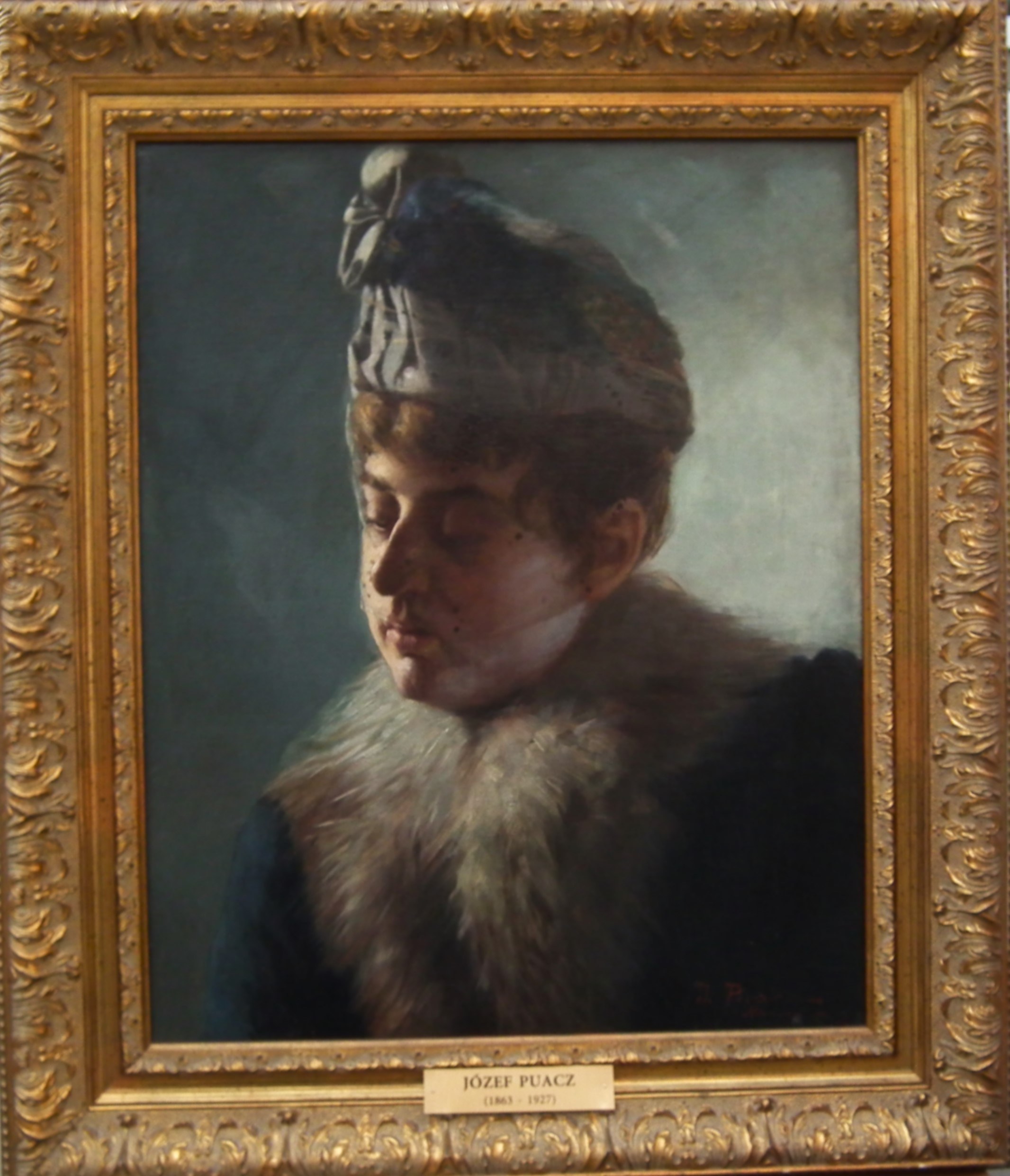
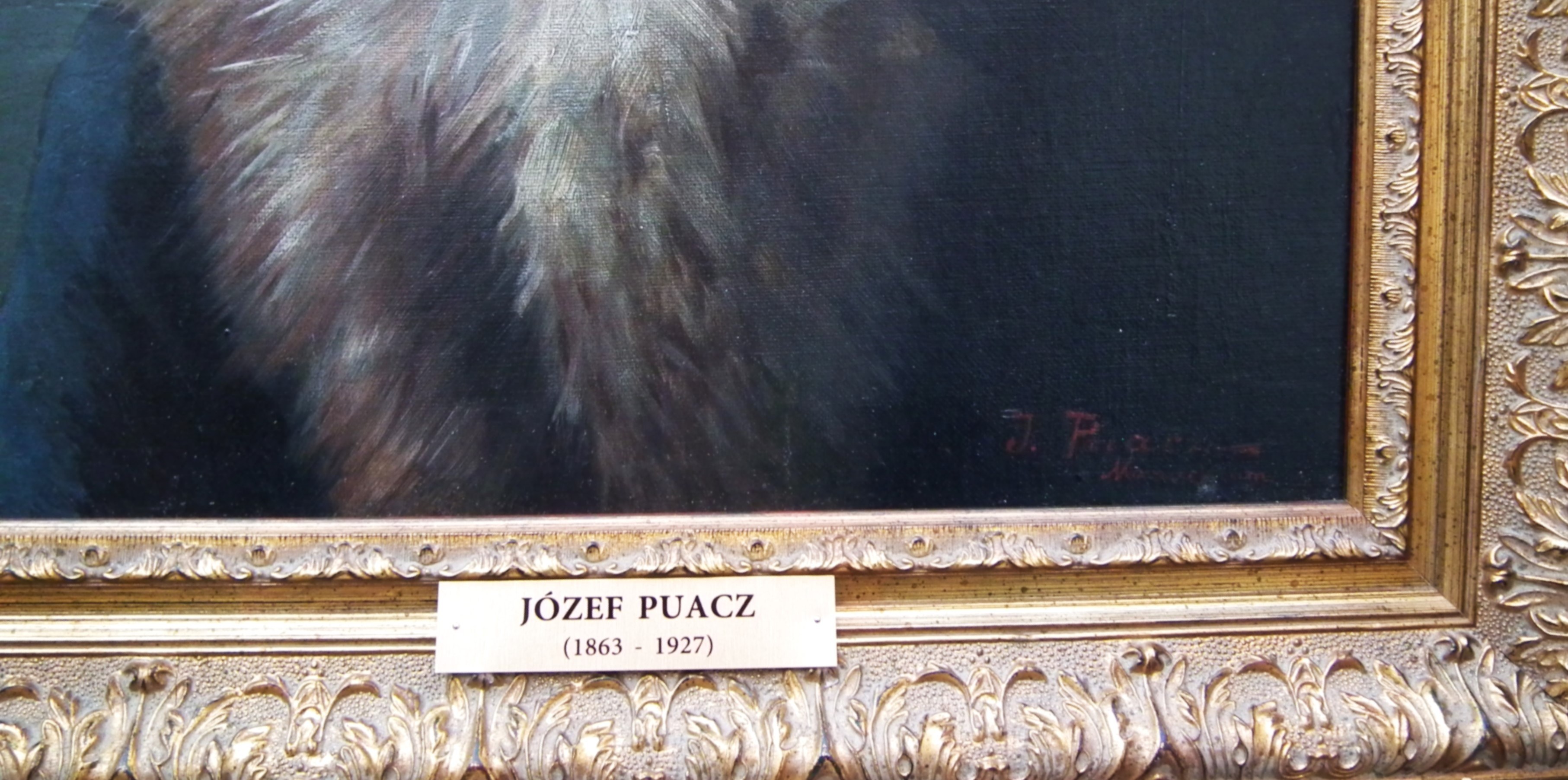
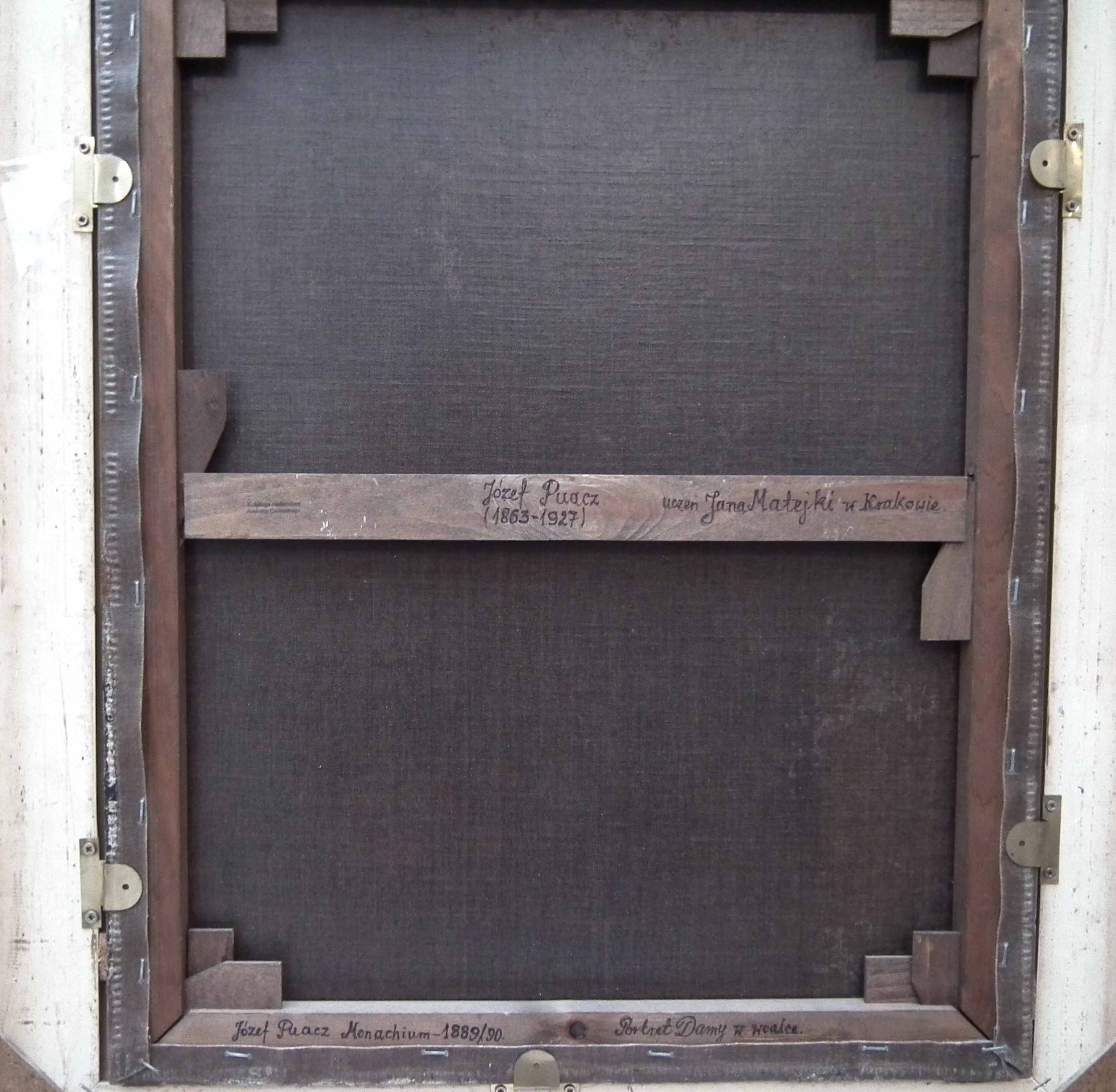
oil on canvas , 53,5x42,5cm in frame 71x60cm signed d.p J.Puacz Munich, painting after conservation. Portrait of a model from Munich who posed many times for Polish artists.
Polish painter, member of the "Munich school". Student at the Academy of Fine Arts in Munich (Akademie der Bildenden Künste München) from 1889 to 1892. *27.11.1863 Staropole, Municipality of Przyrów, now Staropole (Silesian Province), east of Częstochowa, †21.10.1927 Piotrków (now Piotrków Trybunalski). Son of a married couple running an inn, Stefan Puacz und Jadwiga née Gębaszka or Gęborska. He graduated from the gymnasium in Lublin. In 1884-1888 he studied painting at the School of Fine Arts in Cracow under Feliks Szynalewski (1825-1892) and Jan Matejko (1838-1893, member of the "Munich School"). On 21.10.1889 he entered the Class of Painting from Nature (Naturklasse) of the genre and monumentalist painter Nikolaus Gysis (1842-1901) at the Royal Academy of Fine Arts (Königliche Akademie der Bildenden Künste) in Munich; he studied until 1891 under Gysis himself and the history painter Sandor (Alexander von) Wagner (1838-1919). In 1892 he settled in Warsaw, where he ran his own studio. In 1914 he married a Czech woman, Emanuela Jahnel, daughter of the Kapellmeister of a Lithuanian dragoon regiment. During World War I, the couple lived in a villa in Świder near Otwock, where the artist had his studio. Abandoned by his wife after the death of their four-year-old son, he returned to Warsaw. In 1925, he liquidated his Warsaw studio and moved to Piaseczno, south of Warsaw, where he took a position as a drawing teacher at a junior high school. In 1926 he moved to Piotrkow, where he was also a drawing teacher at a junior high school. - Puacz's artistic output is rather little known, although he was regarded as a hard-working and prolific artist, painting mainly in oil and occasionally working in watercolor and etching. Puacz created genre paintings and made costume sketches under the influence of the "Munich school." His greatest fame, however, came from his portraits. Among others, for the Diocesan Curia in Wloclawek, where his cousin worked, he made portraits of the clergy and for the local Cathedral Basilica of the Assumption of the Blessed Virgin Mary he painted religious paintings. He also painted salon portraits of women, which after 1900 oscillate stylistically between the realism of the "Munich school" and moderate impressionism. In addition, he created landscapes and still lifes with flowers. His works are in the National Museum in Warsaw.










