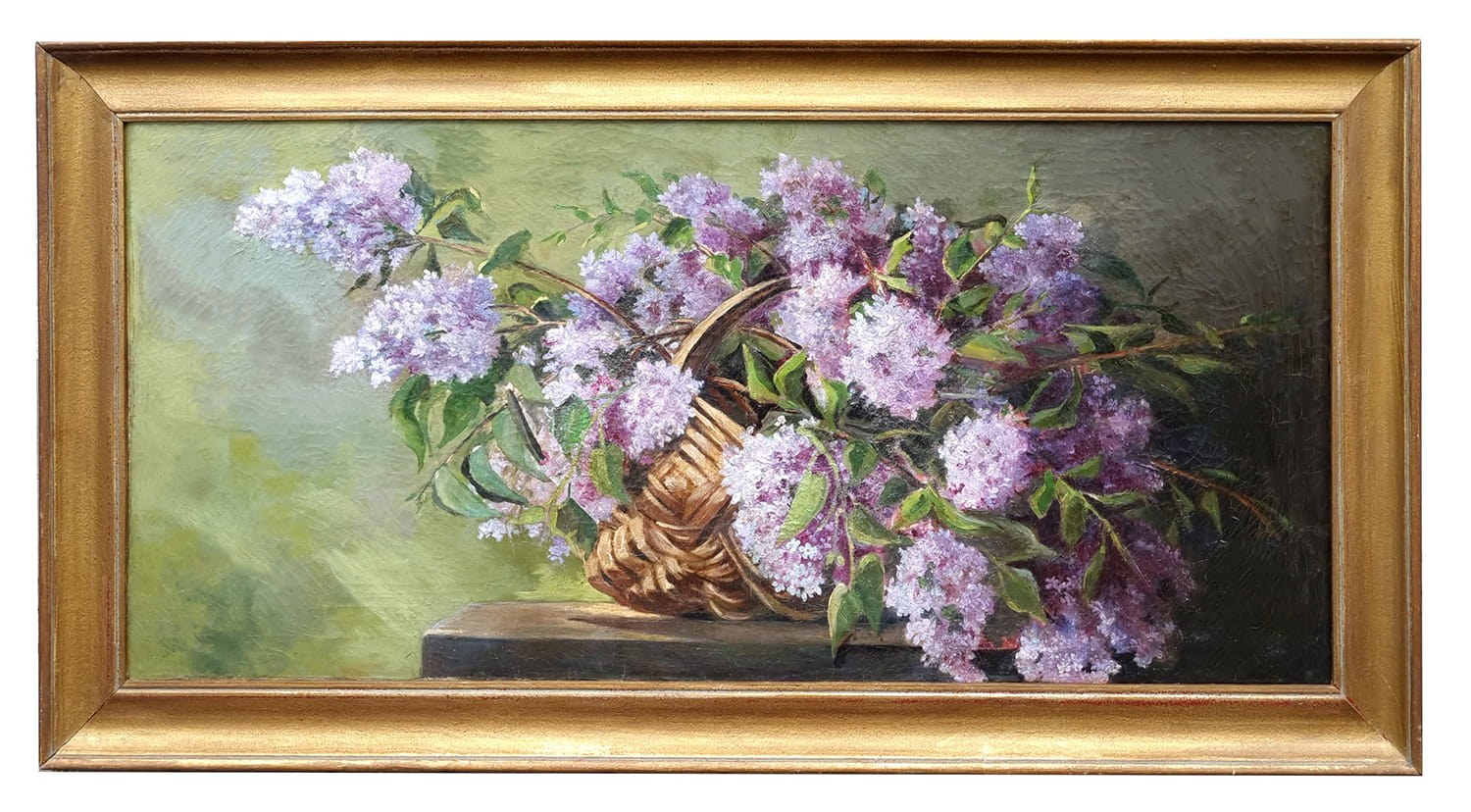
Oil on canvas, dated and inscribed on the reverse: "1916 Moscow"
Dimensions with frame: 70x137 cm (55x122 cm)
Attribution: Ignacy Pieńkowski (Dołubowo 1877 – 1948 Kraków) – Polish painter, lecturer at the Academy of Fine Arts in Kraków. From 1892 to 1895, he studied painting at the Drawing School in Warsaw under Wojciech Gerson, and subsequently at the Academy of Fine Arts in Kraków under the guidance of Teodor Axentowicz and Leon Wyczółkowski. In 1898, he left for Paris, where he continued his studies at the Académie Julian, after which he studied in Munich and Rome. He traveled to France, Italy, Russia, and Brazil. As an educator, he taught at the School of Fine Arts in Warsaw from 1909 to 1913. In 1916, he organized an exhibition of Polish art in Moscow and lived in Crimea. In 1918, he became chair of the painting department at the Academy of Fine Arts in Kraków. He was a member of the “Sztuka” Society of Polish Artists and the Professional Union of Polish Visual Artists. He regularly participated in exhibitions organized by the “Sztuka” Society of Polish Artists and also held numerous solo exhibitions, including one in Curitiba, Brazil, in 1925. On November 11, 1937, he was awarded the Commander’s Cross of the Order of Polonia Restituta. He spent World War II in Kraków. After the inauguration of the Kraków Academy of Fine Arts on March 29, 1945, he once again assumed the chair of painting, which he held until his death. Ignacy Pieńkowski’s work shows strong connections to French Post-Impressionist art. His students included, among others: Tadeusz Kantor, Stanisław Borysowski, Tadeusz Brzozowski, Jan Cybis, Józef Gaczyński, and Stefan Maciej Makarewicz. His paintings are housed in the National Museum in Warsaw, the National Museum in Kraków, the Podlasie Museum in Białystok, and in private collections. The Museum of Agriculture in Ciechanowiec features a permanent exhibition dedicated to Ignacy Pieńkowski—his paintings are displayed there alongside items transferred from the Pieńkowski manor in Sutno.