


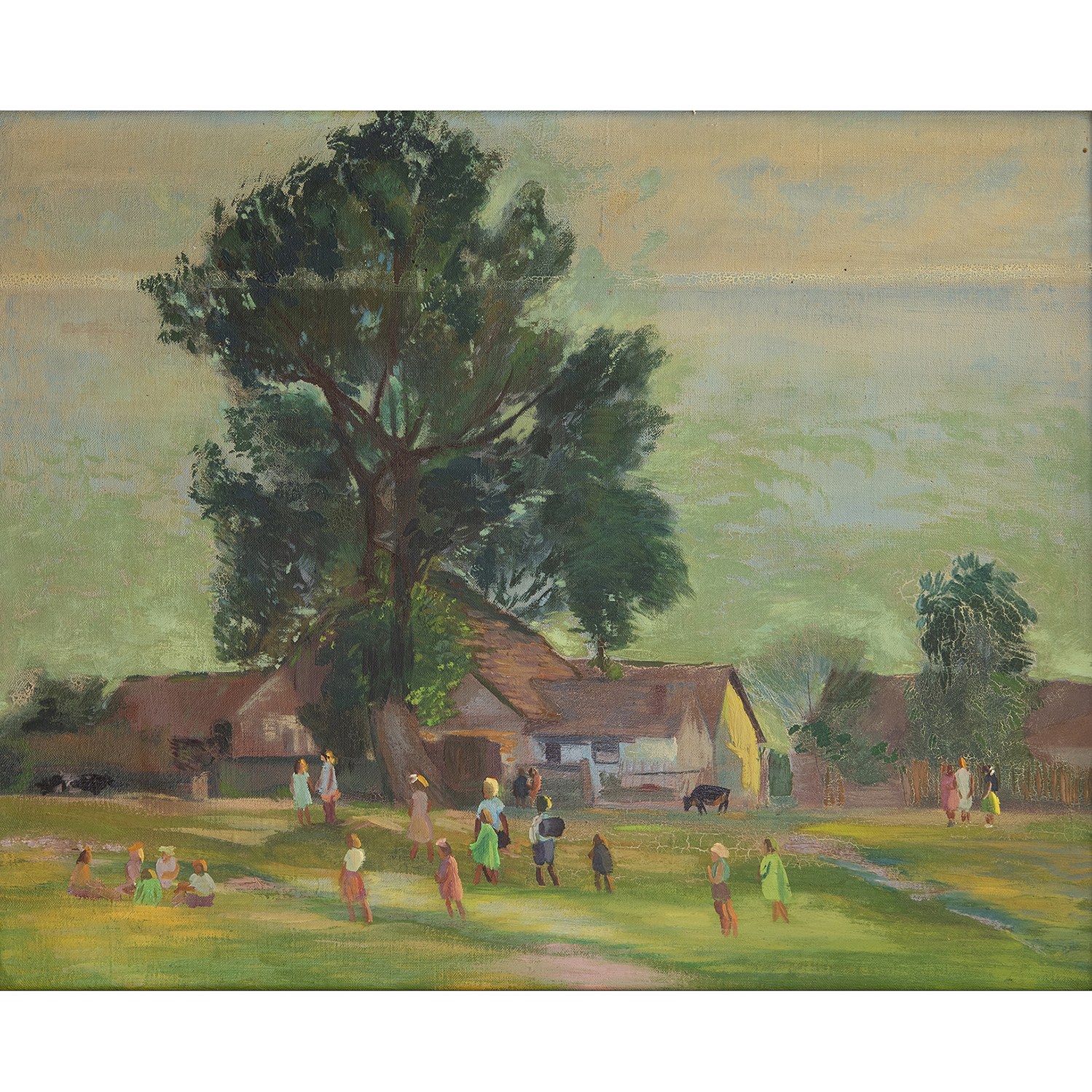
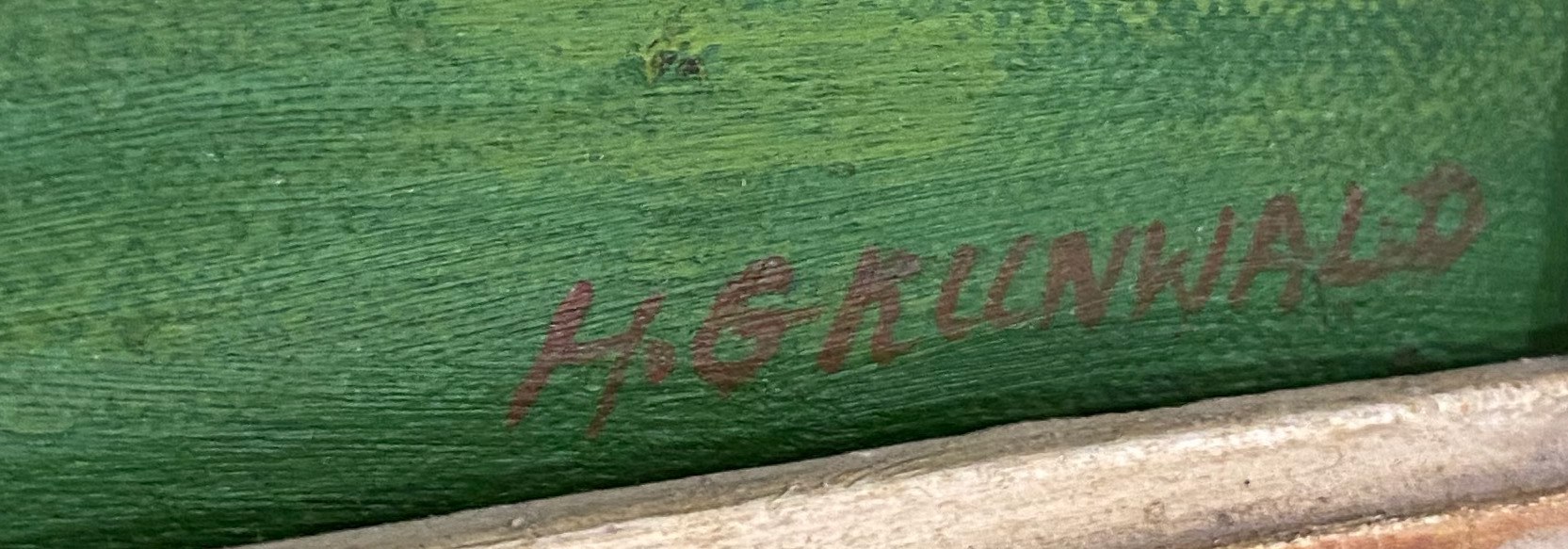
Oil/canvas, 54 x 65 cm Signed p.d.: 'H.Grunwald' On the reverse a sticker: 'Henryk Grunwald | Pejzaż z drzewem-Wierzbno p/W-wa |ol. pł. 54 x 65 | Nr. kat. (Muzeum Narod.1960) 542'.
Henryk Grunwald was born on January 14, 1904 in Warsaw, where he died on March 21, 1958. He initially studied law at the University of Warsaw (1923-1924), but in 1924 began painting and printmaking at the Academy of Fine Arts in Warsaw, where he studied from 1924 to 1928 under the tutelage of Kotarbiński, Tiche, Stryjeński and Czajkowski. After graduation, he was an assistant at the Academy of Fine Arts in the studios of metal techniques (1927-1939), and in 1929-1930 he perfected his technique on a scholarship in Paris.
The artist was versatile: he created easel paintings (landscapes, portraits), book graphics, satirical drawing (in "Szpilki" from 1935), and above all metalwork - goldsmithing and architectural decorations. Already in the 1930s he won recognition as a designer of grilles, candelabras and ashtrays for the Brühl Palace (the headquarters of the Ministry of Foreign Affairs) He took part in the International Exhibition in Paris (1937) and the World Exhibition in New York (1939)
During World War II he lost most of his output - he took part in the Warsaw Uprising - and after the war he designed decorative metal elements for the Tomb of the Unknown Soldier (1945), the Office of the Council of Ministers, the Belvedere, the National Philharmonic Hall and the Polish embassies in Berlin and Beijing. He was awarded the Golden Cross of Merit for his contribution (1947)
After the war, he returned to painting - he created landscapes, drawings, as well as medals - and exhibited individually (Warsaw, Paris, New York). Posthumous retrospective exhibitions of his works were held at the National Museum in Warsaw (1960) and the Institute of Polish Culture in London (1961)










Viimeksi katsotut
Kirjaudu sisään nähdäksesi kohdeluettelon
Suosikit
Kirjaudu sisään nähdäksesi kohdeluettelon