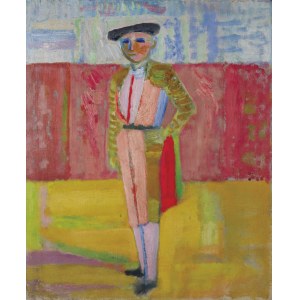
oil, canvas, 55 × 46 cm, unsigned
Provenance: Collection of the artist's family
Exhibited:
- Artur Nacht-Samborski (1898-1974). Monographic exhibition, National Museum in Warsaw 1977, National Museum in Cracow 1978, National Museum in Poznań 1978, National Museum in Gdańsk 1978
- Artur Nacht-Samborski 1898-1974, National Museum in Poznań, "Zachęta" Gallery of Contemporary Art, Palace of Art of the Society of Friends of Fine Arts in Cracow, 1999
- Artur Nacht-S
The featured painting is associated with the painter's stay in Spain in the summer of 1934 and his subsequent trip with
with Zygmunt Menkes to the Balearic Islands in 1935, about which he wrote in a letter to the Cybis family: "from Spain I benefited greatly". It was created around 1939 and is extremely rare, as the artist lost most of his pre-war works, both the deposited ones he would leave behind in Paris and Poland, in the turmoil of war. Around 1934, there was a change in the color scheme of the
of the paintings, resulting from a brightening of the color palette, which can be linked to the artist's stay in Spain and the Balearic Islands. As Maria Golab writes, "At the root of this transformation was the painter's attempt at the time to adopt a Kapist aesthetic. Acceptance of the basic principle - and this was the expression of all relations in the painting by means of fine color patches differentiated not in terms of value, but in terms of temperature - led the artist to several compositions close to such assumptions.
Maria Gołąb, Introduction [in:] Artur Nacht-Samborski 1898-1974, National Museum in Poznań, "Zachęta" Gallery of Contemporary Art, Poznań 1999, p. 12.
Joanna Pollakówna notes: in Torreador, he actually adheres to the principles of Capism with its strict use of color contrast, the practice of laying down paint in small patches, and the even-value surface of the painting.
Joanna Pollakówna, Przez gęstwinę dziwnej piękności [in:] Myśląc o obrazach, Warsaw 1994, p. 102.