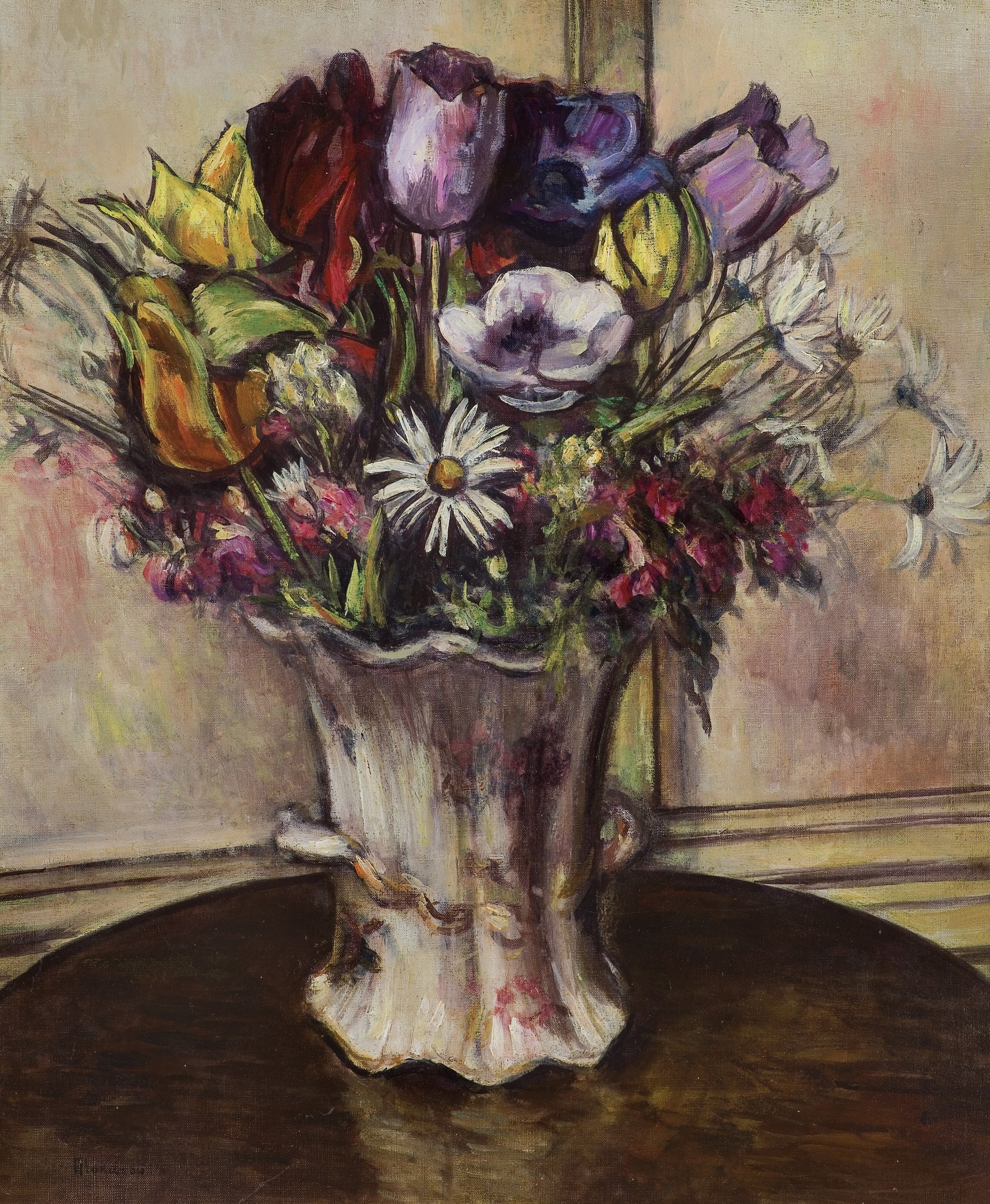
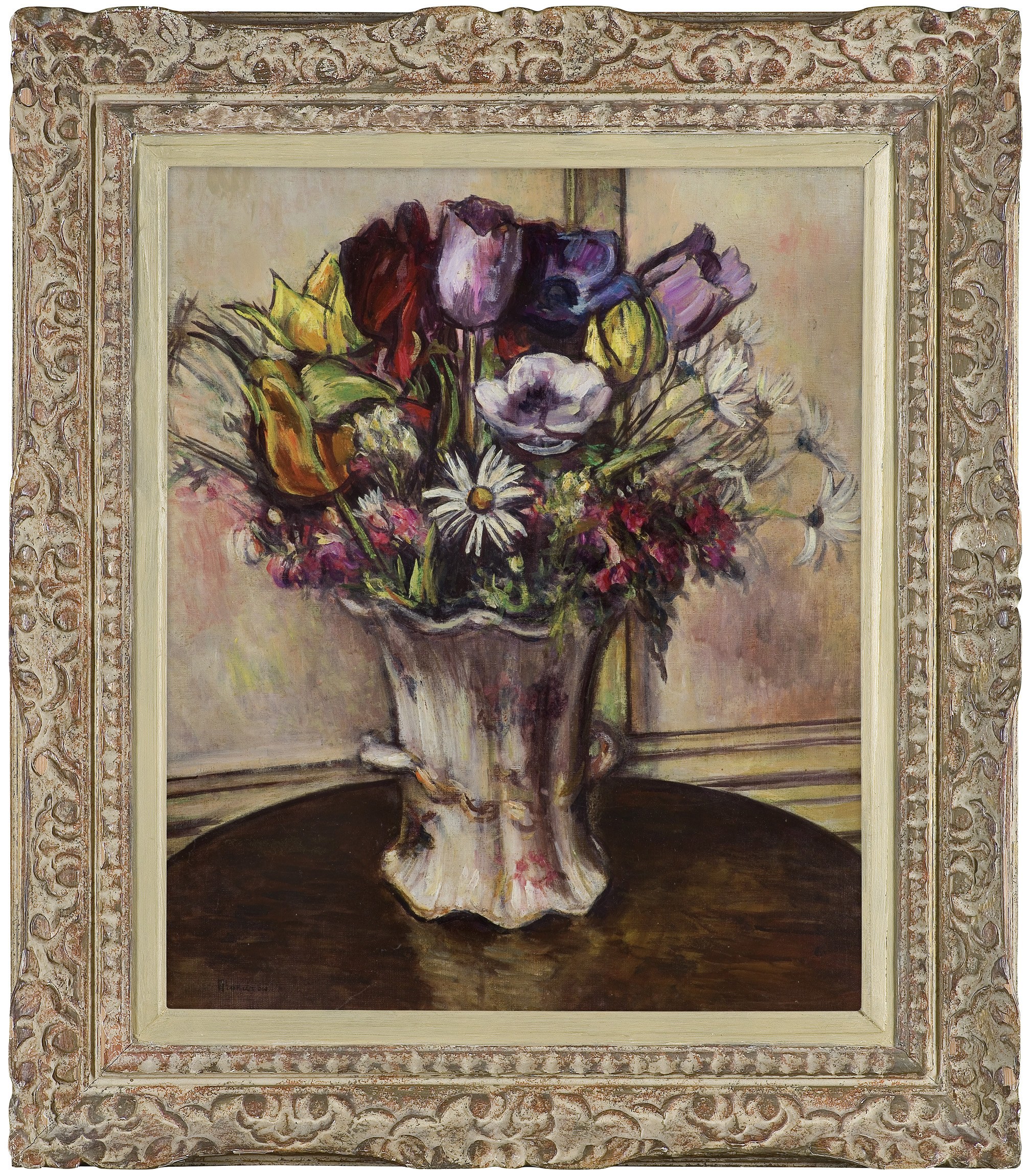
55.00 x 46.00 cm - oil, canvas
Signed l.d.: Mondzain
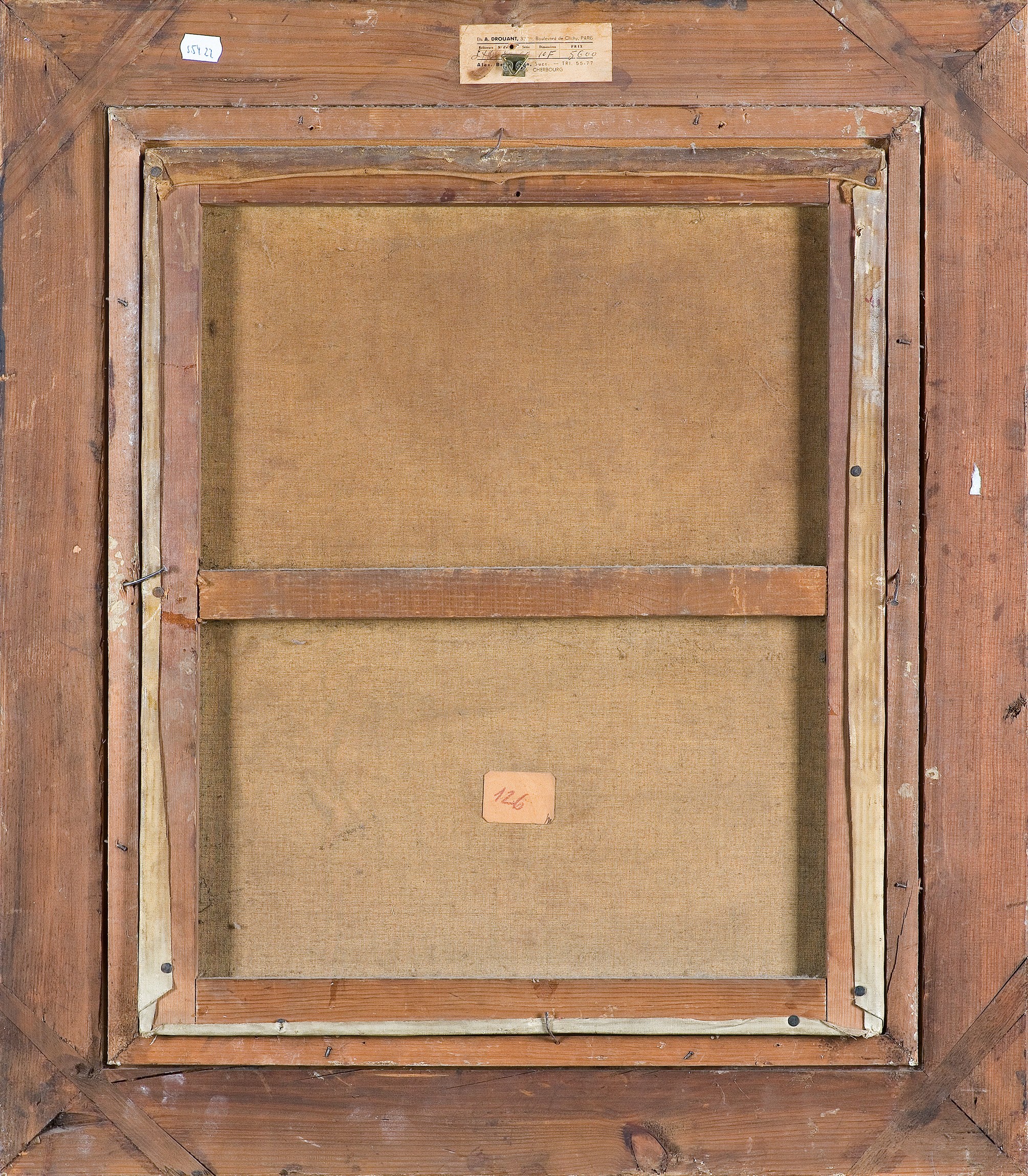
On the reverse, on the upper slat of the frame, a stamp with a number referring to the size of the subpainting: 10 F; in addition, on the canvas, a sticker with no. (in red marker): 126. on the g. strip of the frame a sticker of the Paris framing workshop.
- The Collection of Ursula and Piotr Hofman, edited by Ursula Hofman, Warsaw 2013, p. 20;
- Szymon Mondzain and the École de Paris. Polish avant-garde painting of the second half of the 20th century. Collection of Ursula and Piotr Hofman, Abbotsford Palace - Department of Modern Art of the National Museum in Gdansk 21 II 2015 - 22 IV 2015;
- The Collection of Urszula and Piotr Hofman, edited by Urszula Hofman, Warsaw 2018, p. 19.
Under items 52 to 68, we present to you carefully selected works of artists from the École de Paris circle, which are part of the collection of Ursula and Piotr Hofman. The family collection is subject to constant development, expansion and reconstruction aimed at seeking new directions. It is the result of an evolving way of perceiving, understanding and learning about art.
Ursula and Piotr Hofman's collection grows out of their fascination with the paintings of Polish-Jewish artists associated with the pre-war creative community in Paris. It was the activities of the Parisian artistic émigrés - centered around Montparnasse and co-creating one of the most important phenomena in the art of the first half of the 20th century - that became the foundation of their collection.
The first painting purchased, which gave the impetus and started the adventure and passion of interacting with art, was one of Simon Mondzain's canvases. A painter who combines the geometrizing construction of form with the sensibility of Krakow modernism. His still lifes, landscapes and portraits show a fascination with Cézanne and the tradition of French Post-Impressionism. Mondzain still holds a prominent place in the entire collection of works by artists such as Eugeniusz Eibisch, Rajmund Kanelba, Henryk Epstein, Henryk Hayden, Maurice Blond, Dora Kucembianka, Alexander Blonder, Henryk Berlewi, Zdzislaw Cyankiewicz, Zygmunt Landau, Jean Peské and Joachim Weingart, presented next.
Of interest are two canvases by Dora Kucembianka, an artist who for many years remained in the shadows and rarely appeared on the auction market. Her paintings show inspiration from Post-Impressionism, Colorism and an interest in a synthetic approach to form. She painted primarily portraits, still lifes and landscapes - subjects characteristic of École de Paris artists - focusing on compositional harmony and subtle color relationships. Her paintings are characterized by balanced construction, softness of modeling and moodiness, which gives the representations a lyrical character. Today we have the opportunity to present her work to a wider audience and rediscover the silhouette of this interesting painter.
All the presented canvases from the collection of Ursula and Piotr Hofman, carefully selected from an artistic and historical point of view, become an opportunity to spread knowledge of the artistic milieu that made Paris the world capital of the avant-garde in the early 20th century. They develop a sensitivity to the paintings of the École de Paris, which shaped the modern view of color, form and emotion in art.
Each of the paintings on offer is not only an artistic work, but also a testimony to an extraordinary time and place where diverse cultures, ideas and creative personalities met. Mr. and Mrs. Hofman invite you to co-create this history and join them in their mission to keep alive the memory of the unique phenomenon that was École de Paris painting.
Szymon Mondzain (Chełm 1888 - Paris 1979) - owner of Shamay Mondszajn - painter, representative of the so-called École de Paris; he began his painting studies at the School of Fine Arts in Warsaw in 1905 and in the same year - for participation in a school strike - was arrested and imprisoned in the Citadel. In 1908, with the help of the Jewish Community, he left for Cracow, where he took up studies at the Academy of Fine Arts under Teodor Axentowicz and Jozef Pankiewicz. At that time he became friends with Mojżesz Kisling, Wacław Zawadowski and Jan Hrynkowski. In 1909 and 1911 he traveled to Paris, and at the end of 1912 settled there permanently, entering the circle of Montparnasse artists and becoming friends with André Derain, Guillaume Apollinaire, André Salmon, among others. In 1913 he traveled to Switzerland and Brittany. During World War I, he served as a volunteer in the Polish-French units of the Foreign Legion. In 1923 he received French citizenship. He traveled to Italy for plein air trips (1923) and, from 1925, regularly to Algeria, where he also spent the years of World War II and where he later - with a break in Paris - stayed permanently. In 1965 he returned to Paris permanently and took up his former studio in Rue Campaigne Première in Montparnasse. Active in the French-Polish art community, he repeatedly presented his works at the Salon Indépendants (from 1911), Salon d'Automne (from 1913) and Salon des Tuileries (from 1923). He also participated in other Parisian exhibitions, and also took part in exhibitions of Polish art in Paris (1920, 1929, 1935), Pittsburgh (19234), and New York (1933). He also had a number of solo exhibitions in Paris (1922, 1923, 1931, 1926, 1927, 1934, 1937, 1946, 1950), Chicago (1920), New York (1933), Oran (1943), Algiers (1948). A posthumous exhibition of the artist's paintings was held at the Musée Granet in Aix-en-Provance in 1983.
The earlier phase of Mondzain's work is dominated by landscapes and still lifes, revealing clear influences from the art of Paul Cezanne. Later he also painted geometrized compositions inspired by the paintings of A. Deraine. In 1917 he made "Diabolic Caprices," a series of gouaches with erotic themes. He also created allegorical-symbolic compositions with dark color tones ("Pro Patria," a painting dedicated to fallen soldiers). After World War I, he painted portraits and figural scenes maintained in lighter colors and stylized after the model of Italian quattrocento painting. After 1925, i.e., since his constant trips to Algeria, his work is dominated by landscapes, portraits, still lifes and genre scenes with Arabic motifs, paintings with precise drawing, vivid colors and decorative treatment.
Note: Mondzain's birth date is given after: E. Grabska, "Simon Mondzain," in Paris and Polish Artists around E.-A. Bourdelle", Catalogue of the MNW, Warsaw 1997, p. 126. In the literature on the artist, the dates 1887 or 1890 are also encountered.