


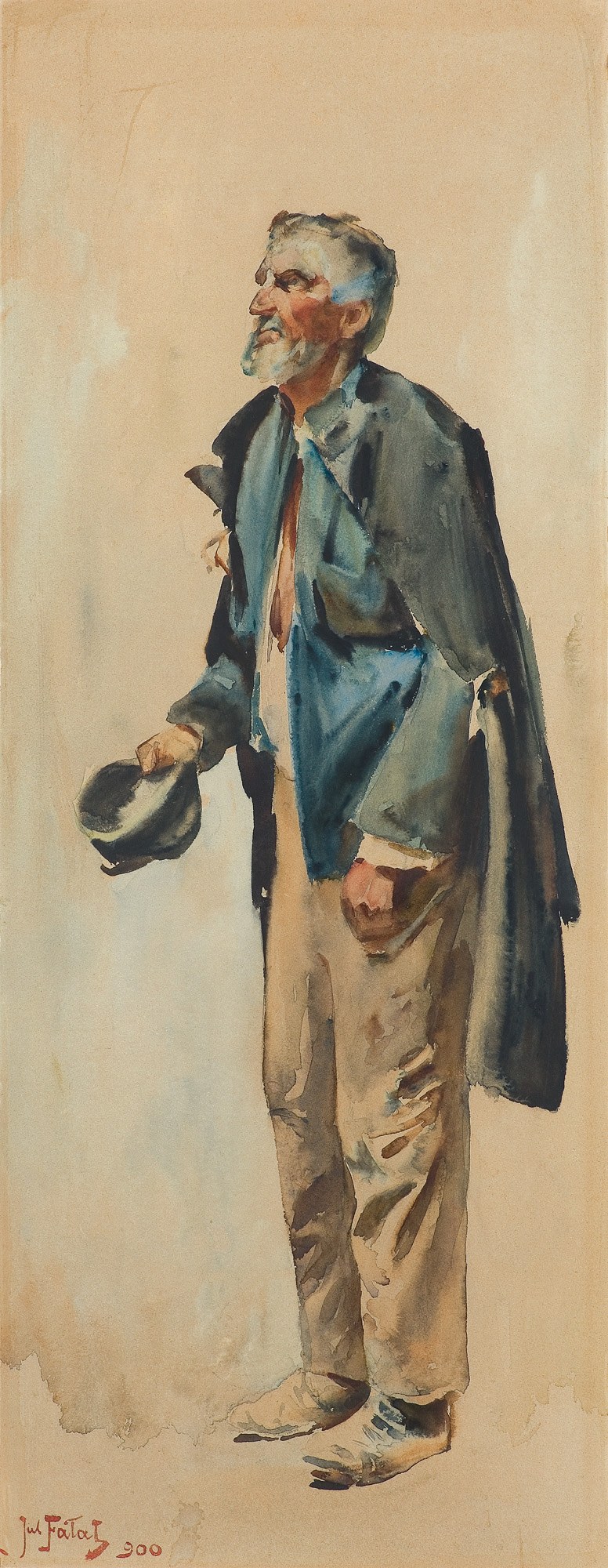
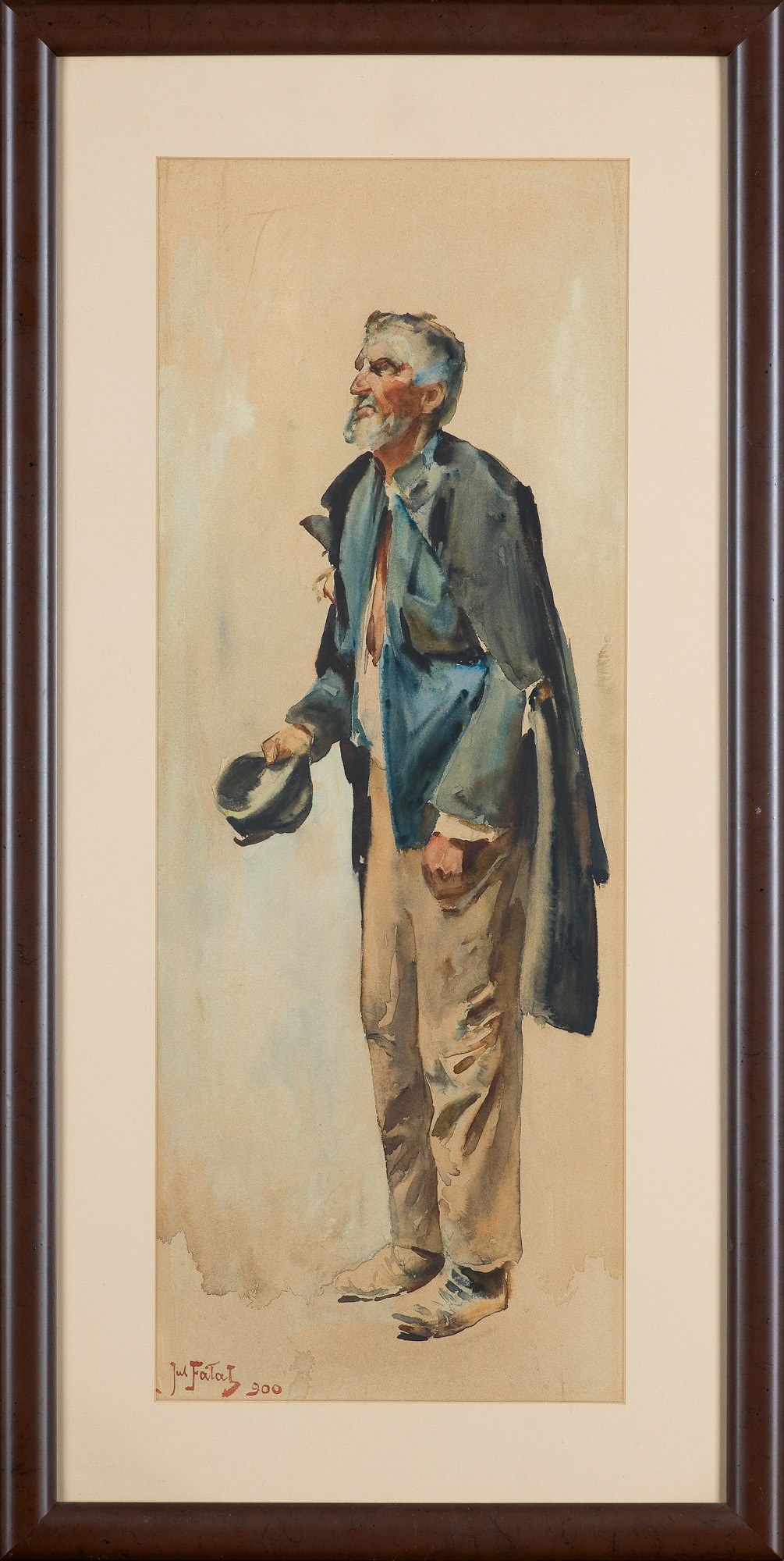

37.5 x 26 cm — watercolor, paper mounted on cardboard
signed lower left: Jul Fałat | 900
In Julian Fałat’s work, a special place is reserved for members of the lower social classes—peasants, the elderly, and the poor—whom the artist depicted with exceptional sensitivity and keen observation. His interest in the lives of ordinary people stemmed both from his background as the son of a rural organist and from his early life experiences. As early as the 1880s, while working as an illustrator for the Warsaw press, Fałat captured scenes from everyday life, particularly those of residents in the city’s poor neighborhoods. Insightful psychological studies and folk types later became a recurring theme in his work.
The painting *The Request* on offer belongs to the artist’s finest creative period, which spanned the years leading up to World War I, when Fałat achieved full technical mastery and developed his own distinctive painterly language. At that time, he combined an almost naturalistic sense of observation with an increasingly bold use of the techniques characteristic of Impressionism: light, color, free form, and painterly spontaneity. The elderly man depicted, shown in half-profile, leans forward slightly and extends his hand, while holding his hat with his other hand. This gesture, an expression of humility and supplication, contrasts with his upright posture and his focused, resigned gaze. His worn clothing, long dark coat, and distinctive headgear create a evocative image of a man weathered by life. Fałat neither idealizes his subject nor succumbs to sentimentality—on the contrary, through his restrained portrayal, he brings out the man’s loneliness and weariness, as well as his faint hope for a kind gesture.
The work is an outstanding example of the artistry of one of Poland’s most distinguished watercolorists. Fałat makes use of the transparency and unpredictability of this extremely demanding painting technique. The seemingly uncontrolled flow of sprawling patches of color is masterfully controlled by the artist and rendered in the clear form of the figure. Blues, grays, beiges, and muted greens intermingle, creating a soft, shimmering painterly texture.
*The Request* combines the poetics of a free sketch with an exceptionally precise observation of the model. The economy of means here does not imply understatement; on the contrary, it allows the viewer to focus on the gesture, the gaze, and the psychological truth of the depicted figure. The work is an excellent example of Fałat’s characteristic blend of realistic social observation with a modern, impressionistic approach to building a painterly composition.
Provenance: Collection of Zbigniew Malewicz (Biłgoraj 1892–Warsaw 1979), a landowner and industrialist,
who, from 1924 onward, was the owner of the Przeździatka estate and the “Elżbietów” sugar factory in Sokołów Podlaski.
Julian Fałat (Tuligłowy [Lviv District] 1853 – Bystra near Bielsko 1929) — painter and educator — one of the most outstanding Polish artists of the turn of the 19th and 20th centuries, a member of Polish and European artistic associations as well as the Royal Academy of Fine Arts in Berlin, and a multiple medalist at international exhibitions. He studied painting under Władysław Łuszczkiewicz and Leon Dembowski at the School of Fine Arts in Kraków (1868–71 and 1881) and at the Academy of Fine Arts in Munich under Alexander Strähuber and Johan Leonhardt Raab (1877–80). After completing his studies, he spent several months in Rome; in 1884, he visited Paris and Spain; and in 1885, he undertook a sea voyage around the world. In 1886, while hunting at the Radziwiłł estate in Nieśwież, he met the future German Emperor Wilhelm II—for whom he subsequently worked in Berlin as a court painter from 1886 to 1895. From 1894 to 1896, he collaborated with Wojciech Kossak on the Berezina panorama. In 1895, he was appointed director of the School of Fine Arts in Kraków, where he thoroughly reformed the educational system, transforming the institution into the modern Academy of Fine Arts (1900). He served as rector of the Academy until 1910; after retiring, he settled in the village of Bystra near Bielsko. An outstanding watercolorist, he also painted in oils. In his early period, he worked in the realist style; over time, he lightened and enriched his palette, and in his watercolors he introduced flowing patches of color. He became famous as a painter of hunting scenes, most often set in winter landscapes; he also painted landscapes, rural genre scenes, portraits, and cityscapes.













Viimeksi katsotut
Kirjaudu sisään nähdäksesi kohdeluettelon
Suosikit
Kirjaudu sisään nähdäksesi kohdeluettelon