


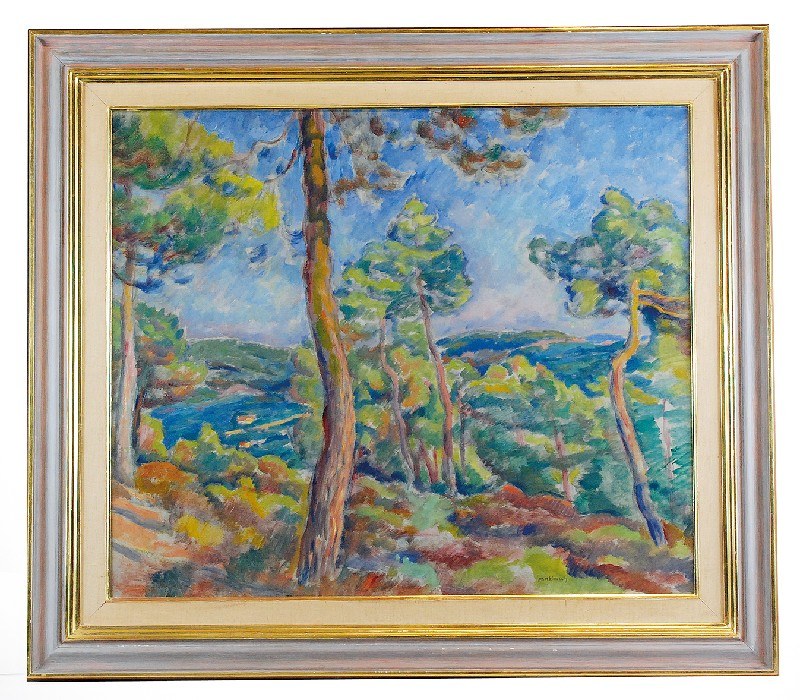
oil, canvas; 65 x 77 cm;
Signed p. d.: Pankiewicz
"Jozef Pankiewicz, in the 1920s, initiated the current of Polish colorism. He exerted a great influence on the members of the Paris Committee, on the artists who are now so well known, such as: Jan Cybis, Józef Czapski or Artur Nacht-Samborski. A turning point in the painter's work was a trip at the end of the first decade of the 20th century, to the Mediterranean, where he stayed in Saint-Tropez in the company of Pierre Bonnard, for example. According to Elzbieta Charazinskaya, "Ultimately, it was a vacation in 1909, spent on the Mediterranean in Saint-Tropez, in the company of Pieere Bonnard and his wife Marta, that caused Pankiewicz to take the side of color and light and an ostentatious, refreshing return to studies from nature. And although the Mediterranean coast, known as "paradise found," was recommended to the sick (...) in the 19th century, it was discovered for painting by Gustave Courbet, and annexed by the Impressionist generation. The ferociousness of the colors and their unique "luminosity" completely seduced Paul Signac (...) whom Pankiewicz met there (...). The dazzling midday sun giving the earth, water and sky an exceptional intensity of color, and finally the beauty of the almost mountainous landscape descending to the sea, or terraced olive groves and vineyards, with their aged or emerald green contrasting with the earth, red roofs juxtaposed with the blue of the water or sky, offered Pankiewicz, sensitive to beauty, an unusually wide range of new inspirations".
Elżbieta Charazińska, Józef Pankiewicz's battle for pure painting [in:] Life and Work. To the Artist on the 140th Anniversary of his Birth. Catalog of the monographic exhibition, National Museum in Warsaw 9. I - 26.III. 2006, Warsaw 2006, p. 18.


![Józef PANKIEWICZ (1866-1940), Tulipany w dzbanie [Tulipany w wazonie], ok. 1920](https://img1.one.bid/img/304/43663_1w.webp)
![Józef PANKIEWICZ (1866-1940), Tulipany w dzbanie [Tulipany w wazonie]](https://img1.one.bid/img/183/29812_1w.webp)










Viimeksi katsotut
Kirjaudu sisään nähdäksesi kohdeluettelon
Suosikit
Kirjaudu sisään nähdäksesi kohdeluettelon