


48.3 x 63.8 cm - oil, plywood
Signed l.d.: F.M. Wygrzywalski | 1928.
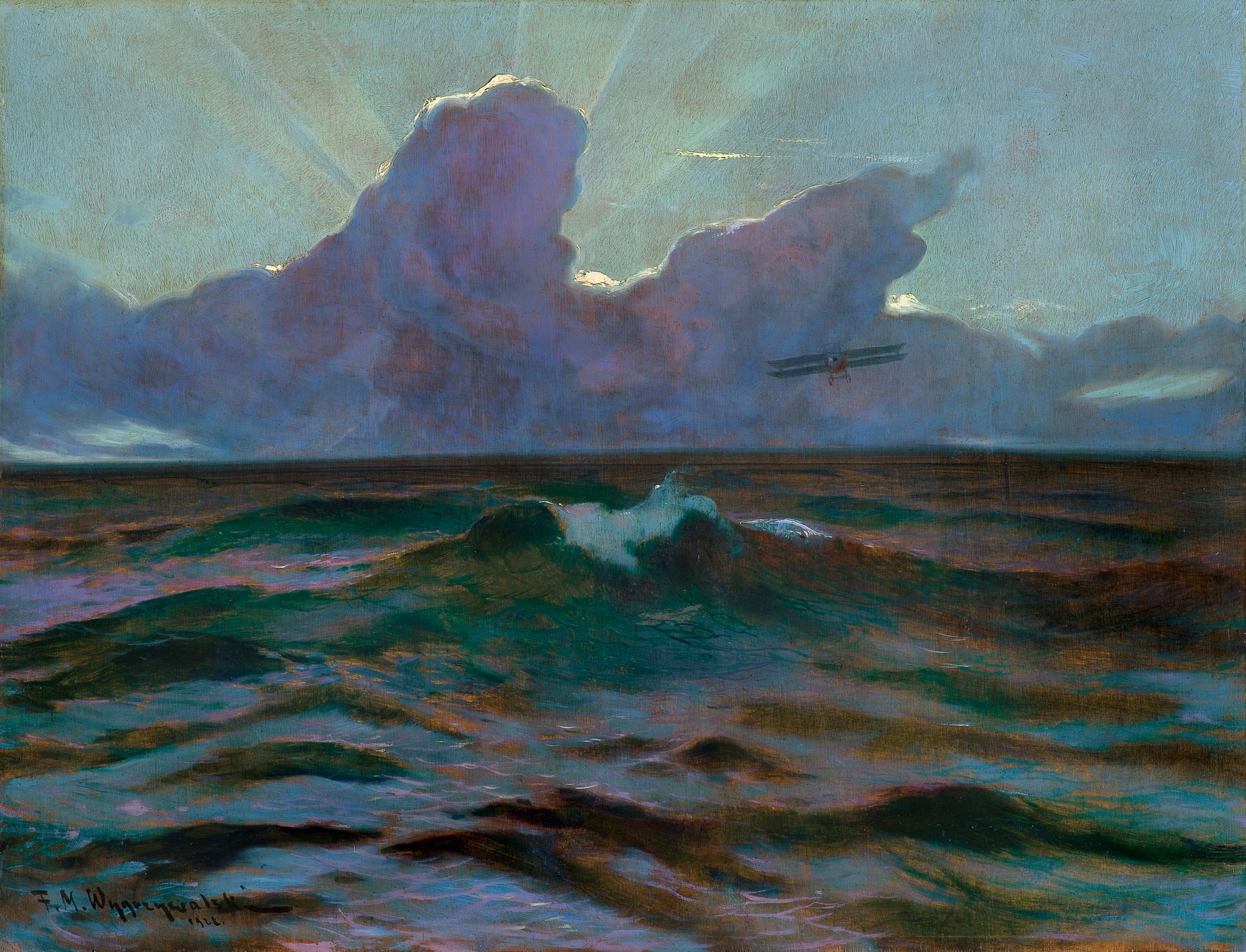
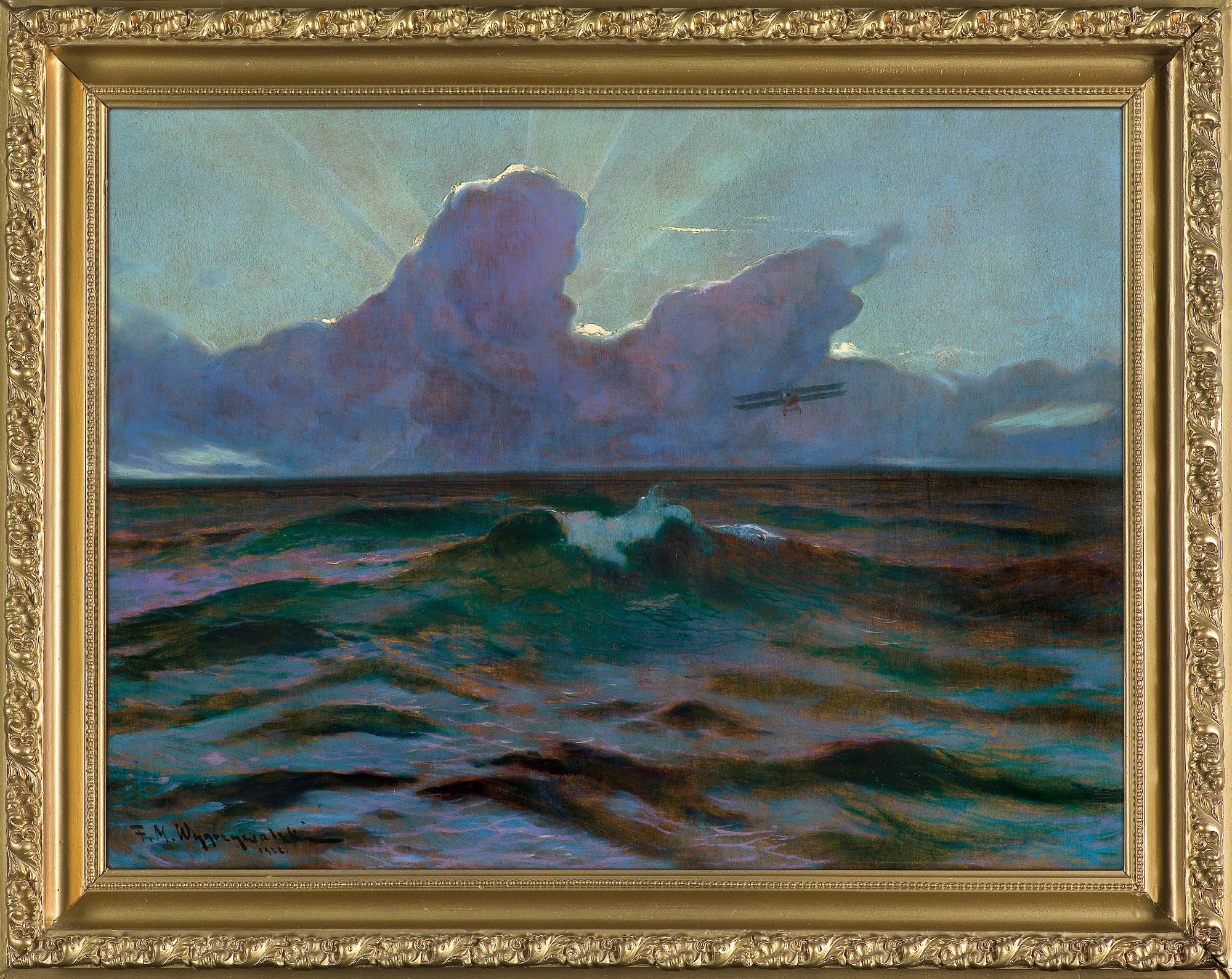
Wygrzywalski's work, created in 1928, is striking not only for the grandeur of its composition, but also for its unusually modern subject matter for its time. Against a backdrop of monumental, heavy clouds, pierced by the sun's rays, we see a lone airplane flying over the ocean - a motif that can be read in the context of landmark events in aviation history. In 1928, news of the first female flight over the Atlantic circulated around the world: American Amelia Earhart became the first female pilot to take part in a flight across the ocean. The flight took place from Newfoundland, Canada, to Burry Port, Wales. Although Earhart did not pilot an airplane on this transatlantic journey, the flight brought her international fame and made her a prominent figure in the aviation world.
The symbolism of the lone airplane against the vastness of the sea may thus have reflected the artist's fascination with this daring, high-profile feat and a new era of conquering the elements. The painting's color scheme enhances the drama of the vision - the cool, greenish-blue tones of the waves contrast with the pinkish-purple reflections and illuminated glow from behind the clouds. Wygrzywalski, known for his mastery of rendering lighting effects, achieves an almost cinematic effect in this composition - we get the impression of frames from films documenting the first aerial expeditions.
This work combines Wygrzywalski's painterly sensibility, shaped by his studies in Munich and contacts with European artists, with the spirit of modernity and fascination with the technical progress of the 1920s. It is among those compositions in which the artist abandons his typical oriental or portrait scenes, focusing instead on the dialogue between nature and a new, groundbreaking invention - the airplane.
Feliks Michał Wygrzywalski (Przemyśl 1875 - near Rzeszów 1944) studied at the Academy of Fine Arts in Munich under J.C.Herterich and K.Marr in 1893-98. He supplemented his studies at the Académie Julian in Paris. Already during his studies he traveled to Italy, and after 1900 he lived in Rome for several years. In 1906 he traveled to Egypt. In 1908 he settled permanently in Lviv. In 1909-14 he worked in the local theater as a stage inspector. He traveled to Italy several more times. He was a realist painter; in his earlier period of work he leaned towards naturalism and strong expression. He paid great attention to lighting effects and used a rich, vivid color palette. In his early paintings, he often depicted human labor (Burlacy) or dramatic events and social tensions (Strike, Bread to Us Hungry). He also painted portraits, nudes, seascapes, landscapes from Italy and Ukraine. After his trip to Egypt, oriental motifs and themes recurred in his paintings (Prayer of the Arabs, Carpet sellers). He was involved in decorative wall painting, including designing and later executing allegorical murals for the Chamber of Commerce and Industry building in Lviv in 1908. He was involved in printmaking, illustrated books and magazines, designed stained glass windows, costumes and theater decorations (including for Peer Gynt, Irydion, November Night).













Viimeksi katsotut
Kirjaudu sisään nähdäksesi kohdeluettelon
Suosikit
Kirjaudu sisään nähdäksesi kohdeluettelon