


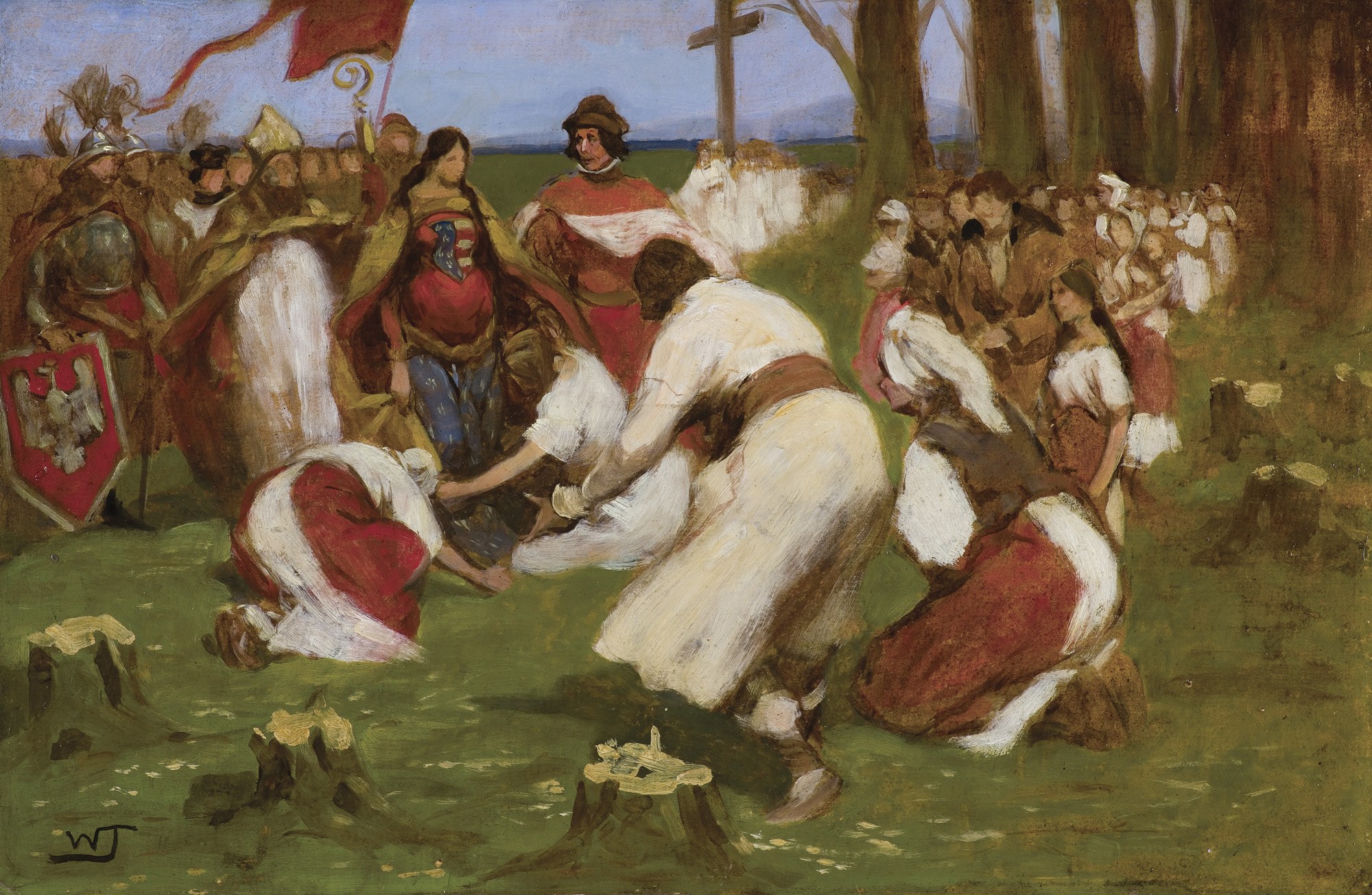
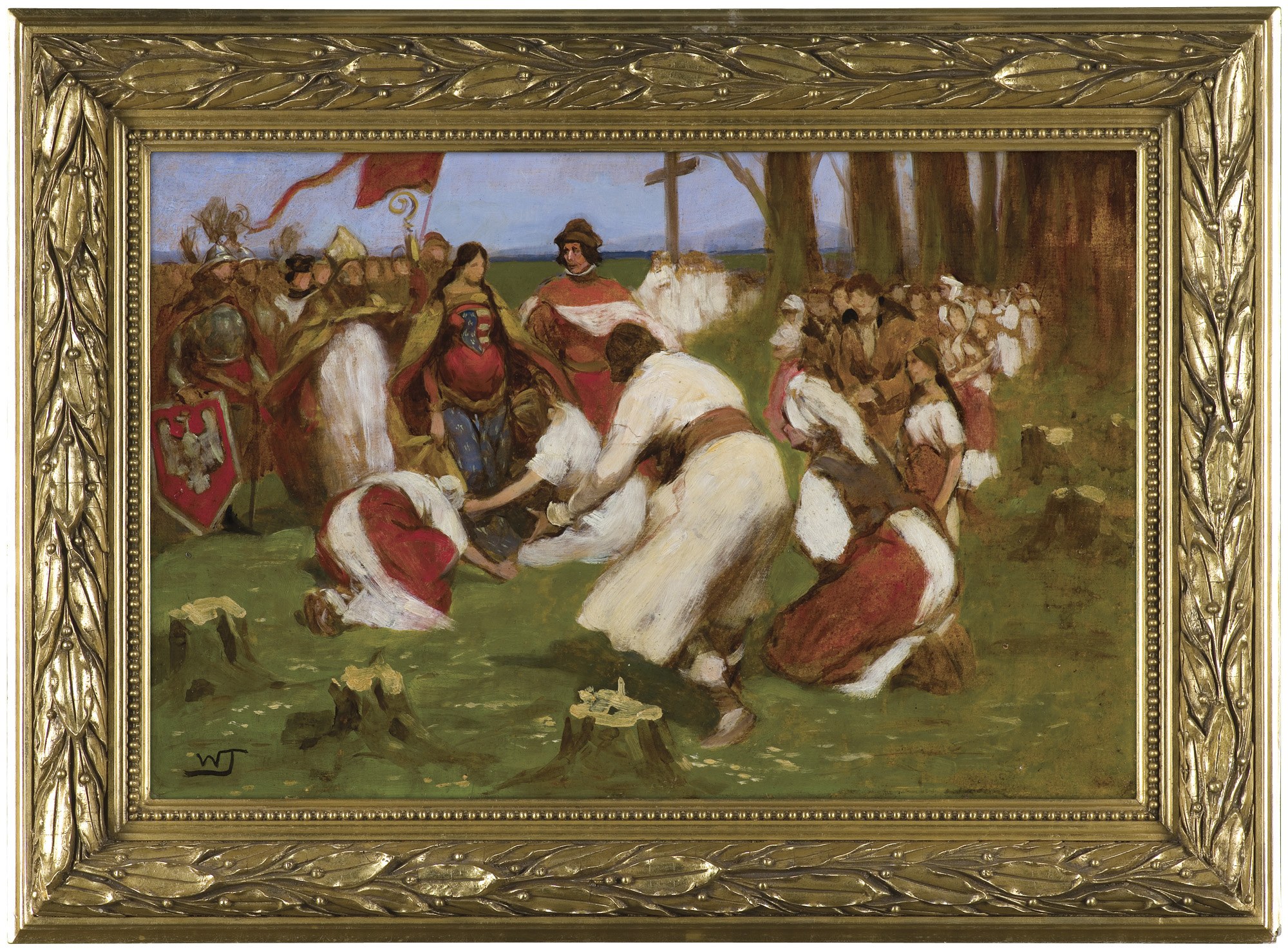
43.7 x 66.3cm - oil, cardboard signed l.d.: WT
Compare:
- Queen Jadwiga, Agra-Art Early Art Auction, 17 III 2024, cat. no. 29.
Depictions of Queen Jadwiga appear in the monumental paintings of Włodzimierz Tetmajer. The image of the Wawel Lady can be found in the Chapel of the Holy Trinity in Wawel Cathedral (1902) and in the Corpus Christi church in Biecz (1905). And in the cathedral in Sosnowiec, the artist depicted her in a scene of the baptism of Lithuania (1904-1906). The offered painting may have been created while the artist was working on the design for this scene.
Włodzimierz Przerwa-Tetmajer (Harklowa near Ludźmierz in the Podhale region 1862 - Kraków 1923), half-brother of the poet Kazimierz, began studying painting at an early age; as early as 1875 he attended classes at the School of Fine Arts in Kraków, where he continued (with breaks) to study until 1895 - initially with Franciszek Cynk, Leopold Loeffler and Władysław Łuszczkiewicz, and after 1889 with Jan Matejko. At the same time, he studied classical philology at Jagiellonian University. In 1882 he still studied at the Vienna Academy, and in 1886-89 at the Munich Academy under Alexander Wagner. He supplemented his studies at the Académie Colarossi in Paris. An imperial scholarship enabled him to travel to Rome. Upon his return, he lived in Cracow. In 1890 he married Anna Mikołajczykówna, daughter of a farmer from the village of Bronowice near Krakow, where he himself often stayed, and in 1895 settled permanently. In 1901 he founded and then ran a painting school for women for several years. Since 1899 he was a member of the Society of Polish Artists "Art"; in 1901 he was one of the founders of the Society "Polish Applied Art"; in 1908 he co-founded the "Zero" group. He was a prominent representative of the "folklore" trend, a painter of customs, labor and landscapes of the sub-Cracow countryside. In his earlier period he created in the spirit of academic, Munich realism. Later he developed his own original style - the composition of his paintings was free, he painted with broad brushstrokes and used bright, vivid colors. In 1892-1894 he collaborated with Wojciech Kossak and Jan Styka on Panorama Raclawicka. He designed stained glass windows, did illustration and mural painting, including a polychrome of the Queen Sophia Chapel at Wawel Cathedral in 1902. The artist was the prototype for the character of the Host in S. Wyspiański's drama The Wedding.








Viimeksi katsotut
Kirjaudu sisään nähdäksesi kohdeluettelon
Suosikit
Kirjaudu sisään nähdäksesi kohdeluettelon