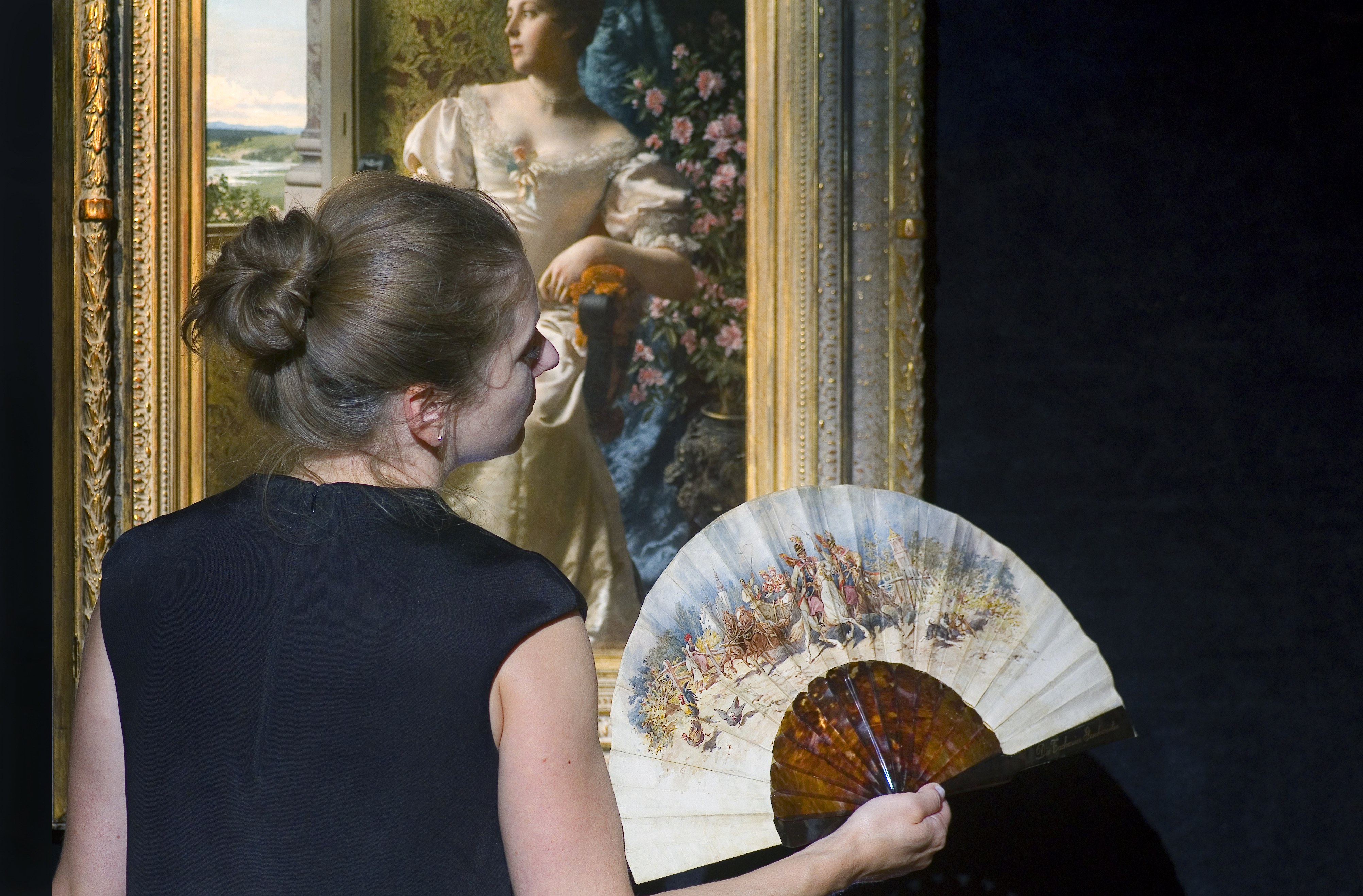
27.8 x 53.5 cm — watercolor, swan skin glued onto silk
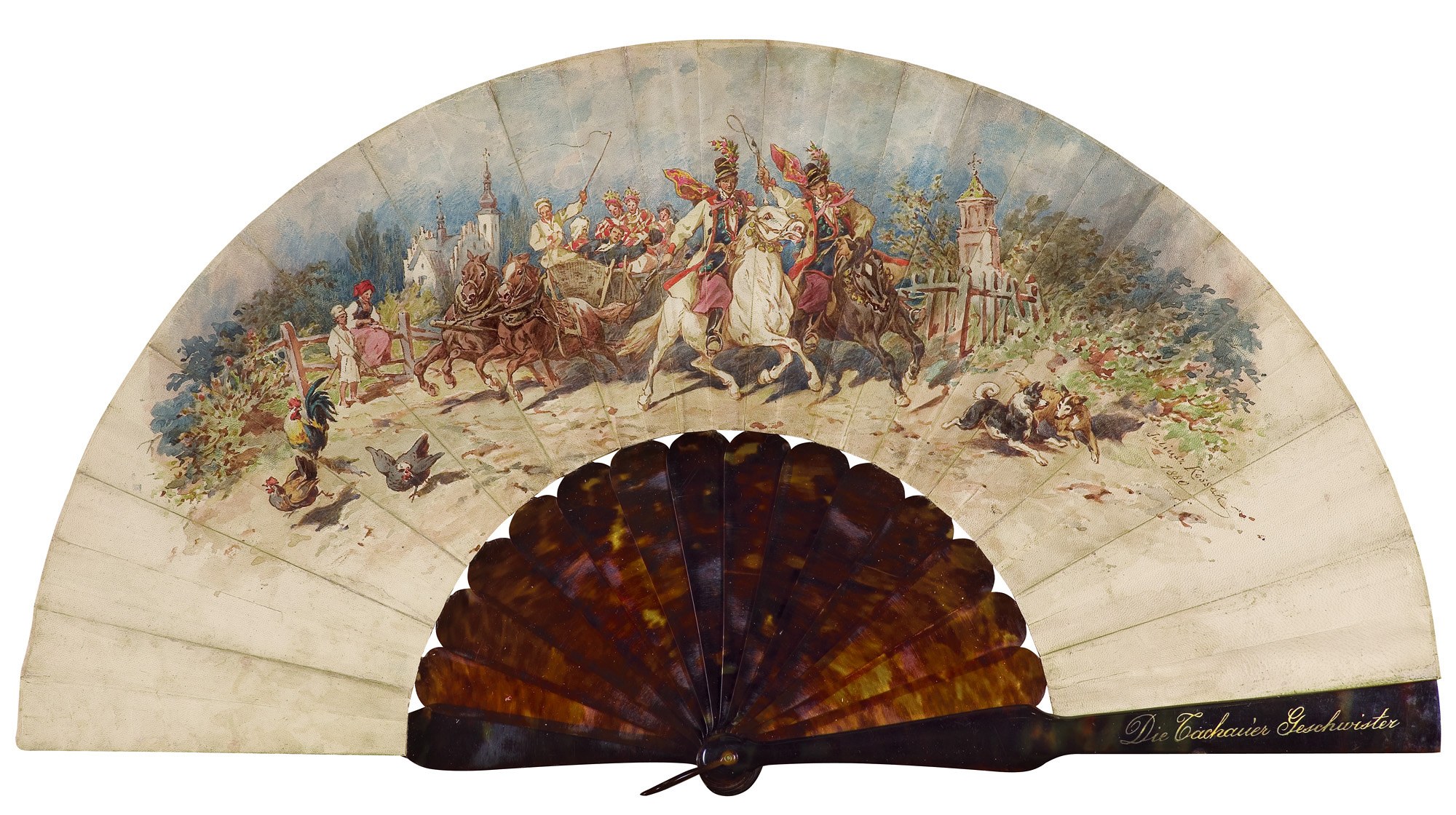
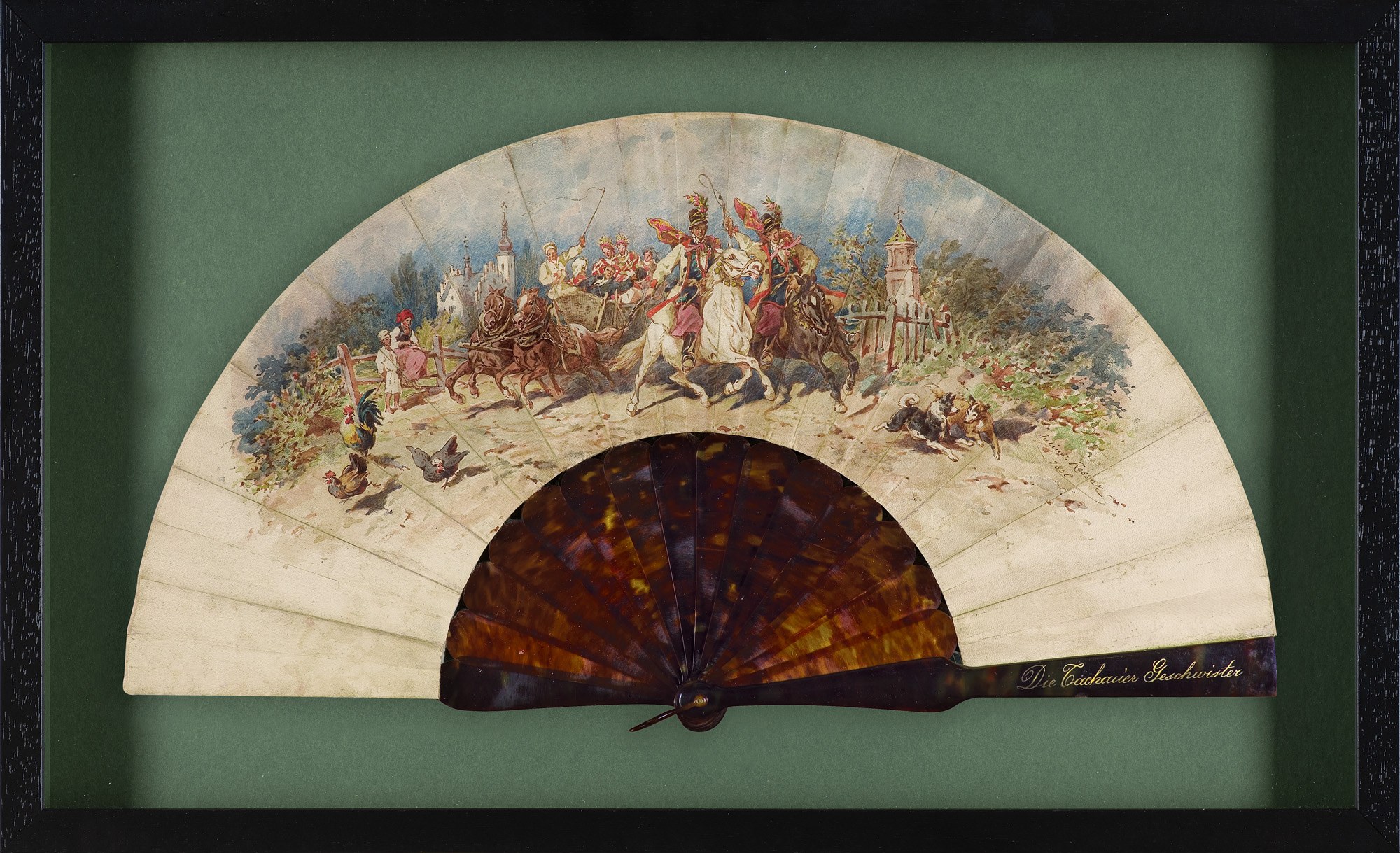
fan with 14 + 2 tortoiseshell feathers, 27.8 x 53.5 cm, feather length 27.8 cm, covering length 14.8 cm
signed on the right: Juliusz Kossak | 1880
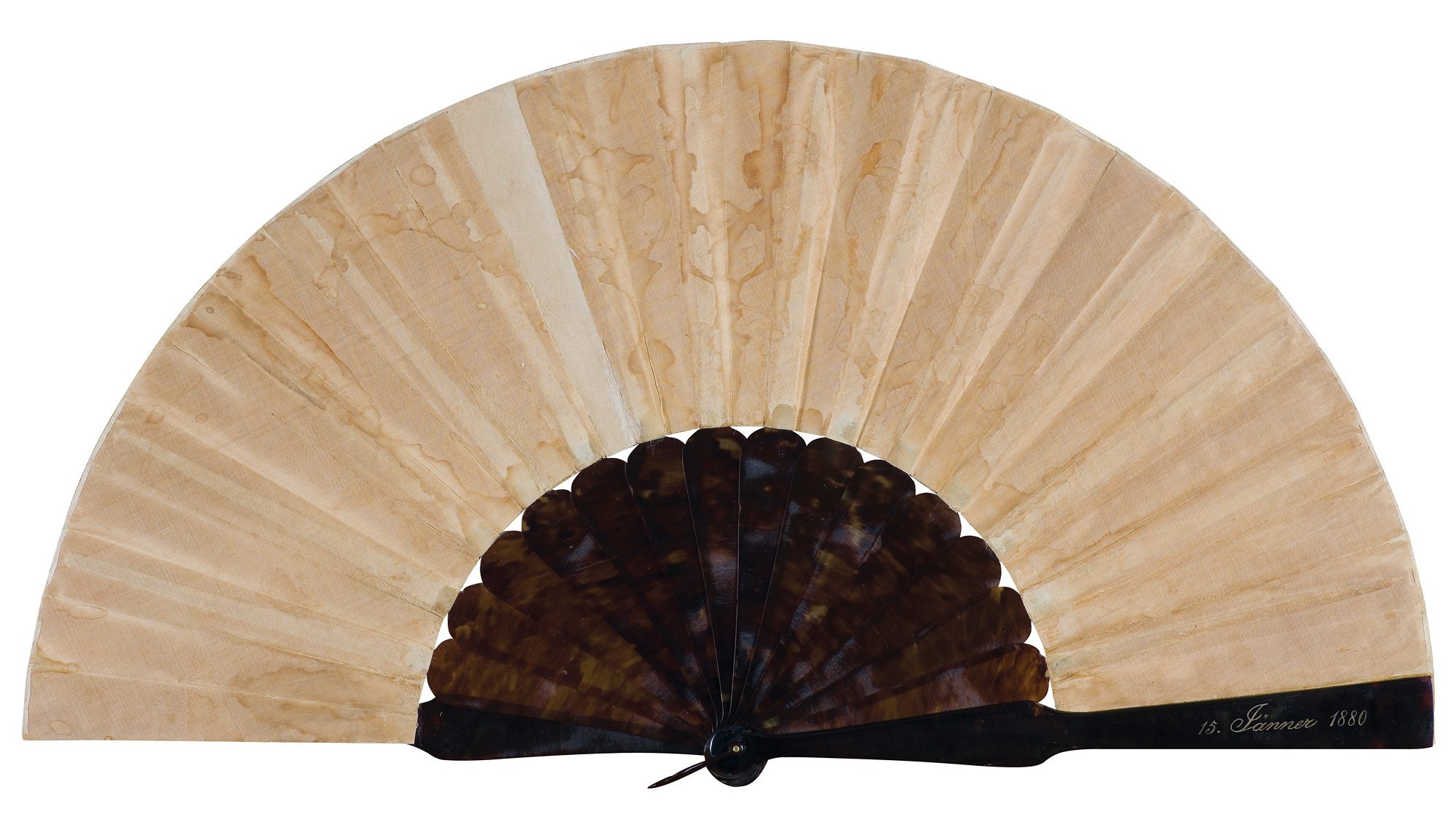
Additionally, the fan’s covers feature inlaid inscriptions: Die Cachauer Geschwister; 15 Jänner 1880.
Provenance:
- Collection of the Trauttmansdorff family, Horšovský Týn Castle, Czech Republic;
- Subsequently owned by the Trauttmansdorff family, who emigrated from the Czech Republic after World War II;
- Private collection, Canada.
Originally, fans served a practical purpose. They were part of a woman’s wardrobe, complementing elegant dresses. They were carried to theaters, balls, or social gatherings. The precision of the painting was crucial, and their decorations had to be neutral and appropriate for the occasion. They were painted with idealized genre or historical scenes. In the second half of the 19th century, in addition to historical and Oriental scenes, depictions of the rural world—which was equally exotic to both bourgeois and noble audiences—began to appear. Seemingly familiar, this world was in reality unknown; it captivated with its mystery, “naturalness,” the colorfulness of festive attire, and characteristic rituals. [...] At the same time, peasant life and its associated folklore began to be perceived as a treasure trove of ancient culture and customs in their purest, unadulterated form (cited in: J. Różańska, *Polski wachlarz malowany 1850–1914*, Warsaw 2006, pp. 45–46).
An elaborate scene of a Kraków wedding, painted in watercolor on a swan-skin cover and reinforced on the underside with a silk lining, was mounted on feathers made of tortoiseshell. Kossak used a landscape of the countryside near Kraków as the background for the scene, featuring a small church, a peasant couple by a fence curiously watching the procession, chickens fleeing in panic from under the horses’ hooves, and a pair of dogs placed on the opposite side of the composition for balance. In the foreground, the artist depicted a wedding procession led by two groomsmen on horseback. The exceptionally colorful and elaborate Kraków costumes were a frequent source of inspiration and a creative theme for Juliusz Kossak. The Krakow costume was admired above all for its color combinations. In addition to the dominant white and red—which evoke the national colors—the people of Krakow wore richly embroidered caftans as well as various accessories and ornaments that added to the picturesque quality of their attire. The beauty of the traditional costume and its rich ornamentation were showcased most prominently during weddings, when the newlyweds, groomsmen, and guests appeared in all their splendor, reflecting their financial status and the roles they played during the ceremony.
A key element of men’s attire and a symbol of the region was the white sukmana. On his head, the Krakowiak wore a black hat, which could be tall and conical or low and soft; sometimes he also wore a white magierka or a red rogatywka. A white shirt, tucked into cotton trousers, was often adorned with narrow red stripes. Over the shirt, he wore a caftan, topped with a belt of one of two types: one with bells or a pouch, and on his feet, boots with uppers. All of this made the Kraków costume exceptionally colorful; no wonder Kossak eagerly immortalized it in numerous paintings.
Border VAT: * In addition to other costs, an 8% border VAT will be added to the winning bid (in accordance with §12, point 3 of the Regulations).
Juliusz Kossak (Wiśnicz 1824 – Kraków 1899)—painter and illustrator—was one of the most popular Polish artists of the second half of the 19th century. He began his studies in drawing and painting at Jan Maszkowski’s studio in Lviv; later, he drew extensively from life while visiting noble estates in Ukraine, Podolia, and Volhynia. In 1852, he traveled to Vienna, Hungary, and St. Petersburg, and subsequently settled permanently in Warsaw. He spent the years 1856–1860 in Paris, where he befriended Horace Vernet. Upon his return to Warsaw, from 1862 to 1868 he served as artistic director of *Tygodnik Ilustrowany* (*Illustrated Weekly*). In 1869, he moved permanently to Kraków, from where he would still travel to Munich to paint in the studio of the battle painter Franz Adam. Kossak was, above all, an outstanding watercolorist; he used oil paint less frequently. He painted historical and battle scenes, as well as genre scenes illustrating the life and traditions of the noble court and the customs of the Polish people. But the true heroes of his paintings were horses, whose movement, temperament, character, and individuality he was able to depict masterfully. He was also the author of numerous illustrations for magazines and books, unerringly capturing both the atmosphere of literary works and the longings and needs of his audience—the readers of Wincenty Pol’s *Song of Our Land*, Henryk Sienkiewicz’s *Trilogy*, *Pan Tadeusz*, and Adam Mickiewicz’s poems.