


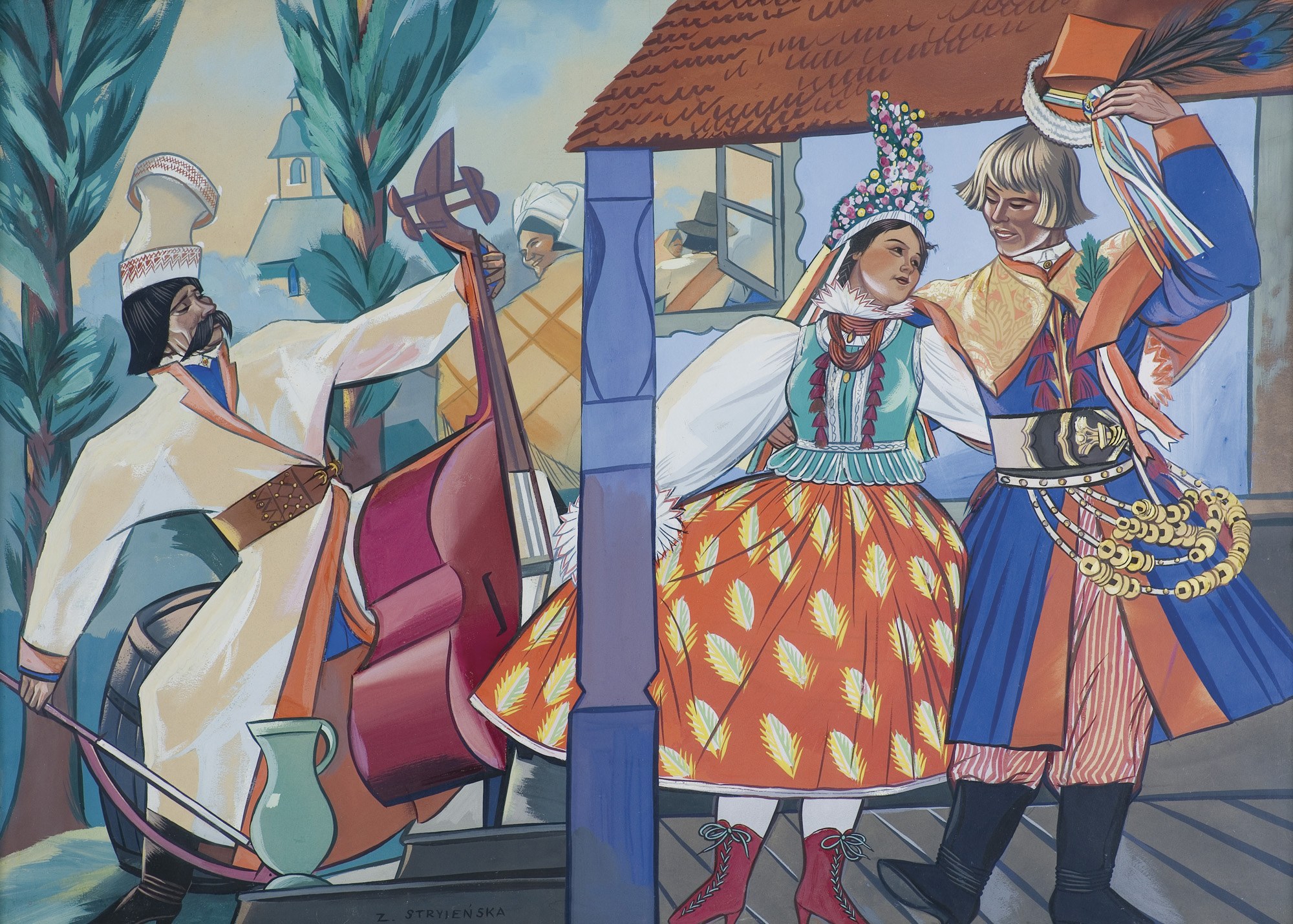
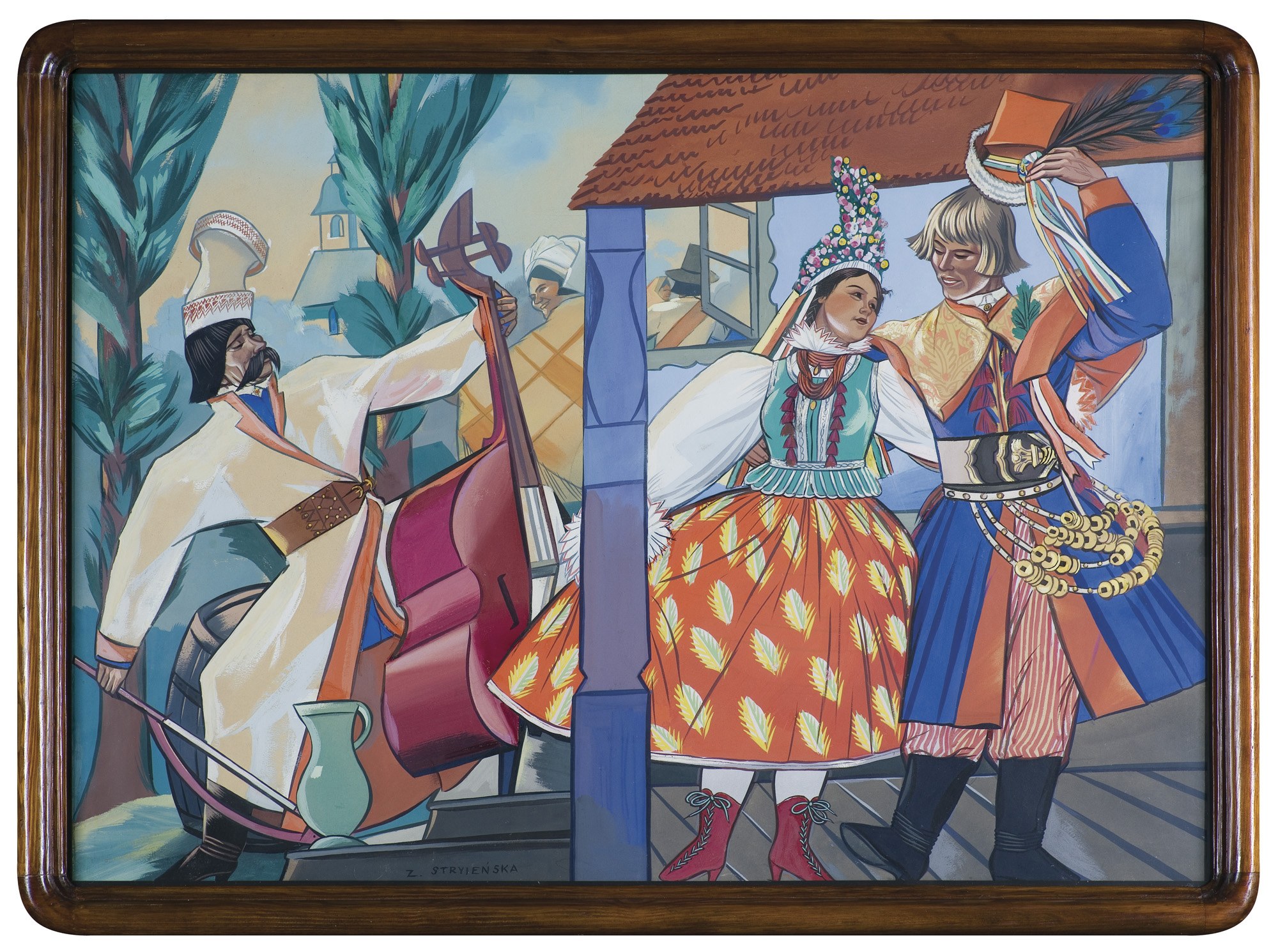
70.5 x 97.2cm - watercolor, gouache, paper signed below: Z. STRYIEŃSKA
Krakow Wedding is a large, elaborate composition depicting a scene from the life of a village near Krakow. Stryjeńska, like a director and stage designer on a theatrical stage, spins a tale of old Polish tradition. The architecture of the wooden porch delineates the frames and builds the individual plans. A carved column, a bordure as it were, separates the young couple, allowing them a brief moment of intimacy. The player standing on the threshold, though it could be a separate composition, with a broad gesture beckons the young couple to join the wedding party. The guests, placed by the painter in the background, just behind the house, eagerly await the arrival of the newlyweds. The newlyweds once again look at each other affectionately and set off with an almost dancing step. The blue of the sky and the saturated green of the trees emphasize the idyllic atmosphere of a warm summer day.
Stryjeńska's paintings are a tribute to folklore, which the artist considered a symbol of Polishness. Like an ethnographer, she paid a lot of attention to the detailed study of regional costumes. She believed that for color one must go to the countryside, and in her painting she wanted to escape from the gray reality that surrounded her. Her paintings are filled with vivid and saturated colors. She deftly and with great freedom plays with drawing, making excellent use of perspective shortcuts to heighten the dynamism. The Krakow wedding, painted in an atmosphere of undisturbed idyll, fits perfectly into the joyful, colorful stories of Polish folklore.
♣ A fee will be added to the auctioned price in addition to other costs, based on the right of the artist and his heirs to receive remuneration in accordance with the Act of February 4, 1994 - on Copyright and Related Rights (droit de suite).
Zofia Stryjeńska, née Lubanska (Krakow 1891 - Geneva 1976) - painter, illustrator, stage designer - was one of the more colorful figures of the Polish artistic community in the interwar period. After a short period of study with Leonard Stroynowski and at Maria Niedzielska's school in Cracow, she left for Munich, where in 1911-1912 she studied at the Academy of Fine Arts in male disguise (women were not admitted at the time). She made her debut at the Kraków TPSP in 1912 with a series of cartoons of Polish fairy tales inspired by folk tales. In 1916 she married Karol Stryjeński. She lived in Cracow until 1919, later living in Paris, Cracow, Zakopane and Warsaw. In 1925, she achieved international success at the Decorative Arts Exhibition in Paris, receiving the Gran Prix in four divisions (painting, poster, textile, illustration) and the Diplom d'Honneur for her toy designs. She was involved in decorative architectural painting, polychromy, illustration, stage design (including Karol Szymanowski's Harnasie; 1938), industrial design (kilim designs, toys). She created her own specific style in decoratively stylized, colorful, dynamic and temperamental paintings; tempera, watercolors and gouaches. In their subject matter she referred to legends, beliefs, history and folk customs. She published several graphic volumes (Slavic Idols, 1917 and 1922) and albums of reproductions (Polish Dances, 1927; Pascha, 1929; Piasts, 1929; Slavic Gusła / Magie Slave, 1934). Her works were also popularized by numerous color postcards.













Viimeksi katsotut
Kirjaudu sisään nähdäksesi kohdeluettelon
Suosikit
Kirjaudu sisään nähdäksesi kohdeluettelon