


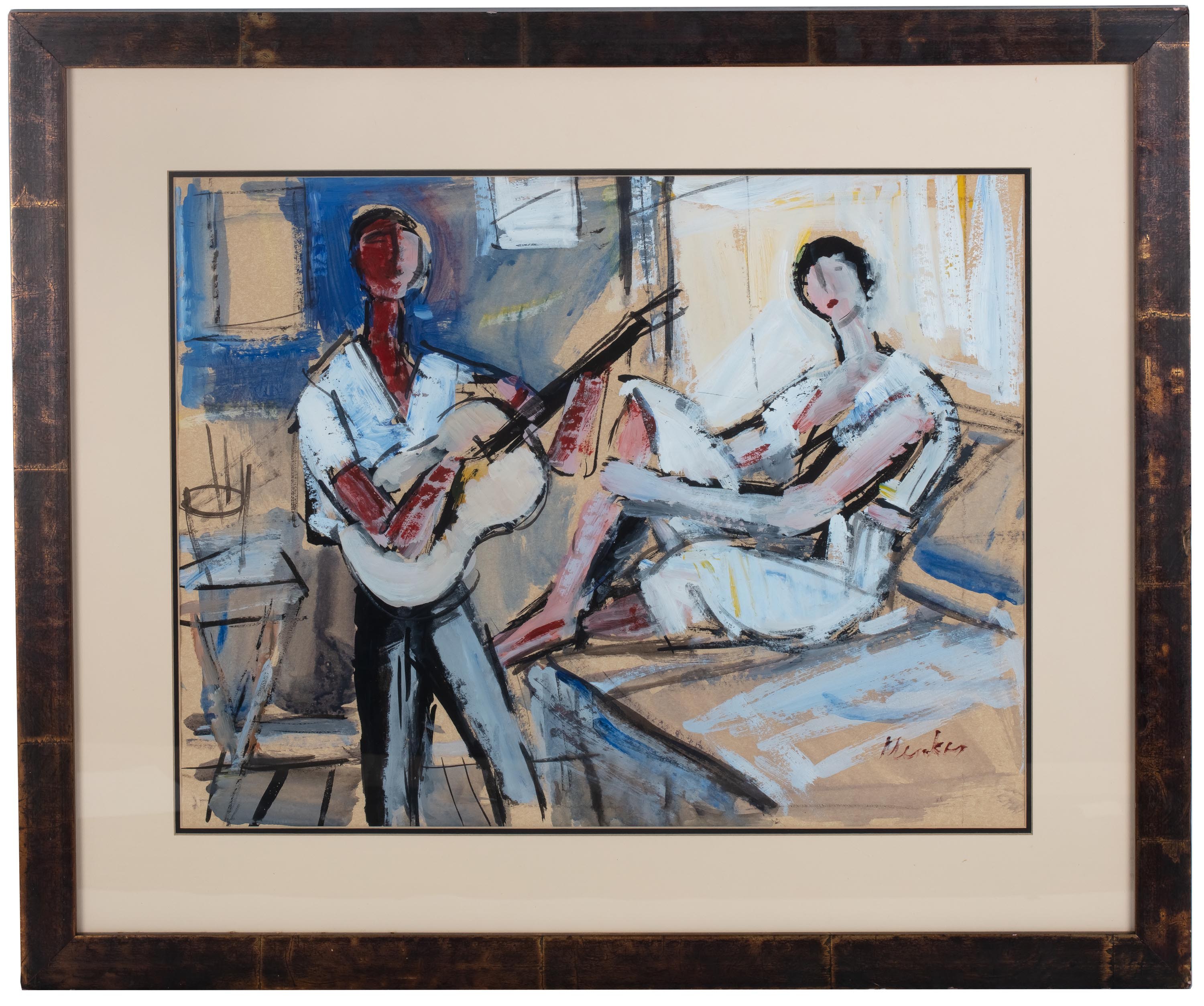
watercolor, gouache, paper, 35.5 × 45.5 cm (light passe-partout)
signed p. d.: "Menkes"
On the reverse, author's dedication: "To Lilian and Sara/Frockliel/With best wishes/ Menkes/1968
"In many of Menkes' canvases we notice almost imperceptible brushstrokes of various colors around the people and objects depicted. These are shimmering, "lacy" embellishments that create a circular swirling frame, and give the entire canvas an indefinable vibration. Perhaps this is where the musicality, so often mentioned by critics writing about Menkes, comes from? André Salmon paid particular attention to the musicality of color rhythms and chiaroscuro in Menkes. This is, of course, an oft-used metaphorical reference of the plastic values of painting to another branch of art - music. Regardless, however, musical instruments very often appear in Menkes' compositions. They are natural "models", compositional props, but the predilection for them is not a matter of pure chance. He himself was musical after his mother, played a little, and is said to have said that if he had not become a painter, he would have devoted himself to music. He had a whole collection of old instruments in his attic studio."
Władysława Jaworska, "Zygmunt Menkes. Painter of École De Paris," in Bulletin of Art History 1996, No. 1-2, P. 20.










Viimeksi katsotut
Kirjaudu sisään nähdäksesi kohdeluettelon
Suosikit
Kirjaudu sisään nähdäksesi kohdeluettelon