


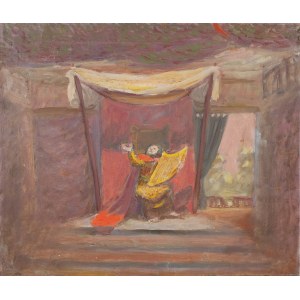
oil/canvas, 67 x 79 cm
on reverse on stretcher bar Dimensions and technique: 79 x 67 I oil
Certificate of authenticity confirmed by the artist's Heirs.
He was engaged in easel painting and realized monumental projects in sacred interiors - polychromes and stained glass. In 1958, he represented Poland with Maria Jarema and Artur Nacht-Samborski at the Venice Biennale.
Waclaw Taranczewski studied from 1921 to 1931, and began his education at the Poznan School of Decorative Arts. In 1922 and 1925-1929, he continued it at the Krakow academy - initially under the direction of Fryderyk Pautsch, then under the supervision of Felicjan Szczęsny Kowarski. Following Professor Kowarski, he came to Warsaw in 1929. The period 1931-1935 was considered by the painter to be decisive for his further work. During this time, his own independent artistic search led him to solutions, which he continued to pursue for the following years. In 1935 he traveled to France and Italy, and in 1937 to Italy and Greece. The opportunity to get acquainted with the greatest works of ancient art was a formative experience for Taranchevsky. He was most impressed by the Italian masters Giotto, Cimabue, Fra Angelico, Piero della Francesca, Tiepolo, but also Rubens and Rembrandt. Italian monumental painting would be a point of reference for Taranchevsky in the postwar era when working on church polychromes. After completing his studies, the artist settled again in Poznan. In 1945, he became director of the Poznan School of Decorative Arts. The following year he began to lead the Monumental Painting Department at the Academy of Fine Arts in Krakow. He moved to Krakow in 1950.
Taranczewski worked in cycles, exploring several motifs over the years. After the war, he took up the themes started in the 1930s. Over the decades, numerous versions of "Little Painter," "Concert at the Atelier," "Trio" or "Still Life with a Saint" were created. These works were stylistically diverse - once close to historicizing realism, at other times synthetic, almost abstract. It is not without significance that the painter was a music lover and played the violin and cello amateurishly himself. He also gave expression to his passion for music in painting, as evidenced by his numerous versions of "Concerto at the Atelier" and "Trio," as well as still lifes with musical instruments. The painting on offer probably depicts King David playing the harp. The Old Testament ruler of Israel was depicted in Christian iconography as the slayer of Goliath (famous sculptures by Donatello, Michelangelo or Bernini, among others, or Caravaggio's painting "David with Goliath's Head"), the seducer of Bathsheba, or as a psalmist and poet accompanying himself on the zither, flute or harp. Of contemporary artists, Marc Chagall repeatedly depicted David in his graphic illustrations of the Bible. The featured painting is unique in Taranchevsky's oeuvre, although like many other works it alludes to the work of Rembrandt. Among others, the first version of "The Little Painter" was created from Rembrandt's inspiration in 1934. Pawel Taranczewski, the artist's son, recalled: "This subject - of undoubtedly Rembrandtian inspiration - had lived in Father's work since the 1920s. The idea for the canvas was born in Rudki, when he and Piotr Potworowski were looking at a reproduction of a Rembrandt painting depicting the painter in front of a nude posing on a small podium" (P. Taranczewski, Waclaw Taranczewski's Ways, "Aesthetics and Criticism" 2004, no. 1, p. 2). The solution of the space emphasizes the theatricality of the performance and suggests a connection between this composition and the painting on offer: "The interior where the little painter begins to paint the nude is the stage, the figures the actors" (Ibid., p. 3). Interestingly, Taranczewski's other pre-war studio in Poznań looked like this: "One entered the studio from the hall through a large passageway without a door covered with a curtain. [...] In the right year of the studio there was a door to an oblong balcony that sometimes served as a stage on which the model posed" (Ibid., p. 4). Of great importance for the interpretation of the auction painting is the fact that Taranczewski's painting was embedded in the tradition of European painting, but also marked by personal themes: "The canvases of the Little Painter series visualize seeing the world through art. The interior of the room [...] was seen through Rembrandt, at the same time, the inspiration flowing from Rembrandt is saturated with emotion, which can only be evoked by directly seeing the figure, the interior, the climate of the whole. [...] The little painter - the figure in the painting - is also a spiritual self-portrait of Waclaw Taranczewski. [...] The spiritual self-portrait is not embodied in the figure of the little painter because the Father painted his psyche. The little painter can still be asked if, and if so, what is the meaning of the objects present in the painting? Do the violins on the chair by the wall [...] symbolize harmony or merely indicate that the painter played them amateurishly? Either way, the meaning of the presence of a musical instrument on the canvas should be explained. Why the absence of a painter's workshop in the studio? Why does the Little Painter - the figure in the painting - not have a palette or paints? So is she really painting or is she just pretending, playing a role on stage, inside?" (Ibid., p. 4). We can then pose a similar question regarding the mysterious iconography of the offered painting. Is the harp player another spiritual self-portrait of the painter? Has Taranczewski here turned the palette into a musical instrument, and colors into sounds?





Viimeksi katsotut
Kirjaudu sisään nähdäksesi kohdeluettelon
Suosikit
Kirjaudu sisään nähdäksesi kohdeluettelon