


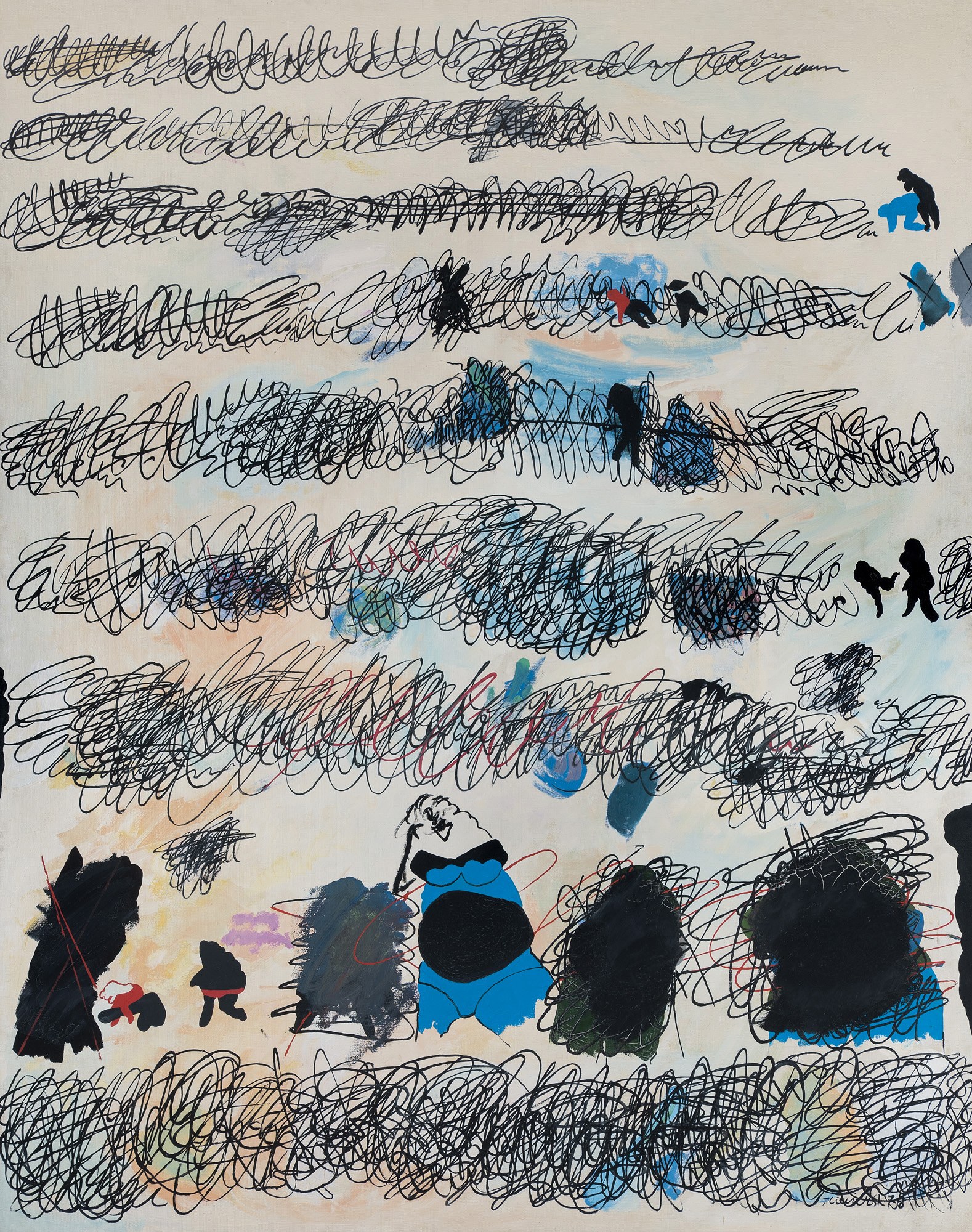
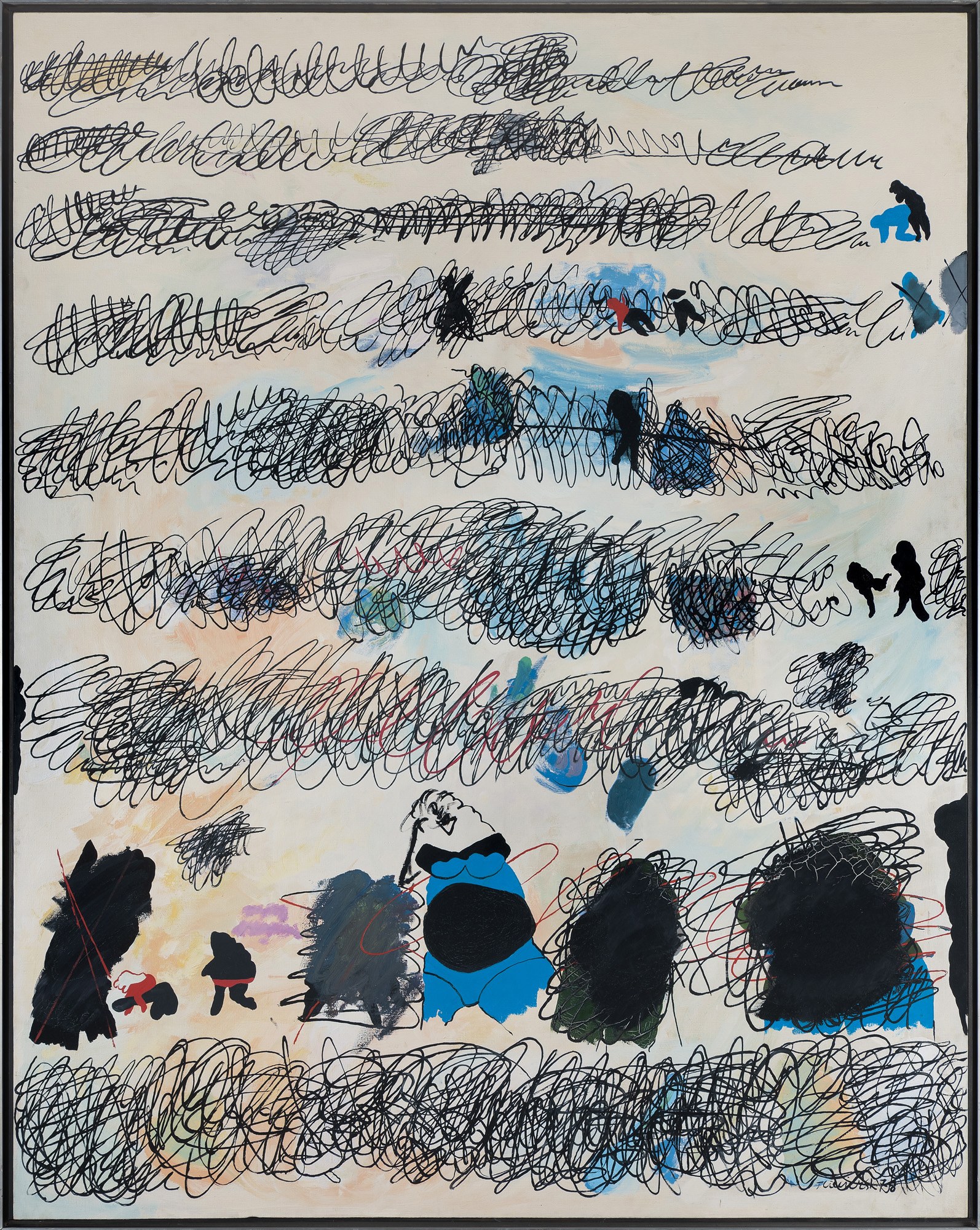
150.5 x 120 cm - oil on canvas
signed lower right: T. Ciecierski 78
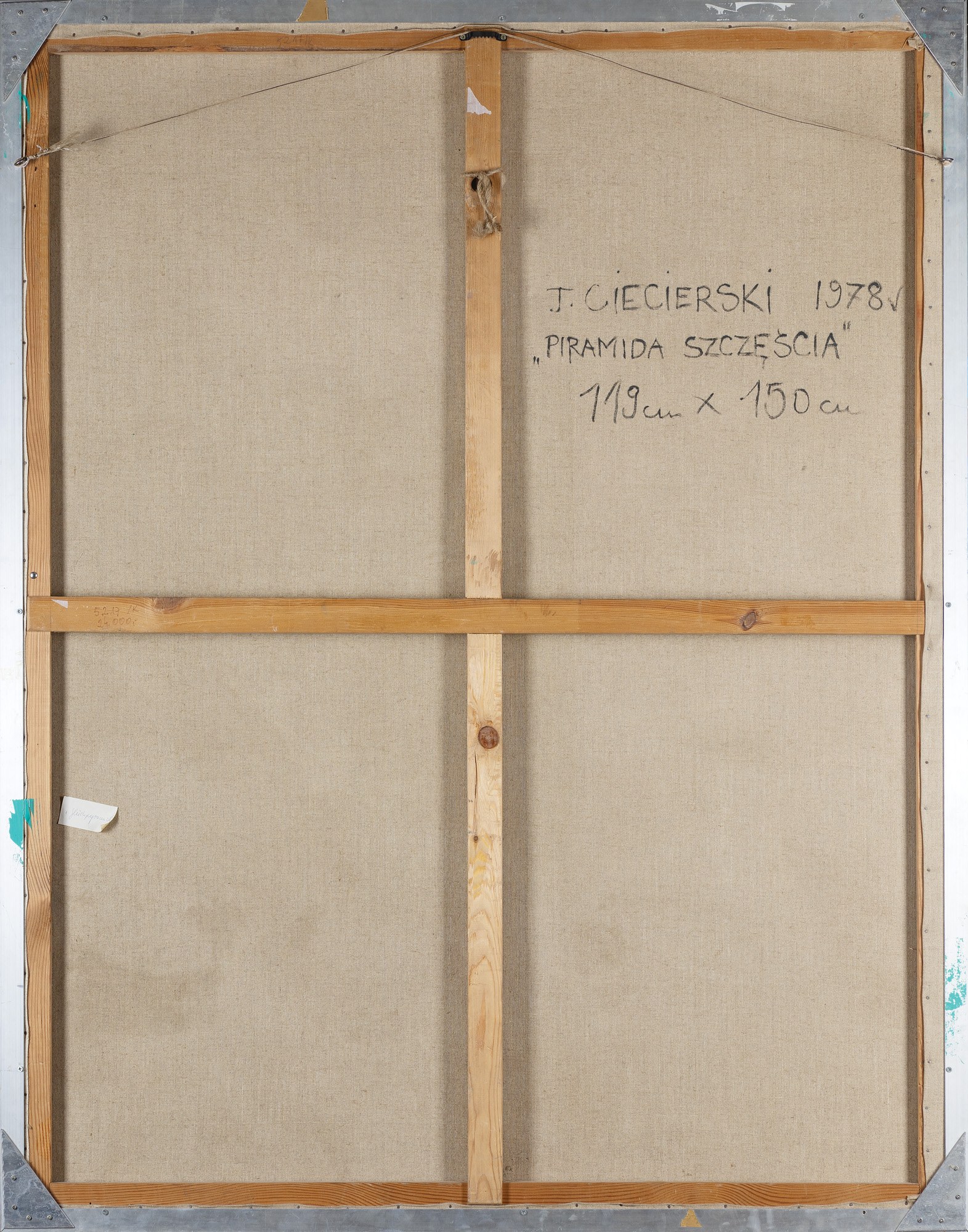
signed on the reverse, bottom left: T. CIECIERSKI 1978 | “PYRAMID OF HAPPINESS” | 119 cm x 150 cm
In the 1970s, Tomasz Ciecierski established himself as one of the most original artists associated with the New Figuration movement. This was a pivotal period in the development of his unique artistic language. He typically divided his early paintings into fields, placing figures and abstract patterns, symbols, and ornaments within them—elements that appeared to have no connection to one another (hence the title of one of his series—“Alogical Paintings,” 1975–1976). Drawing and drawing techniques occupied a very important place in Ciecierski’s work; in the form of hasty, dynamic, and simplified figurative notation, they appeared on many of the artist’s canvases from his early period.
According to Marek Goździewski, Ciecierski’s characteristic “scribbling” refers not only to street graffiti but also to the Surrealist tradition of automatic writing (Tomasz Ciecierski. Paintings and Works on Paper 1972–2007, ed. Włodzimierz Nowaczyk, Poznań 2007, p. 47).
In the catalog for the 1980 exhibition at Galeria Studio, the artist wrote the following about his painting: The reality that interests me lies on the border of what can be defined. Hence, my paintings hover on the border between the real (representational) world and the unreal (emotional) world. I am fascinated by the possibility of moving individual figures, entire groups of them, minor events, and scenes. The ability to shift them from one place to another, to cross them out and blur them—giving them meaning and mood through a change of context—allows me at times to freeze a moment on the border between reality and fiction (Tomasz Ciecierski. Paintings and Works on Paper..., p. 13).
The painting was exhibited, mentioned, and reproduced, among others, in: – Don’t Ask About Poland, “Znaki Czasu” Center for Contemporary Art in Toruń, Toruń, February 21–May 25, 2025, p. 105, color illustration.
♣ Droit de suite: ♣ A fee resulting from the right of the artist and his heirs to receive remuneration in accordance with the Act of February 4, 1994, on Copyright and Related Rights (droit de suite) will be added to the Purchase Price.
Tomasz Ciecierski (Kraków 1945, Warsaw 2024) studied from 1965 to 1971 at the Faculty of Painting of the Academy of Fine Arts in Warsaw, earning his diploma in the studio of Prof. Krystyna Łada-Studnicka. From 1972 to 1986, he taught at his alma mater. In 1981 and 1983, he was an “artist in residence” at the Stedelijk Museum in Amsterdam. From 1985 to 1986, he stayed at the Atelierhaus in Worpswede (Germany), and in 1991 he was a fellow at the Musée d’Art Moderne in Nîmes (France). He made his debut among the talented artists of the so-called “New Figuration” movement of the 1970s, distinguishing himself from the outset with his individual style and treatment of form. He typically divided his early paintings into sections, placing within them figures and abstract patterns, symbols, ornaments, etc., that appeared to be unrelated (hence the title of one of his series—“A-logical Paintings,” 1975–1976). His paintings from the late 1970s and 1980s were populated by “crowds” of small, restless figures scattering in various directions. Sometimes these were intermingled with symbols, such as letters or ideograms of waves and spirals, which enhanced the impression of the composition’s dynamism. He also painted distinctive polyptychs in which a large central section is surrounded by a “frame” of small images (the Déjà vu series, 1986–1987). His works from the 1990s are predominantly spatial compositions or a kind of relief constructed from many small images attached to one another in a collage-like manner. The subject of such works is often a simplified seascape. Drawing, treated as a means of expression on par with painting, invariably accompanies the various periods of the artist’s work. In particular, the period of compositions featuring the aforementioned “crowds” yielded numerous series of drawings in soft pencil, crayons, and pastels. The artist collaborated with the Foksal Gallery and prestigious international galleries: Vetering in Amsterdam and Hans Strelow in Düsseldorf. He participated many times in major international group exhibitions, such as the Festival in Cagnes-sur-Mer (1982, 1984), the 5th Sydney Biennale (1984), the São Paulo Biennale (1987), “Polish Realities,” Glasgow 1988, “Positionen Polen,” Berlin 1991, and “documenta” in Kassel (1992).













Viimeksi katsotut
Kirjaudu sisään nähdäksesi kohdeluettelon
Suosikit
Kirjaudu sisään nähdäksesi kohdeluettelon