


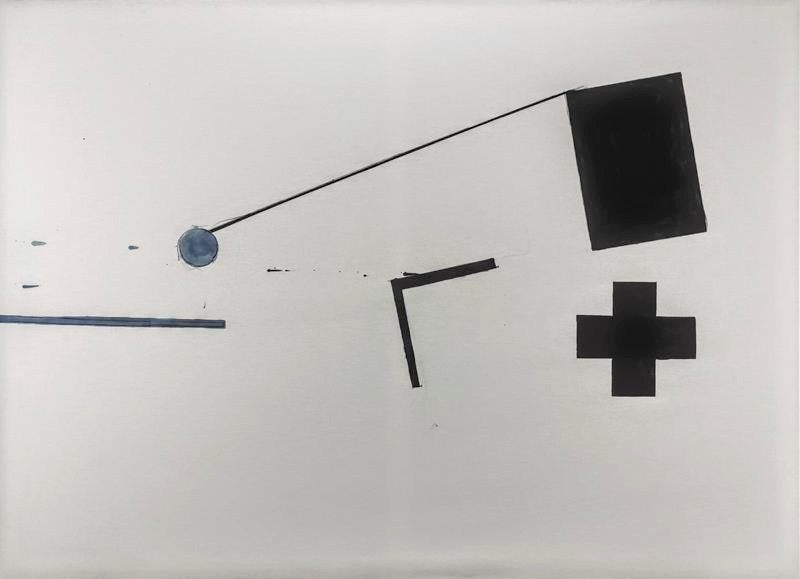
oil, canvas; 110 x 150 cm;
author's description on reverse: RECALIBRATING / SENSE OF COMPOSITION / NORMAN 2012-14;
Work presented at the exhibition "Go and Look," Zabrze City Museum, 2018.
"If painting has any special role in this laboratory, it can be compared to the purifying work that the human mind performs during sleep: the entanglement of memories and the most persistent thoughts in a uniform magma, which paradoxically serves to maintain order. As a result of a similar process - initiated by Norman during breaks from his exhausting work on films - a panorama of the contemporary world emerges from the jumbled figures in his paintings. In this light, it is easy to put Leto's paintings into a realistic formula, however "verisimilitude" does not exhaust it: on the artist's numerous canvases, the viewer will find, among other things, references to technological and scientific representations of the world (diagrams, infographics, etc.), to which modern people are inclined to attribute greater relevance than to photographic reproduction. In the case of similar motifs in Leto's paintings, one can still speak of his realism, however, giving the word philosophical overtones.
The most abstract (and at the same time completely colloquial) understanding of realism that can be associated with Norman's painting has nothing to do with the order of representation of reality. Instead, it is about a disillusionment about the limitations of the traditional medium and a conscious - i.e. "realistic" - approach to its function. A reflection of such an attitude is the imitation of heroic creative attitudes such as Abstract Expressionism or Photorealism (importantly in the present context, Norman did not receive an academic education in painting - imitation is therefore a questioning of heroic greatness). It is also evidenced by the "migration" of selected paintings between different media: in the artist's renderings and films, some canvases recur as textures or set design elements. While undermining the autonomy of the classical field of art, which was fiercely defended by the modernists, Leto paradoxically saves it: for he exploits the functionality of painting to the maximum, treating it already as a field of experimentation, like a sketchbook (in the case of conceptual, flash-painted images), already as a tool for playing with the market-sanctioned canon of art (vide : photorealistic works), a medium of visual diarism (as in the case of various portraits) or a stage of a complex creative process (whenever paintings find their "extensions" in other media)."
(source: www.pgs.pl, excerpt from the text of the curator of the exhibition "People Who Still Want Something from Me" by Arkadiusz Półtorak)





Viimeksi katsotut
Kirjaudu sisään nähdäksesi kohdeluettelon
Suosikit
Kirjaudu sisään nähdäksesi kohdeluettelon