


oil/canvas, 80 x 100 cm
signed, dated and described on the back: Maciej Bieniasz | "From the Window" | ol.pł. | 1972 | 80 x 100 cm
In 1966 the WPROST group was founded by five young Krakow painters: Maciej Bieniasz, Zbylut Grzywacz, Barbara Skąpska (left the group after a year), Leszek Sobocki, Jacek Waltoś. In the founding manifesto, the artists outlined their demands: "We want to express directly, not to overlook the multiple possibilities in plastic art: themes, symbolism, meaningful forms, material appropriate to the content. Any useful method and material for expression is important for imagination, that is - to reveal the shape of experiences." The works presented at the time at the Palace of Art in Krakow marked a turn towards realism, towards socially and politically engaged art. The formation of the group was an expression of opposition to the domination of abstract art. On the other hand, the realism presented by its founders was far from Socialist Realism. Formally and ideologically close to them was the work of Andrzej Wróblewski.
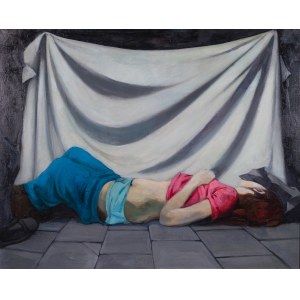
Jerzy Stajuda, writing about Bieniasz's work in 1990, drew attention to the constant "liveliness" of the activity of the artists of the Wprost group: "What is the root of this phenomenon, what is this still living pulse of it? It seems to be the seriousness of the social obligations undertaken. Both a person as an individual and as a member of a collective is taken seriously here, along with all the existential implications and due generalization distance. Although the main premise of the group has become speaking WPROST, at the same time a capacious generalization has been intensively sought. Thus, both everyday reality and human life in its depth were (and still are) endowed with poignant expression. In this art, it is perhaps not so much the vision of man itself that is riveting, but precisely the deep commitment to man. There is nothing mocking, ironic, disparaging here, on the contrary, there is a dramatic identification" (J. Stajuda, On Maciej Bieniasz [1990], [in:] The Presented World? On the group "Wprost", Texts selected, compiled and prefaced by Małgorzata Kitowska-Łysiak, Lublin 2006, pp. 101-102). The painting "From the Window" depicts a scene, behind which, as we can guess, there is a drastic story: we see a dead undressed woman lying on the sidewalk. The title suggests that she fell out of a window. The author does not make this event a sensation. Nor is it a display of composition. It is the gaze of a documentary filmmaker, but one who is not indifferent to human drama. Stajuda notes, "[...] Bieniasz's works win over and attract with their truthfulness. The artist clearly wants to be fair and, even risking much, wants to be modest. The strength of his drawings and paintings does not lie in polysemous vision, but in deep compassion. This is possible within the group's program if a close union of social assumptions with personal love for people is formed. All of Bieniasz's works are characterized by such love. This is most evident in a series of drawings (and also in a few paintings) devoted to the city. Portrait of the City - this is the title of this powerful series, on which the artist began work in 1969 [...]. Everything is here: and the horror of disintegration and entrapment, poverty, frailty and human loneliness. Persistence and annihilation. Only one thing is absent in this series: inhumanity. The painter's love gives great warmth to these images, marks, as it were, the great good that belongs to all human existence. In the visual layer, this truthfulness of Bieniasz - which his attitude directs as a moral imperative - manifests itself as a striving for simplicity" (J. Stajuda, op. cit., p. 102). The series "Portrait of the City" refers to Katowice, but can be read as a universal commentary on the dark side of urban life and existential hopelessness.
The featured painting is one of two versions exhibited at the group's 1973 exhibition at the Palace of Art in Krakow: "From the Window I" (1972) and "From the Window II" (1972) (M. Maksymczak, Revolt Against Authority and Formalism. An attempt to interpret the work of the Wprost group, Warsaw 2017, p. 385).
The second version of the painting is in the collection of the District Museum in Tarnów. The offered composition differs from that one in its motif of white draped fabric, which forms the background for the female figure. The canvas brings out the silhouette of the victim, shining brightly like a shroud with which, it seems, she will be covered.








Viimeksi katsotut
Kirjaudu sisään nähdäksesi kohdeluettelon
Suosikit
Kirjaudu sisään nähdäksesi kohdeluettelon