


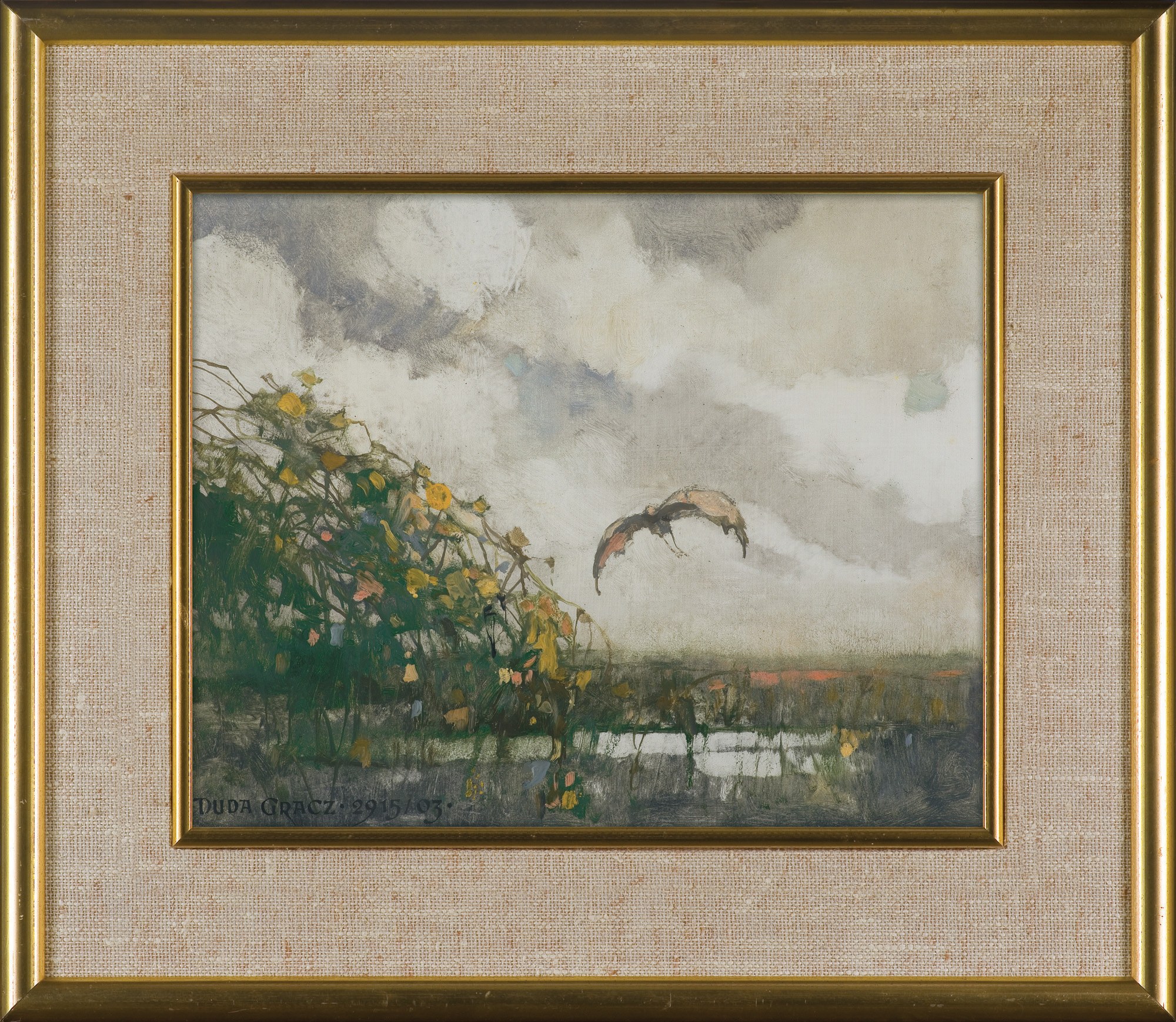

42.0 x 52.0 cm - oil, plate 42 x 52 cm - dimensions in light of frame
Signed l.d.: DUDA GRACZ. 2915/03.
on the reverse: artist's sticker with details of the painting
Jerzy Duda Gracz was a great bard of the beauty of the Polish landscape. As Tadeusz Nyczek recalls, he created his first small landscapes, sonorous and beautiful as the morning sky over the lake, as early as the 1960s. They were not shown to the public, being an intimate area of painting inaccessible to viewers and critics. Over time, the landscapes completely supplanted the journalism and mocking illustration of national vices present in the official mainstream. They were organized into two extensive series: Provincial-Commune Paintings (from 1986) and Chopin (1999-2003). They were created on the basis of notes, sketches and photographs taken during plein-air stays in various parts of the country. In the former, the artist sought to capture the sights of peripheral Poland, which was fading into oblivion, while in the latter he undertook a visual interpretation of Frederic Chopin's music. Both - representing the mature phase of the artist's work - bear numerous similarities in both subject matter and style. The staffage is usually close to phantasmagoria - ghostly figures, not infrequently also native birds that are a quote from the 19th-century landscapes of Józef Chelmonski, the painter's "spiritual master." The unusual moodiness and subtlety of these "portraits" of nature was a consequence of a particular way of painting. In 2000, the artist spoke about the secrets of his workshop: In recent years, when I barely sketch a painting, as soon as the idea of it appears and materializes a little - I finish the work, because I want it to look like a ghost, like a shadow, like a whisper (...) At the same time, I often and persistently cover the clear planes of the painting with dots, blobs and spots of thick oil paint, acting as stigmatic signs and remnants of what is material, that is, doomed to death. About the color I have nothing to say. The monochrome and asceticism of the colors, with few exceptions, does not change. (J. Duda Gracz, Notes on Life and the Art of Passing [in:] Provincial and Municipal Images. Polish Borderlands 2000, Silesian Museum, March-April 2000, edited by M. Branicka, Katowice 2000, pp. 7-8).
The painting presented in the catalog is a melancholy depiction of the picturesque surroundings of Pasym - a Masurian town located between three lakes: Kalwa, Leleski and Grom. The artist has flawlessly recorded the impressionistic beauty of a slice of nature. The autumn monotony of gray and overripe green is broken by the warm ochre accents of the waterside vegetation. The blooming flowers are the last manifestations of the departing summer, as is the soaring heron. This bird, a symbol of birth and rebirth, brings an air of optimism: saying goodbye to summer, while inevitable, is not final. The reference to the rhythm of the seasons, so characteristic of Duda Player's late paintings, was the key to conveying universal truths about life and transience. Of a different nature are the other Pasym views created in the same year, which were part of a monumental series to Chopin and provided the background for the composer's mazurkas (see, among others, Image 2845. Pasym. Mazurka No. 1 in G major without opus, 2003). They are a synesthetic translation of sounds into colors and shapes, an attempt to grasp the admired music into form. A peculiar musicality can also be seen in Pasym - Autumn, which, although not dedicated to a specific Chopin piece, equally convincingly captures Duda Gracz's emotional attitude towards the Polish landscape.
♣ A fee will be added to the auctioned price, in addition to other costs, based on the right of the artist and his heirs to receive remuneration in accordance with the Law of February 4, 1994 - on Copyright and Related Rights (droit de suite).
Jerzy Duda Gracz (Częstochowa 1941 - Łagów 2004) - painter, illustrator, stage designer, educator. He received his diploma from the Academy of Fine Arts in Cracow at the Department of Graphics in Katowice in 1968. In 1976-82 he was a lecturer at the academy, then a professor at the Silesian University in Katowice. He also taught at the European Academy of Arts in Warsaw (1992-2001).
His paintings are characterized by technical virtuosity and attention to detail. He practiced art in the broadly defined realist convention with dominant figure deformation and grotesque. He created a world of unmasking, using the language of journalism and allegory. He is the author of several major projects, including the "Transfiguration" plafond in the church in Toporovo (1995) and the "Golgotha of Jasna Gora" series in the Monastery of the Pauline Fathers in Czestochowa (2000/2001).
The artist has had more than 180 solo exhibitions at home and abroad (including Berlin, London, Paris, Moscow, Rome, Vienna, Florence, Düsseldorf, Chicago, New Delhi, Munich, New York and others). He participated in about 300 national exhibitions and international presentations of Polish art. He represented Poland, among others, at the XLI Art Biennale in Venice in 1984, at the XX and XXI World Art Fairs in Cologne in 1986 and 1987, and at EXPO '92 in Seville.
Jerzy Duda Player's paintings are in the collections of the National Museums in Warsaw, Cracow, Poznan, Wroclaw and Gdansk, the Jagiellonian University Museum in Collegium Maius in Cracow, the Museum of the Earth of the Polish Academy of Sciences in Warsaw, the art collection at Jasna Gora in Czestochowa and other district and city museums, and in private collections, including those of W. Ochman and W. Fibak; abroad - in the collections of the Uffizi in Florence, the Pushkin Museum in Moscow, the Ghent City Museum, the "BAWAG" Foundation in Vienna and the Vatican Collection, as well as in the galleries and collections of Austria, Belgium, the Czech Republic, Denmark, France, the Netherlands, Israel, Japan, Canada, Mexico, Norway, Russia, Sweden, Switzerland, the USA, Venezuela, the UK, Italy and Hungary.







![Jerzy DUDA-GRACZ (1941-2004), Bez tytułu [Błazen i klaun, autoportret utajony]](https://img1.one.bid/img/10574/3329975_1w.webp?1791476857)
![Jerzy DUDA-GRACZ (1941-2004), Bez tytułu [Staropolska para]](https://img1.one.bid/img/10574/3329976_1w.webp?1791476938)








Viimeksi katsotut
Kirjaudu sisään nähdäksesi kohdeluettelon
Suosikit
Kirjaudu sisään nähdäksesi kohdeluettelon