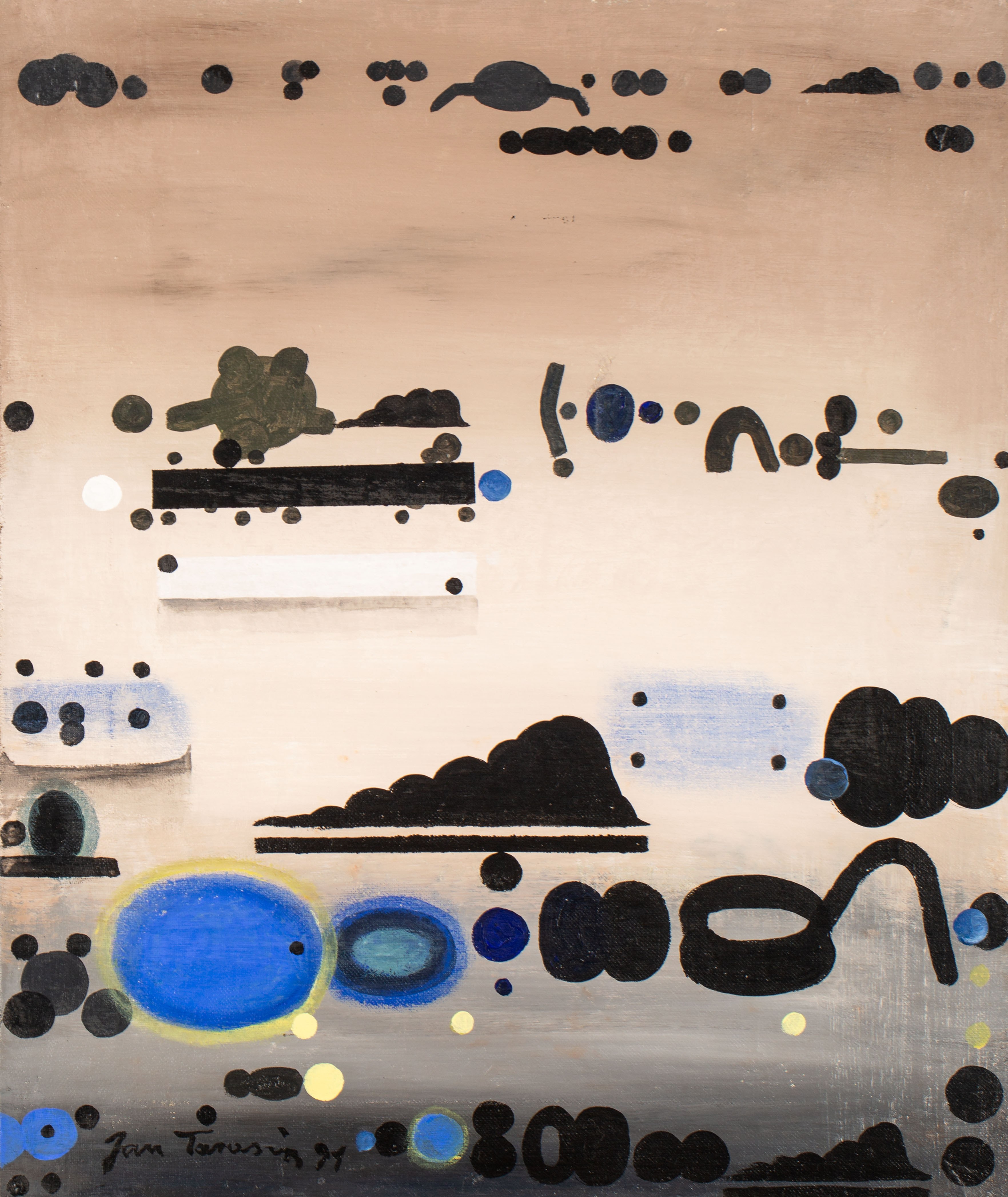

oil / canvas
46 x 37 cm
signed, dated and inscribed on the reverse: 46 x 37 | "Record" Jan Tarasin 91
Jan Tarasin (1926-2009) - painter, printmaker and draughtsman, as well as art theorist and educator. He studied painting at the Academy of Fine Arts in Cracow under Zbigniew Pronaszko and Waclaw Taranczewski, among others. While still a student, he made his debut at the famous First Exhibition of Modern Art in Cracow (1948). He taught at the Warsaw Academy of Fine Arts for many years and held the position of its rector from 1987 to 1990. In 1984 he was awarded the Jan Cybis Prize.
During the First Exhibition of Modern Art, Tarasin presented geometrizing abstractions similar to the explorations of Andrzej Wróblewski at the time, but a decade later his formal experiments led him to develop his own unique style. His works - seemingly non-representational - usually contain references to the real world in their titles(Objects, Situations, etc.). For Tarasin was a keen observer of visible, material reality, but he did not see the role of painting as imitating nature, but rather as an insightful study of its mechanisms and structures. Thus, he simplified actual objects to the level of abstract signs arrayed in rhythmic, harmonious systems. It is not uncommon for them to be arranged in strip systems, reminiscent of musical notation on a stave. Another association is with Far Eastern calligraphy, which Tarasin encountered in the 1960s while on scholarship in China and Vietnam. Undoubtedly, the distinctive characters in his paintings form a kind of symbolic alphabet, read at the level of visual structures.
"I am not looking for a universal formula in my painting, allowing me to order and understand the world. Nor do I chase a unique, ephemeral phenomenon, fascinating us with its uniqueness. What I do is subordinated to the determination of an endless projection of changing phenomena, an endless register of situations and facts subjected in their incessant course to the action of unforeseen cases and circumstances. After all, this incomprehensible, dynamic and open system is the greatest mystery of any phenomenon that has managed to come into existence. For me, painting is that wonderful tool through which we can get as close to it as possible, feel its almost physical presence, get to know it beyond the control of all the ballast of rational barriers. Painting with its concreteness and openness makes our subconscious, intuition, inquisitiveness and all other means of contacting the world have to reveal their discoveries in an extremely concrete and legible way as well. Otherwise painting will not accept them. It is precisely its concreteness and rigor, combined with its almost unlimited ability to penetrate the dense network of our physical and intellectual conditions and limitations, that determines its strength and possibilities, and that is why I paint. "*
* Quoted in Jan Tarasin. Paintings and works on paper. 2005-1959, cat. exhibition, State Art Gallery in Sopot, Sopot 2006, p. nlb.