PROVENANCE:
- private collection, Poland
- Desa Unicum - Auction of 11.10.2018 (item 22)
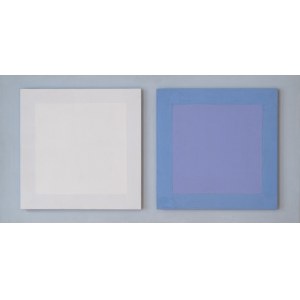
Works by one of the most important creators of geometric painting remain the most sought-after on the market. At the Polswiss Art auction house at this year's auction, his Relief No. 31 of 1973 (61.3 x 61.3 cm) sold for 300,000 zlotys (excluding auction commission). On the other hand, in the same period at the DESA Unicum auction, Relief No. 11 of 1972 (59 x 59 cm) was sold for 280,000 zlotys (excluding auction commission).
Henryk Stażewski, along with Władysław Strzemiński, was one of the pioneers of geometric art in Poland. Both were active in art groups: Blok, Praesens, a.r.. Stażewski was also associated with Marian Bogusz's Krzywe Koło gallery and was one of the founding members of the Foksal Gallery. Geometry, which the artist chose as almost the only way of artistic expression, gave him the opportunity to study pure form and its arrangement in relation to each other. The limited color palette used by Henryk Stażewski can be traced back to the art of Dutch Neo-Plasticism, which was gradually supplemented by color that was often "pure," uniform and expressive. The artist's paintings deliberately did not have texture or painterly structure, focusing only on shapes and their relationships - relationships. Henryk Stażewski also considered as an element of this arrangement the angle at which the viewer views the composition.
"Stażewski's artistic stance derives from two philosophical traditions: rationalism
and absolutism, Thanks to the first, art based on geometric-arithmetic laws was certain of the unlimited possibilities of rational cognition of the world. The second tradition determined the conviction that aesthetics, in the course of its own development, aims at the absolute, Art is able to capture the entirety of the laws of the universe in a single rule."
("Stażewski Internationale", Andrzej Turowski, in Henryk Stażewski. Economy of Thought, Warsaw, 2005, p. 47.)