


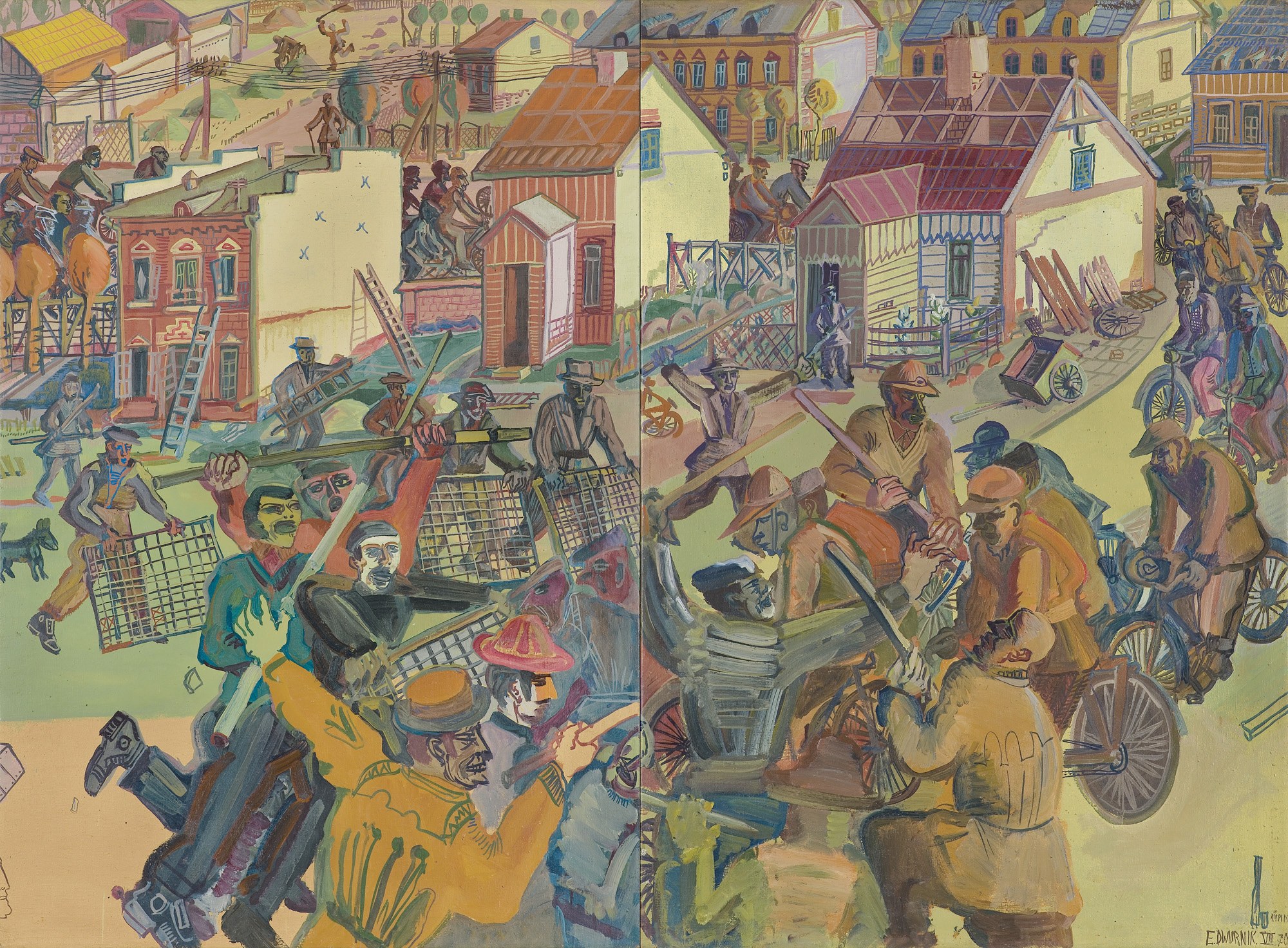
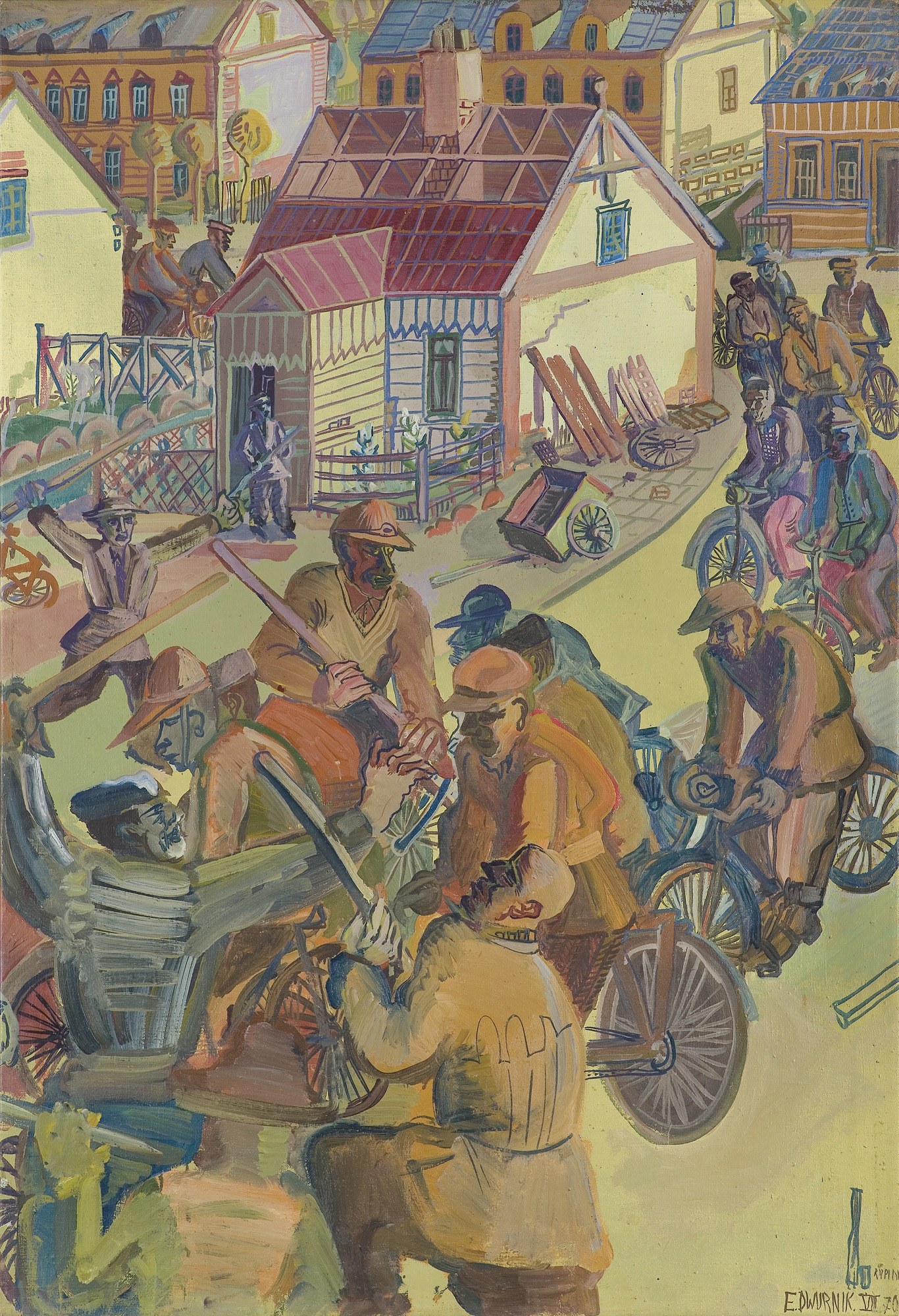
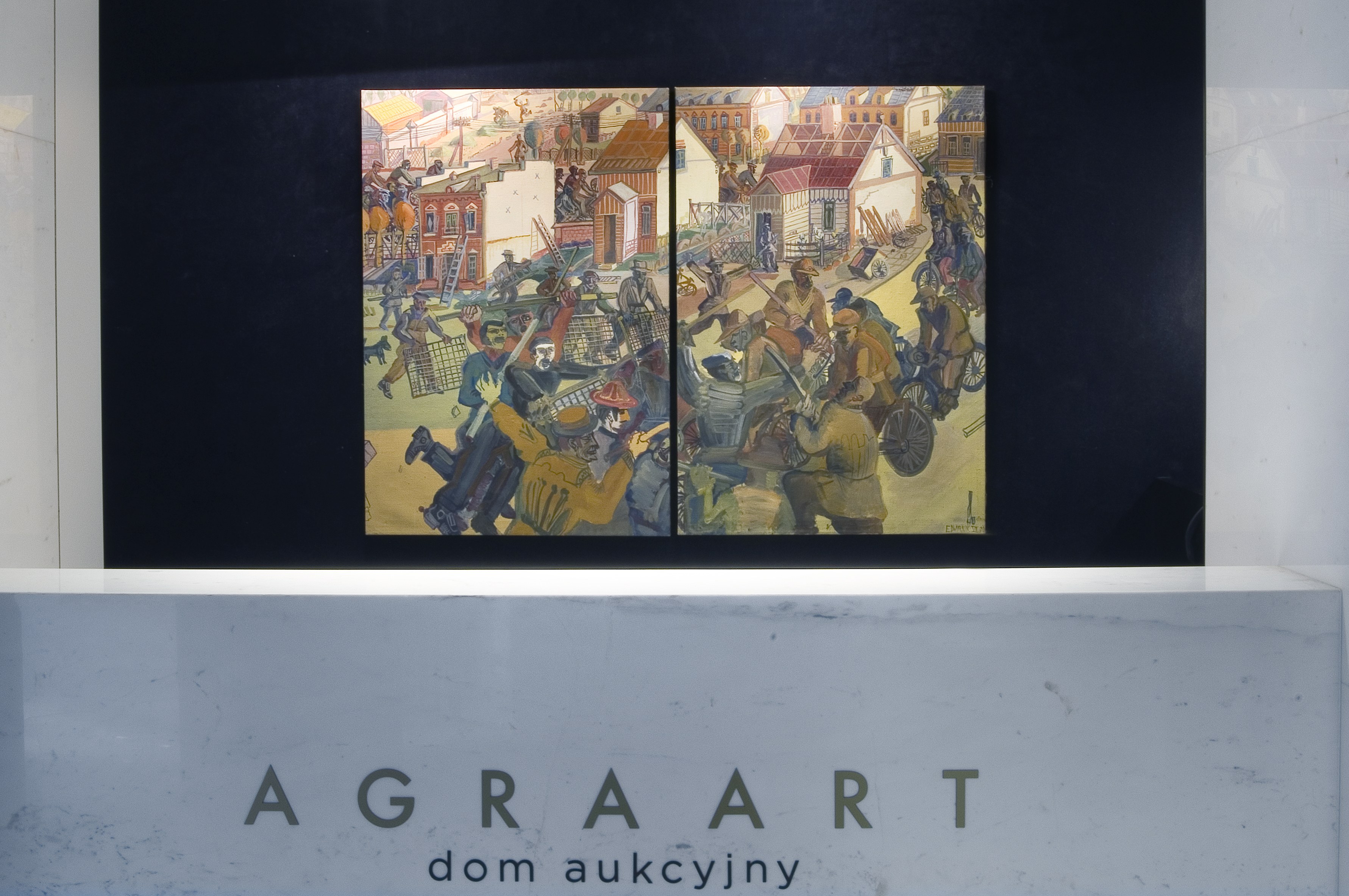
130 x 180 cm - oil on canvas
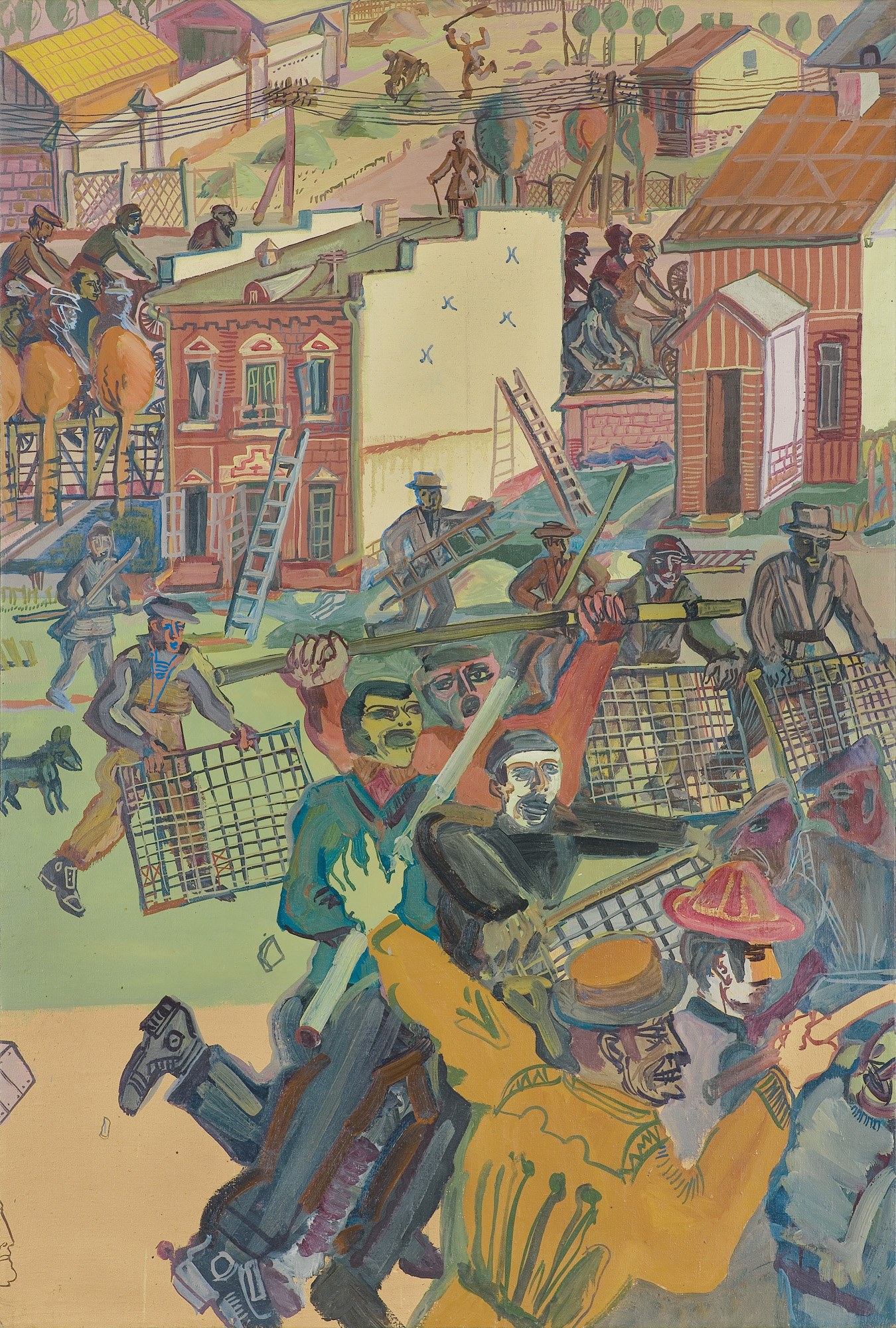
130 x 180 cm (130 x 90 cm – each section)
signed on the back of the lower part: RYPIN | E. DWURNIK. VIII. 70
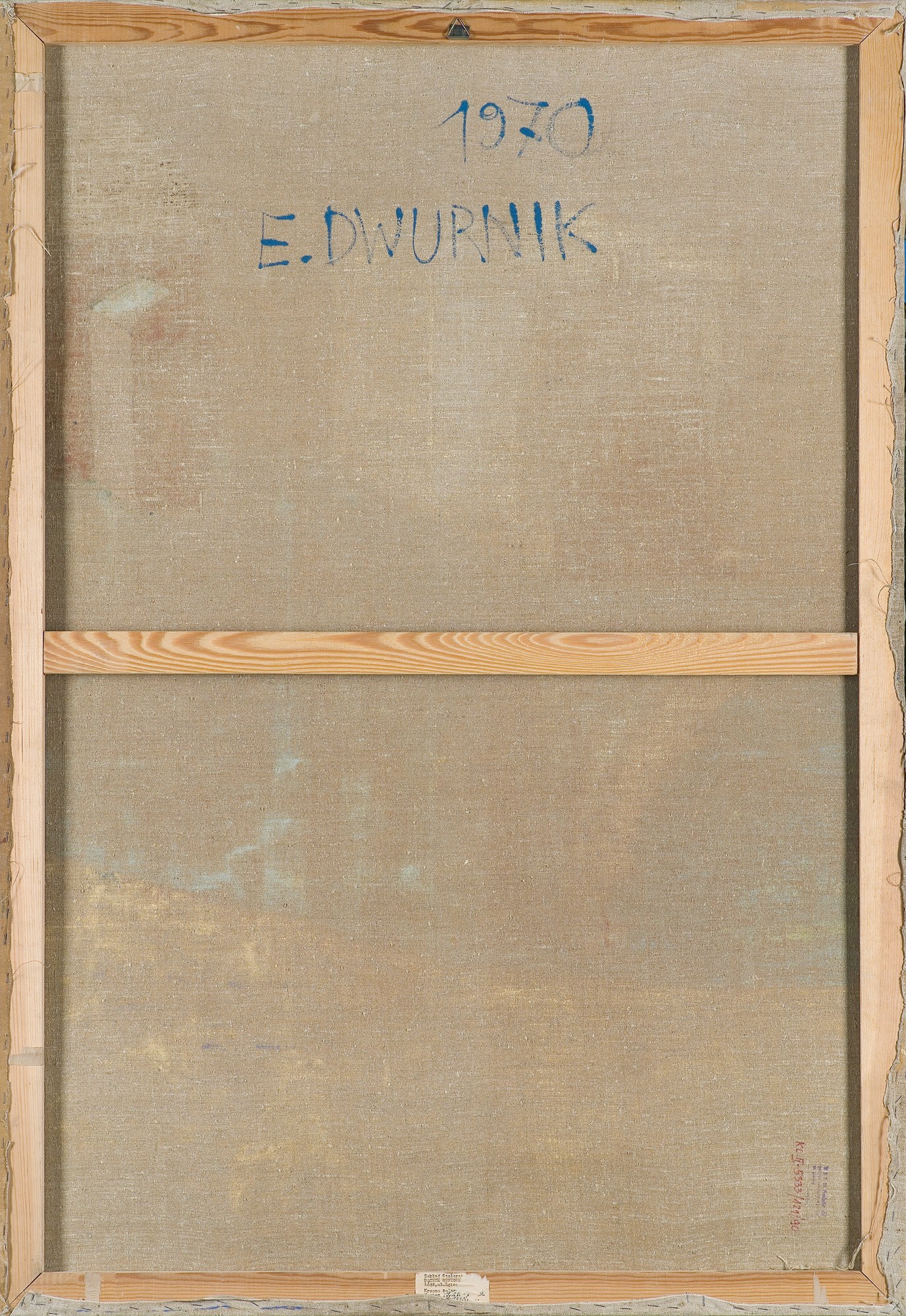
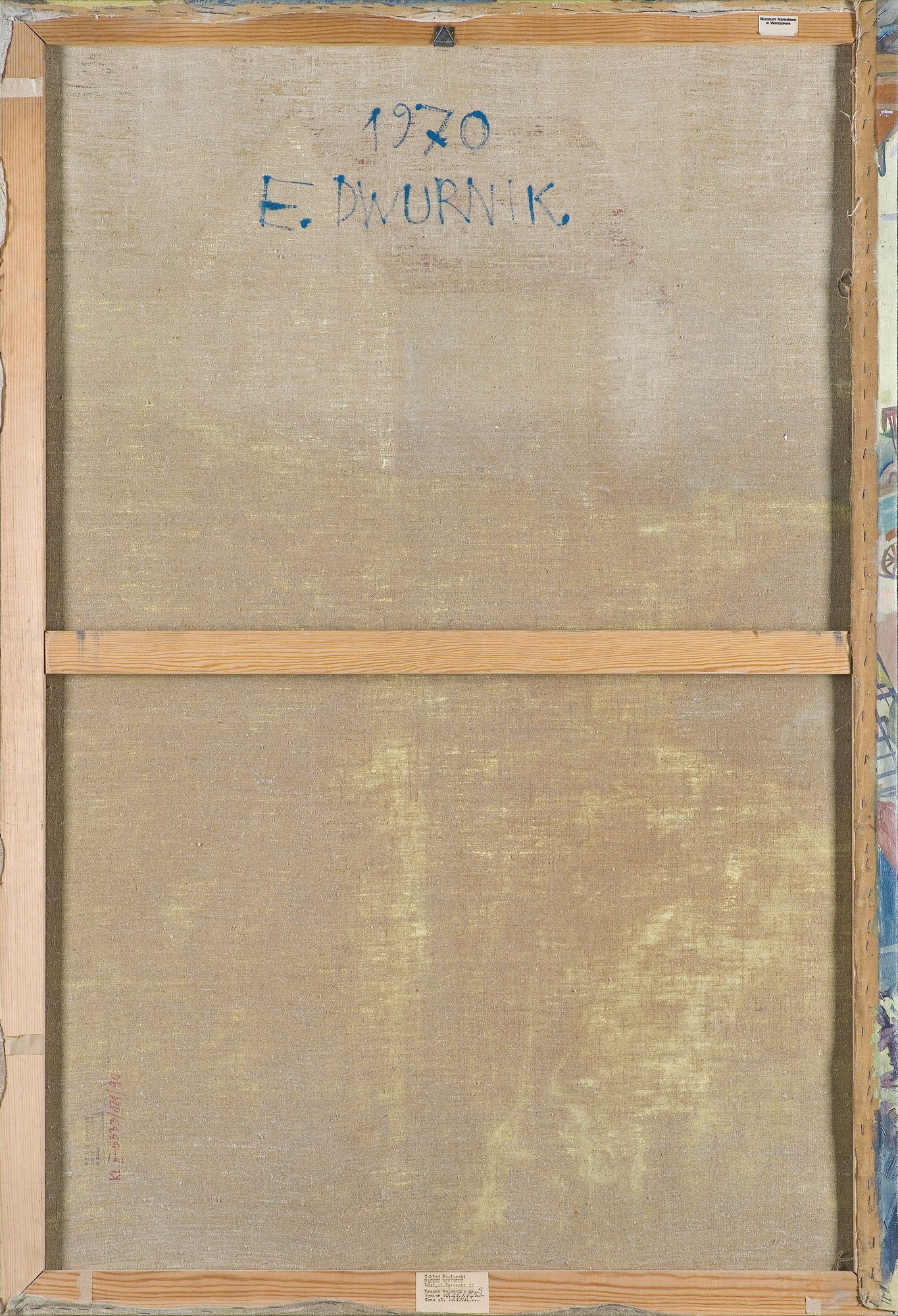
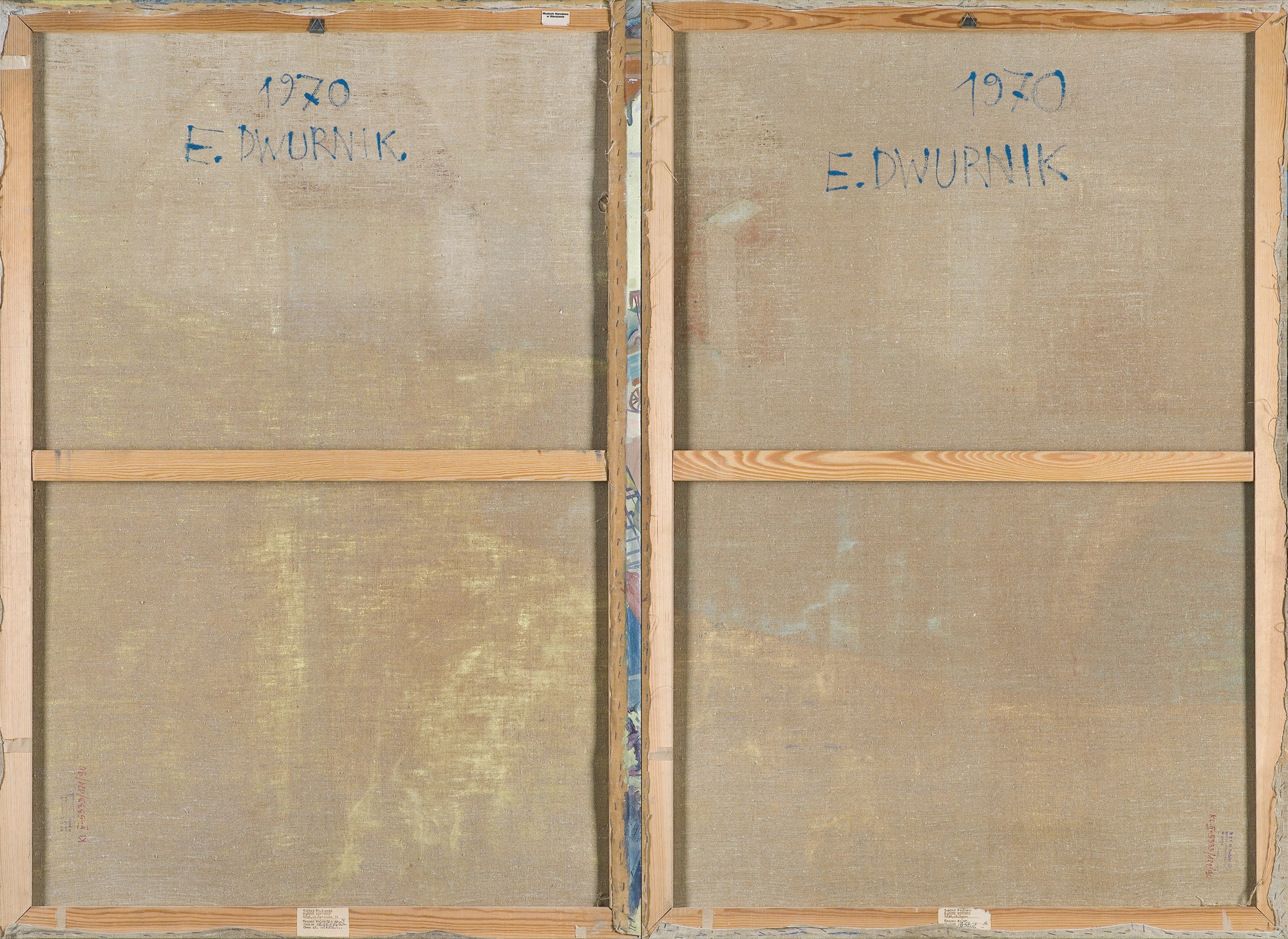
Each panel signed on the reverse, center: 1970 | E. DWURNIK
On the front of the panel, on the top left edge of the stretcher: a printed label reading “National Museum in Warsaw”; on the reverse, on the canvas, on each panel (top left and top right): stamps authorizing export abroad, with permit numbers.
In the work presented at the Rypin auction, one can find all the hallmarks of Dwurnik’s urban landscapes from the People’s Republic of Poland era: a free interpretation of topography, a mixing of scales and perspectives, the absence of a horizon line, and—above all—a street crowd depicted with a journalistic flair, entangled in various genre scenes. At the center of “our” composition is a dramatic brawl: I was constantly drawing and painting brawls. Movement is one of the secrets of painting. Boxing and bodybuilding exercises helped me capture the moment when the unique spirit of a character—one who possesses authentic life—discreetly revealed itself. Because I knew firsthand how to tense my biceps and how to move so as not to fall over or come across as a victim, I was able to transfer the impression of movement onto paper. To that I added attributes from a different world—sometimes I cinched him tightly with a belt, other times I gave him spurs, high boots, breeches, and sunglasses. I drew wars. Most often I drew street brawls; I still have a few drawers full of drawings in which the characters beat each other with fists, sticks, and every kind of weapon (Edward Dwurnik, *Od początku* [From the Beginning], ART Gallery, Warsaw 2016, p. nlb.).
♣ Droit de suite: ♣ A fee resulting from the right of the artist and his heirs to receive remuneration in accordance with the Act of February 4, 1994, on Copyright and Related Rights (droit de suite) will be added to the Purchase Price.
Edward Dwurnik (Radzymin, April 19, 1943 – Warsaw, October 28, 2018) studied painting at the Academy of Fine Arts in Warsaw (1963–1970), though he cites Nikifor as his “master.” It was Nikifor’s works, which he saw for the first time in 1965, that inspired the then-third-year student to create the first pieces in the series “Hitchhiking Journeys,” which he continued in the following years. From 1972 to 1978, he created the “Athletes” series, which portrayed—let’s add—bitingly—typical figures from the 1970s. At the same time, starting in 1975, he created the “Workers” series, which reached its peak during the “Solidarity” period of 1980–1981. For his works in this series, Dwurnik received the Cyprian Kamil Norwid Art Critics’ Award in 1981, while for the paintings from the “Warsaw” series (1981)—which prophetically foreshadowed martial law—he received the Cultural Award from the underground “Solidarity” movement in 1983. In the 1980s, Dwurnik’s painting took on an expressive and dramatic character. The paintings created during this decade often carried political significance and were set in historical contexts, yet always addressed contemporary issues and realities. The series “The Road to the East” (1989–91) commemorated the victims of Stalinism, while the series “From December to June” (1990–94) honored the victims of martial law. Both the ideological and purely painterly merits of these works earned the artist immense recognition, both at home and abroad. This was reflected in the prestigious award from the Coutts & Co. Foundation in Zurich (1992). In the 1990s, he created series that continued the “Hitchhiking Journeys” theme: “Blue Cities” (since 1993) and “Diagonals” (since 1996), as well as new types of compositions, such as seascapes (the “Blue” series, 1992–93) or the “Counting Rhyme” series (1996–99). The artist exhibits frequently; he has had approximately 100 solo exhibitions in Poland and abroad, and has also participated in numerous national and international exhibitions and festivals, including: the 10th Biennale of Contemporary Art, Menton 1974, Documenta 7, Kassel 1982, the 5th Biennale, Sydney 1985, the 19th Art Biennale, São Paulo 1987; and the Art Olympics, Seoul 1988. In addition to painting, he practiced drawing, collage, printmaking (lithography, metal-based techniques, xerography, and stamps), and applied art (illustration and posters for his own solo exhibitions).













Viimeksi katsotut
Kirjaudu sisään nähdäksesi kohdeluettelon
Suosikit
Kirjaudu sisään nähdäksesi kohdeluettelon