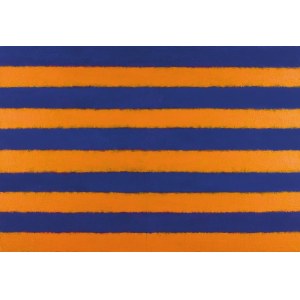
"In the whole artistic attitude of Leon Tarasewicz, not only in painting, there are a number of simple and beautiful convictions, including precisely this one, perhaps not verbally expressed, but imposing itself already at the first contact with his art, that beauty lies in simplicity. Like other truths about Tarasewicz's characters and paintings, this one, too, is essentially modernist in origin. Paradoxically, in an age of postmodern strategies, it is this attachment to modernist order that determines the strength of Tarasevich's art. This is the impression one gets when looking at the extraordinary passion for action and the unflagging belief in the phenomenon of the image as an artificial entity, created by man, but well motivated by the need to confront the outside world. Perhaps it is a romantic trait, or perhaps a manifestation of modern pragmatism, the artist's extraordinary desire to arrive at some resolution - if only it were to fulfill the dream of being able to painterly imitate the luminous juxtaposition of blue and green observed in nature. All this is accompanied by a beautiful in its essence conviction that the creative activity of a person can serve everyone, regardless of the fact that its nature arises from a specific context, such and not other living or cultural space. Perhaps this is a specific characteristic of art. Very local and very universal at the same time. Like Tarasewicz's work, which grew on the foundation of modernist and universal art theory, but in a contemporary way has been subjected to subjectification and regionalization. To put it very poetically, this is modernity tamed - pure painting, in which the trace of a particular man and his land has been imprinted."
Lukasz Gorczyca, February 1999 (...) in: J. Gola, "Leon Tarasewicz," Warsaw 2007, p. 174.
Lukasz Gorczyca, February 1999 (...) in: J. Gola, "Leon Tarasewicz," Warsaw 2007, p. 174.