


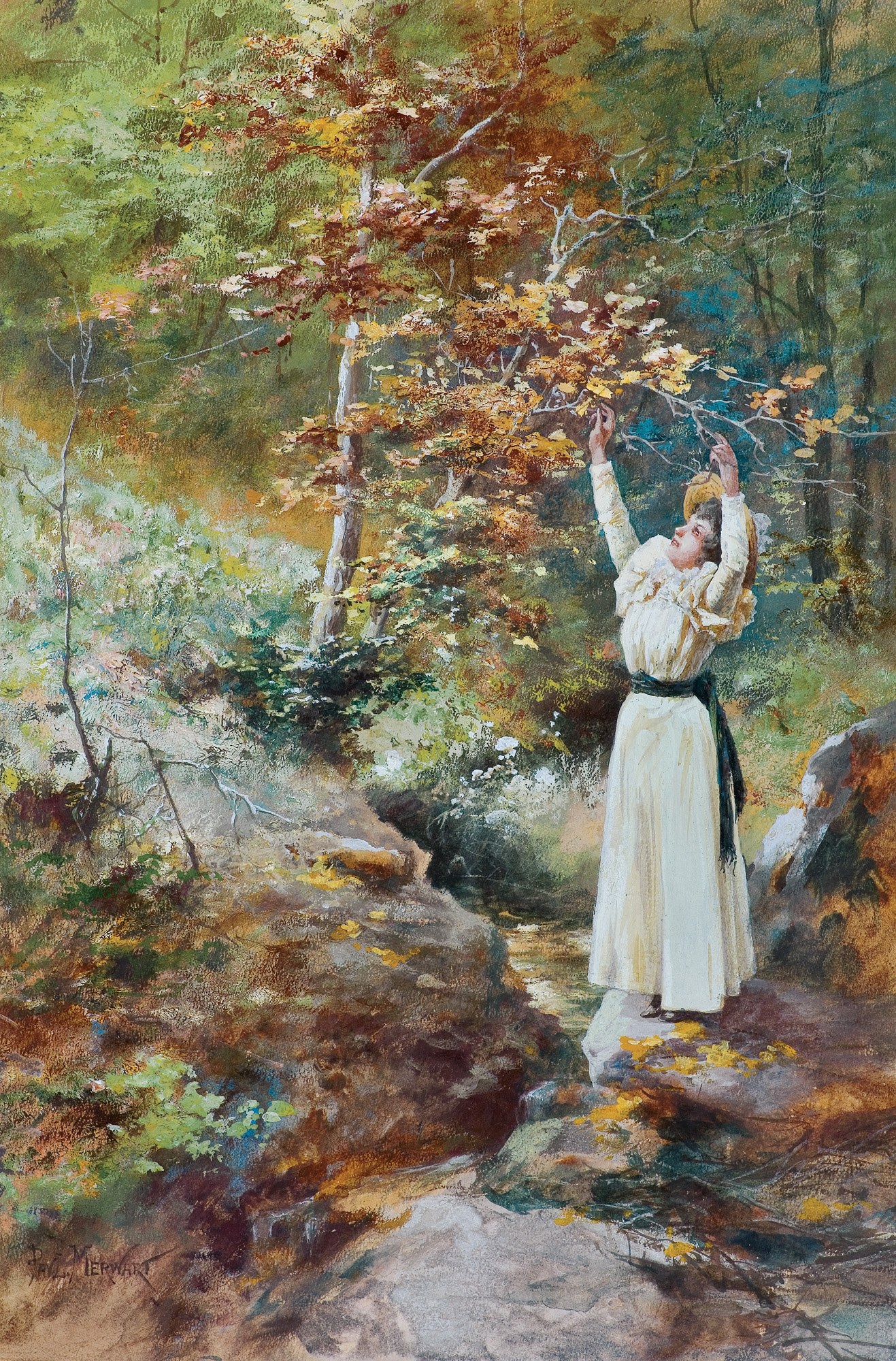
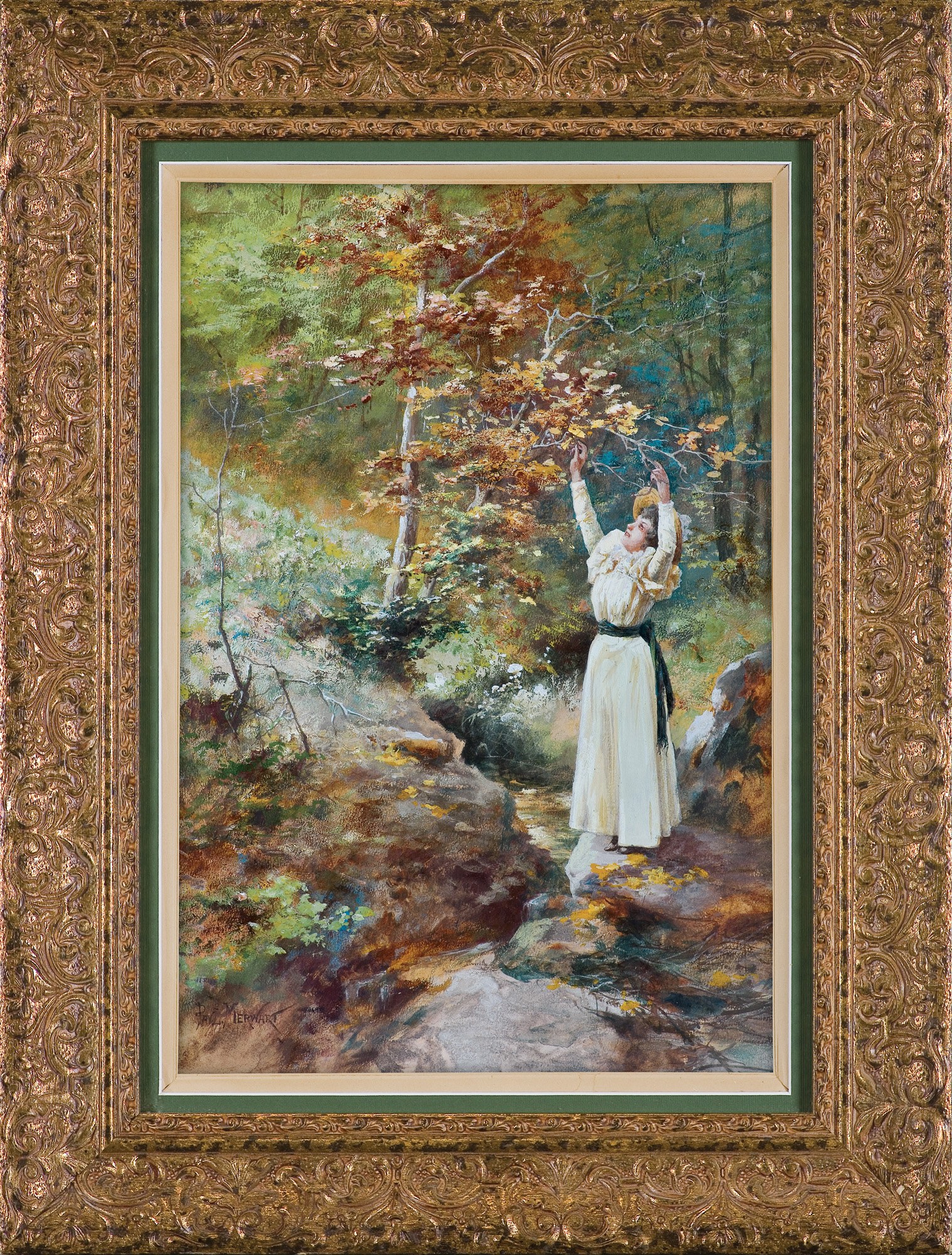
45 x 29.8 cm - watercolor, gouache, oil, paper
watercolor, gouache, oil, paper, 45 x 29.8 cm (inside the mat)
signed lower left: PAVL. MERWART
Paweł (Paul) Merwart (Marianówka, formerly in the Kherson Governorate, Ukraine, 1855 – Saint-Pierre, Martinique, 1902) – came from a Polish-French family; his mother was Polish, and his father was a French soldier who fought in the Crimean War. He graduated from high school in Lviv, where he also began his technical studies, which he later continued in Graz. Wounded in a duel, he traveled to Italy to convalesce and there decided to devote himself to art. He was to begin his studies in painting in Vienna; later, he reportedly studied in Graz, Munich, and Düsseldorf. From 1877 to 1884, he studied at the École des Beaux-Arts in Paris, under Henri Lehman and Isidore A. Pils, among others. His student works were awarded medals on several occasions. Starting in 1882, he worked for the magazine *Le Monde Illustré* and—as an illustrator-correspondent—traveled to Russia and Austria-Hungary. During this trip, he also visited Galicia, including Lviv, Przemyśl, Kolomyia, the Tatra Mountains, and the Carpathians. Around 1884, he became a French citizen and settled permanently in Paris, while remaining actively involved in the life of the Polish community there. In 1878, he participated in the Universal Exhibition in Paris, and in 1879 he made his debut at the official Salon, where he exhibited almost every year thereafter, gaining a reputation as a sought-after painter and portraitist. He exhibited not only in France but also in numerous European cities (including Vienna, London, Prague, Berlin, Brussels, Budapest, and Hamburg) as well as in the United States and French Guiana. He also regularly sent his works to exhibitions in Poland—to Lviv, Kraków, and Warsaw. In 1896, he was appointed painter to the colonial department, likely thanks to the patronage of his brother Emil, governor of the French overseas territories. He traveled to, among other places, the Canary Islands, Senegal, Sudan, the Congo, Tunisia, Mauritania, and Somalia. In April 1902, he sailed to Martinique as a member of a government commission investigating the Montagne Pelée volcano. He died during its eruption on May 8, 1902.
He was a versatile artist—he painted in oils, watercolors, and pastels; worked in printmaking and fresco; and was an excellent draftsman and illustrator. The subjects of his works included, among others, biblical scenes (“The Young Moses”), scenes inspired by literature (“Sarah” – “The Flood”), portraits of famous figures (Helena Modrzejewska as Mary Stuart) and beautiful women (the so-called “gallery of beauties”), genre scenes, and, finally, paintings with exotic motifs created during his numerous travels.













Viimeksi katsotut
Kirjaudu sisään nähdäksesi kohdeluettelon
Suosikit
Kirjaudu sisään nähdäksesi kohdeluettelon