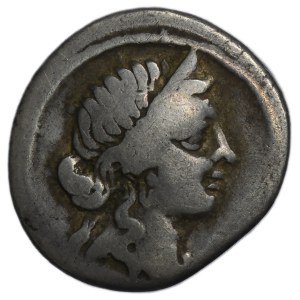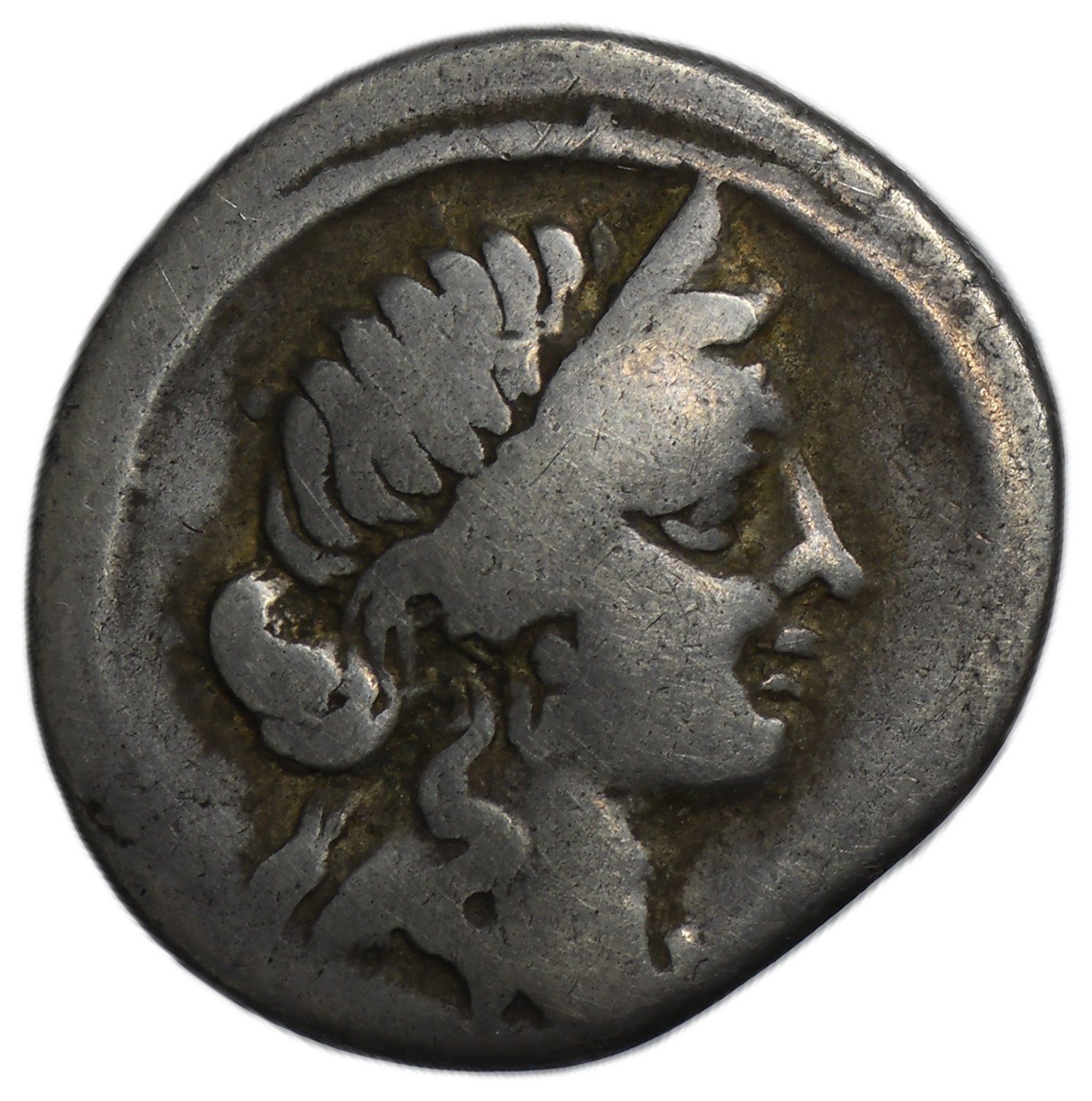


An exceptionally interesting and highly symbolic issue of Julius Caesar, in which the myth of the origins of the Julian family was employed as a direct instrument of political legitimisation. The denarius was struck in 47–46 BC, during the final phase of the Civil War, when, following his victory over Pompey at Pharsalus, Caesar was forced to confront Pompey’s supporters, who had regrouped their forces in Africa.
Following the defeat at Pharsalus and the death of Pompey, the war did not come to an end. Caesar’s principal opponents concentrated their forces in Africa, where they received support from the Numidian kingdom of Juba I. Among the leaders of the Pompeian faction were Quintus Caecilius Metellus Scipio and Marcus Porcius Cato. Caesar came to Africa to deal decisively with his opponents, and the campaign culminated in his victory at the Battle of Thapsus in 46 BC.
It is within the context of this campaign that the present denarius should be understood. Its iconography, however, does not depict contemporary events or another military trophy. Instead, Caesar reached much further into the past, invoking the myth of the Trojan origins of his own family.
The obverse depicts Venus, the goddess whom Caesar regarded as the divine ancestress of the Julian family.
The significance of this image derived from the genealogy claimed by the Iulii. According to Roman tradition, the family traced its descent from Iulus (Ascanius), son of the Trojan hero Aeneas. Aeneas himself was the son of Anchises and the goddess Venus. Caesar could therefore present his family as possessing not merely an exceptionally ancient lineage, but one of divine origin.
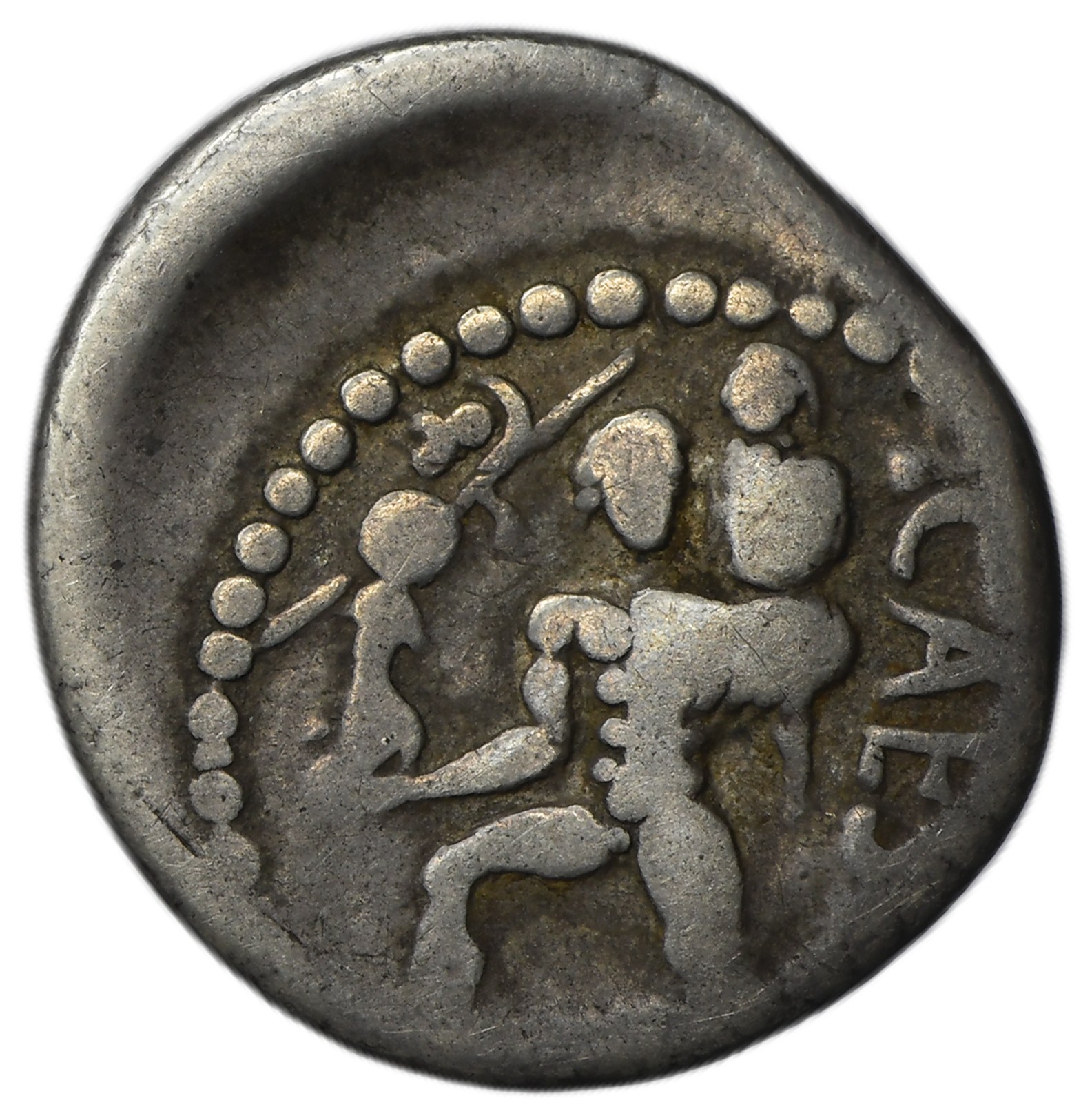
The reverse is even more evocative. It depicts Aeneas fleeing from Troy, carrying his elderly father Anchises on his shoulder. In his other hand he holds the Palladium, the sacred image associated with the protection of Troy. This identification of all three elements of the composition is given by Crawford and is also followed by the catalogues of the British Museum, ANS and Rutgers University.
The scene belonged to one of the most important episodes in the Roman myth of Aeneas. The hero does not abandon the burning city merely to save his own life. He rescues his father and the sacred legacy of Troy, carrying its heritage towards a new homeland. Aeneas thus became the embodiment of pietas, the fundamental Roman virtue expressing duty towards the gods, family and community.
The combination of the two sides of the coin creates an exceptionally coherent message. Venus was the divine mother of Aeneas, Aeneas the ancestor of Iulus, and Iulus the progenitor of the gens Iulia. The reverse bears only a single word, CAESAR. The viewer was therefore invited to connect the mythological narrative directly with the issuer himself.
The choice of iconography was by no means accidental. During the Civil War, Caesar consistently emphasised his special relationship with Venus. This religious and genealogical message enabled him to present his position as deriving not only from military success and the offices he held, but also from the exceptional heritage of his family. The coin thus became an instrument of political communication, distributed in enormous numbers primarily among the soldiers and other participants in the campaign.
Particularly noteworthy is the fact that the issue was struck during Caesar’s lifetime, yet his own portrait does not appear on the obverse. Instead of his own likeness, Caesar employed the image of Venus, marking his presence through his name on the reverse. Only later, in 44 BC, would his portrait appear on Roman denarii struck during his lifetime, representing one of the most significant turning points in the iconography of Republican coinage.
The present denarius is therefore much more than a coin from one of Caesar’s military issues. Within this small silver flan is encapsulated the entire story of the ancestry of the Julian family – from Venus, through Aeneas and Iulus, to Caesar himself. In the realities of the Civil War, this constituted a remarkably powerful message: the issuer presented himself not merely as a victorious commander, but also as the heir to one of Rome’s most ancient and prestigious mythological traditions.
Roman Republic
Julius Caesar (47-46 BC), Denarius 47-46 BC
Obverse: head of Venus right
Reverse: Aeneas walking left, carrying palladium and his father Anchises, on the right CAESAR
Diameter 18 mm, weight 3.67 g