


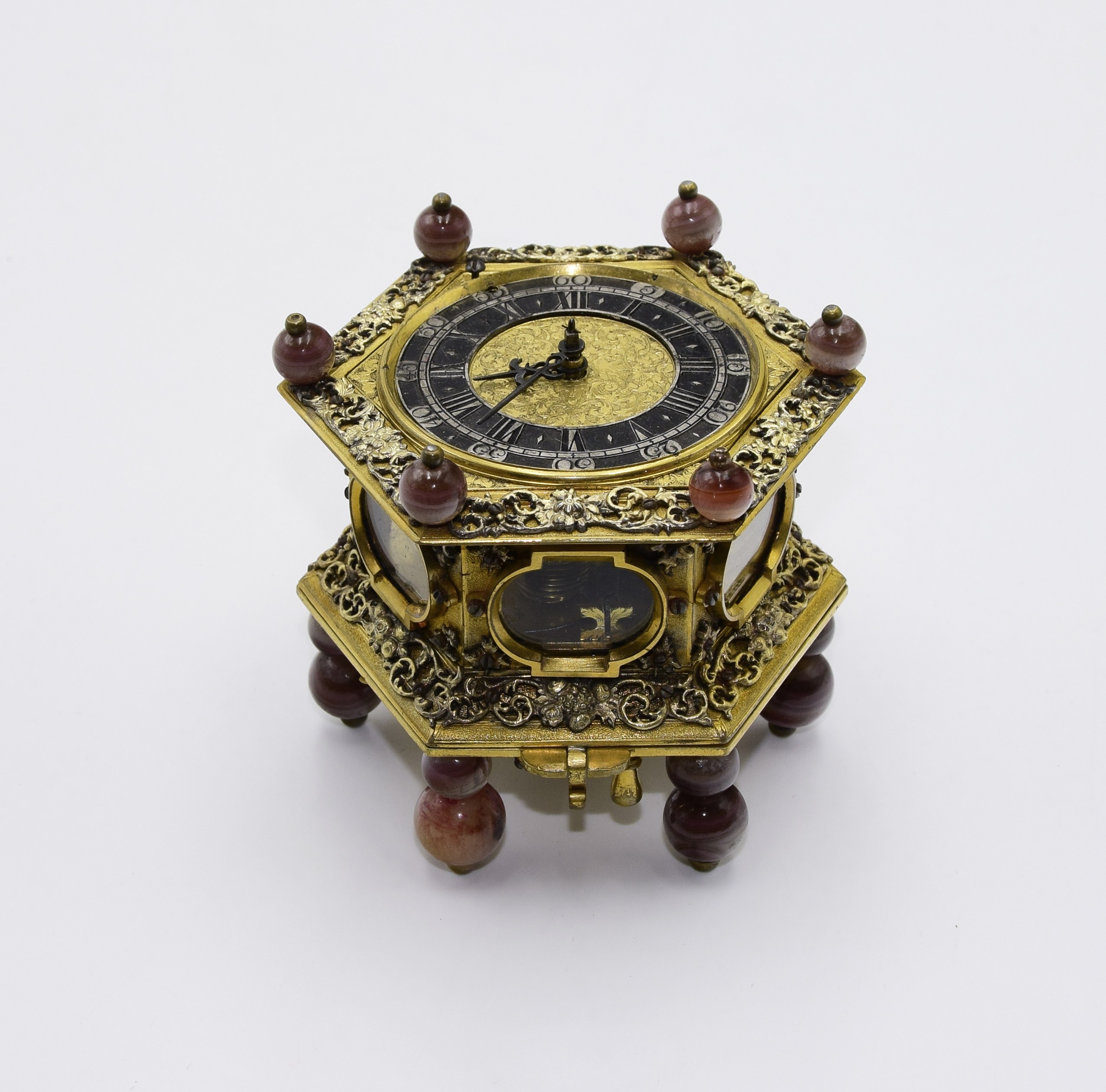
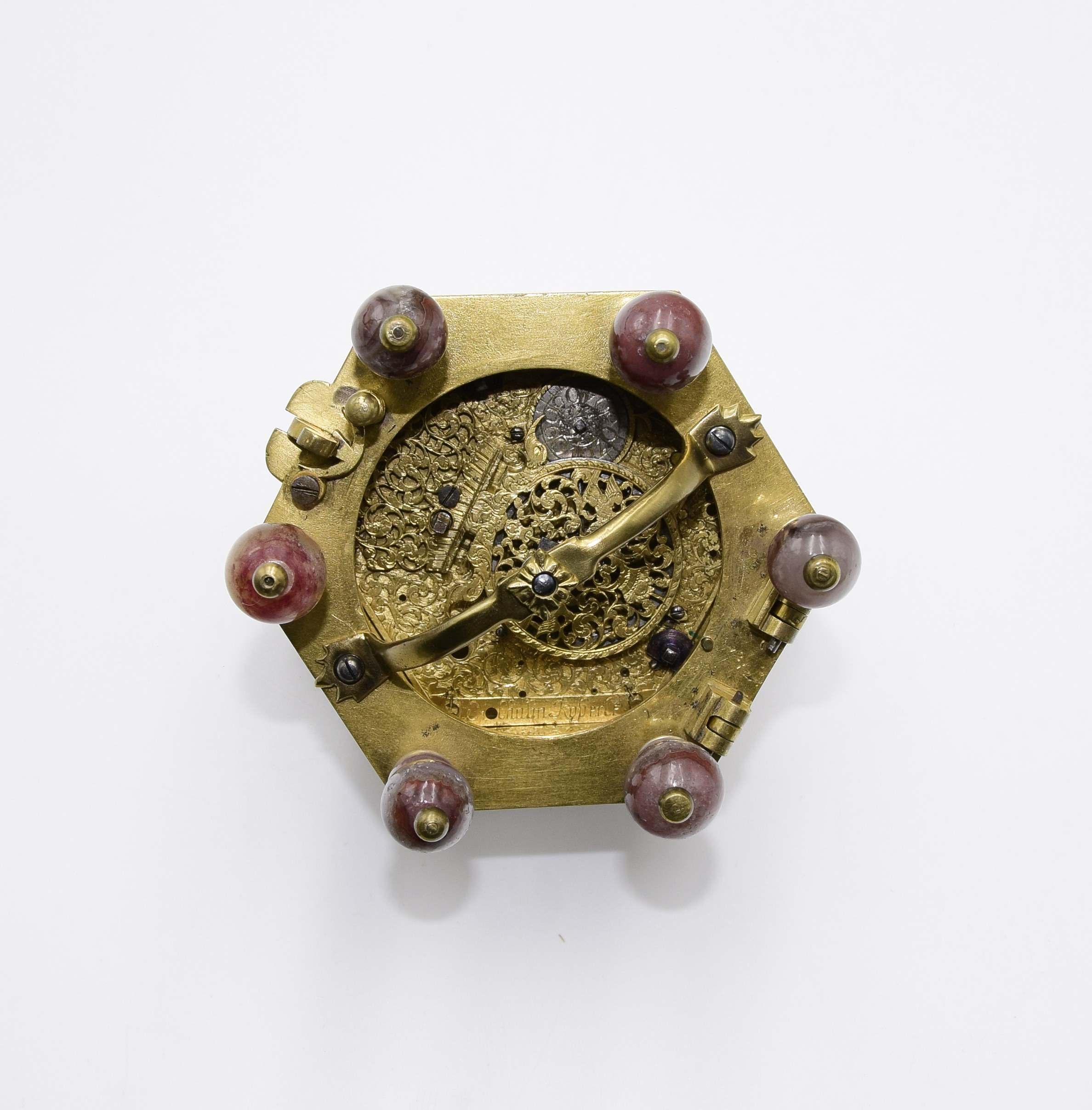
engraved grotesque on a grosgrain background, composed of acanthus and ribbon ornament with a vase and an Indian head (?) placed on the axis of symmetry, as well as birds in an antithetical arrangement. The corners of the dial decorated with a motif of stylized acanthus leaves. Hands of patinated steel, spade-shaped, at the base decorated with two channel bars passing into loops. The mechanism with a brass skeleton, with plates joined by four pillars in the form of tapering columns. Gait drive with compensating worm and Gallic chain. The beating device is not preserved. Spinel escapement with balance regulator. Gilded bottom plate, richly decorated with an engraved ornament of acanthus tendrils on a striated background. Similar ornamental motifs decorate the openwork foot of the chignon. The chignon is of the English type, filled with openwork acanthus volutes, into which are incorporated birds, a vase and a stylized crown. Balance hair regulator in the form of a rotating silver-plated dial with a scale (01-06). Preserved key in the form of a lyre decorated with an engraved oblique grille and acanthus leaves, with two pins at the ends.
State of preservation: the devices of the striking section, bell and hammers are missing.
Clocks in a hexagonal case with a characteristic window design were made by many clockmakers starting from the 1st quarter of the 17th century.
The surviving tiled clocks by Köberle have hexagonal cases and an analogous slit pattern on the sidewalls (the exception is a clock from the collection of the Rundäle Palace in Pilsrundäle, Latvia, with an atypical body that was completely covered, probably in a later period). Also characteristic of Köberli clocks are the carefully worked cornices, either engraved or, as in the case of the clock in question, decorated with an applied silvered vise, strikingly contrasting with the gilded background. The skillful handling of contrasts is also evident on the clock face, where a silver-plated, partly blackened non-null digital ring cuts away from the gilded, richly acanthus-engraved center of the face. The digital rings mounted in Köberli's "tiles" are very similar: blackened with silvered, irregular reserves for the numerals and minute scale. What draws attention, however, are the unusual legs made of agates, uncommon in tiled clocks. They are certainly not an original element, as are the finials on the corners of the dial. However, it is difficult to determine in what period they were installed. All Köberle clocks are distinguished by a beautifully worked lower plate with engraving and acanthus thread openwork covering the entire surface, and a bun often decorated with grotesque masks and birds among acanthus or acanthus thread.
Wilhälm Köberle was born around 1848 in Wasserburg on Lake Constance. He was active in Eichstätt from 1680 to 1715, and married in 1688. He died in 1720. [Abeler 2010, p. 304; Britten 1977, p. 428].
He mainly made tile clocks, but also carriage clocks and watches. His products are in museum collections, min. British Museum in London (pocket watch, inv. no. 1958.1201.654), the Iparművészeti Múzeum in Budapest (two tile clocks, inv. nos. 53.794.1, 52.2279.1), the Rundale Palace museum mentioned earlier, and well-known collections, such as the Abbott Guggenheim in New York [collection for sale at Christie's auction house, auction 3712, two tile clocks, items 94, 95].
Köberli clocks are also frequently auctioned at well-known auction houses such as Christie's, including a watch in a double envelope [online auction 19729, item 216], Dorotheum [tiled clock in leather case, auction 26.04.2018, item 736), Auktioneers Dr. Crott [carriage clock, auction 105 of 13.X1.2021. item 91], as well as in the well-known antique shop specializing in the sale of clocks of various eras Mentink & Roest in Ingen, the Netherlands [tiled clock, no. M&R 212].








Viimeksi katsotut
Kirjaudu sisään nähdäksesi kohdeluettelon
Suosikit
Kirjaudu sisään nähdäksesi kohdeluettelon