


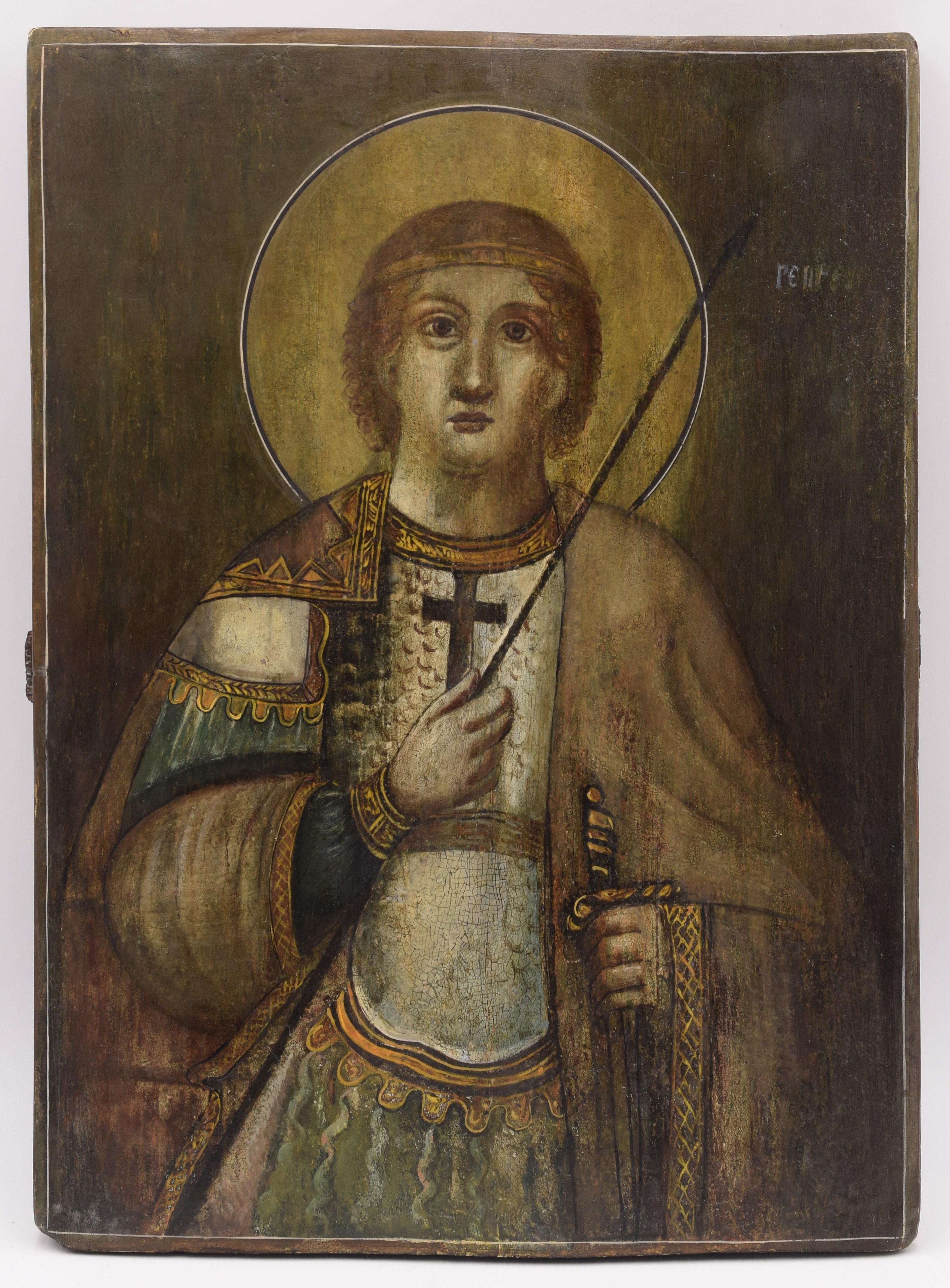
tempera, wood panel, chalk-gypsum ground; 43.5 x 32.2 x 2.3 cm;
back of the icon—one sponge.
Russia, 19th century
An image of Saint George in a three-quarter frontal view, a youthful knight in armor and a red cloak, holding a spear in his right hand and a sword in his left, with his hair tied back with a headband. On the right, at the level of the uniform nimbus, explanatory inscriptions in Cyrillic.
Since early Christianity, soldier-martyrs have played a special role in strengthening the spirit of the nation. Among the great soldier-martyrs, one of the most popular was Saint George the Victorious (Pobiednosiec). He died after being tortured in 303, during the reign of Emperor Diocletian. His name (from the Greek “georgos”) means farmer, though he is better known as the patron saint of knighthood and the Grand Duchy of Moscow. In Byzantium, he was counted among the great Holy Knights, along with Demetrius, Procopius, and Theodore.
The widespread veneration of Saint George is evidenced by the countless churches dedicated to him. Georgia, a strong center of early Christianity in the Caucasus, takes its name, Georgia, from Saint George.
The icon’s field is framed by a white line and a light band.








Viimeksi katsotut
Kirjaudu sisään nähdäksesi kohdeluettelon
Suosikit
Kirjaudu sisään nähdäksesi kohdeluettelon