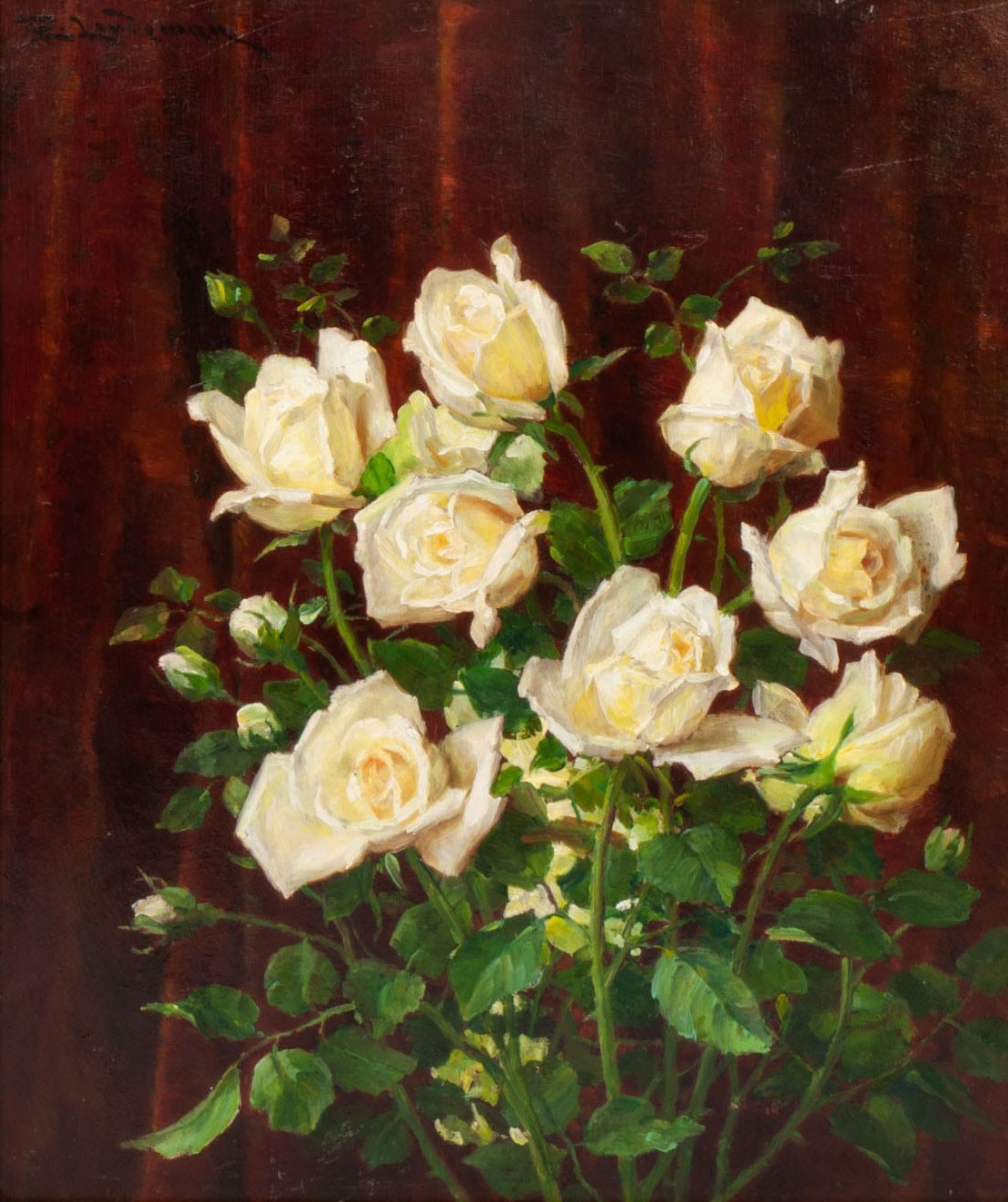
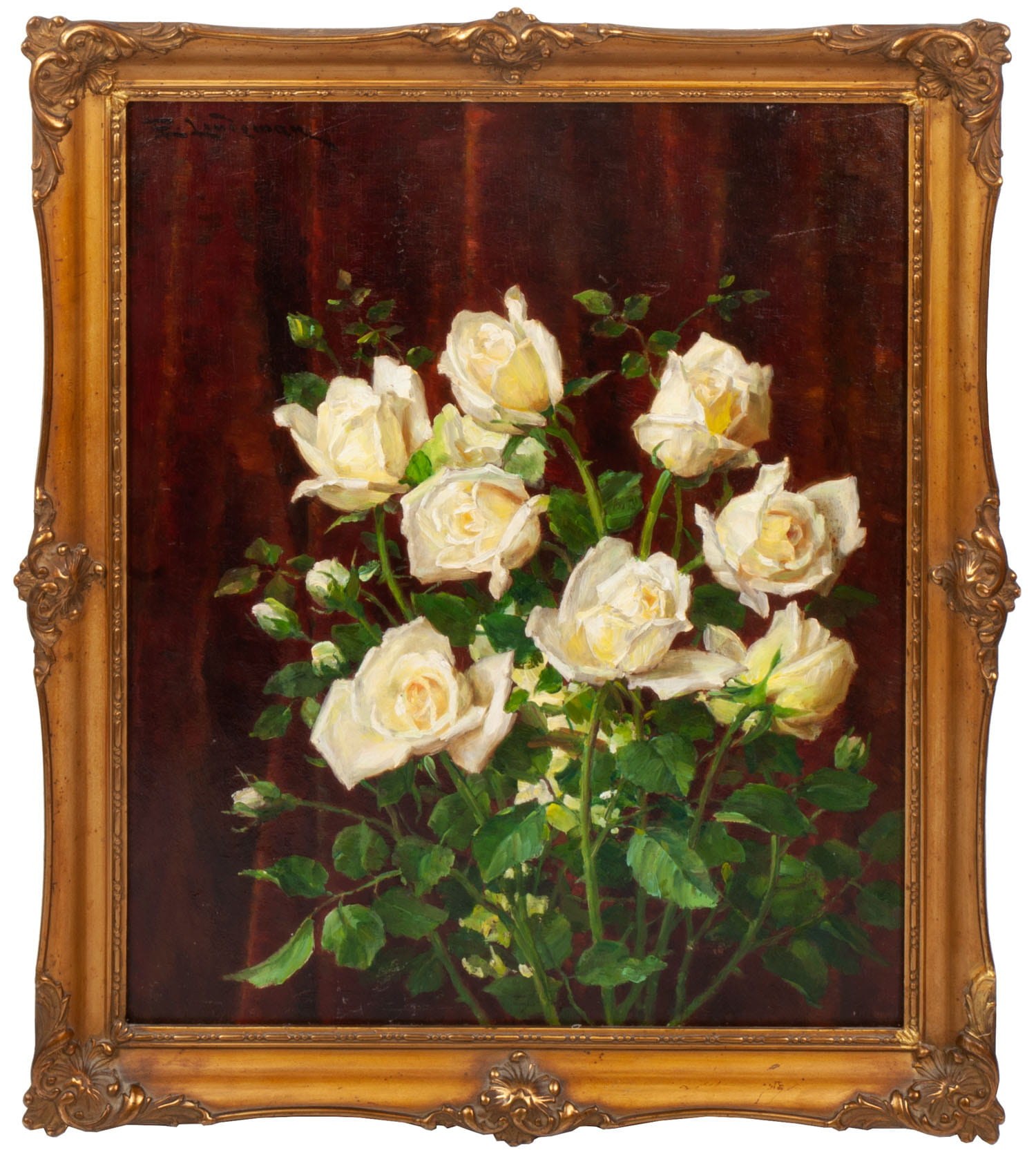
Oil on board, signed l. g. "E.Lindeman."
Dimensions in frame: 53x45 cm (45.5x37 cm)
Emil Lindeman (Lindemann) (Warsaw 1864 - 1945 (?) Ozorków) - Polish painter. He began his drawing education from the Warsaw Drawing Class, run by Wojciech Gerson, where his works were awarded a letter of commendation from the Academy of Fine Arts in St. Petersburg as part of a state drawing school competition. After graduating from Warsaw in 1887, he went to Cracow where he studied for two years at the School of Fine Arts in the studio of Jan Matejko. Under the guidance of the eminent master, he took part in work on the polychrome in St. Mary's Church. In the fall of 1890, he left for Paris, where he studied at the École nationale supérieure des beaux-arts and at the Académie Julian under William-Adolphe Bouguereau and at the Academie Collarosi under Raphaël Collin. While in the French capital, he sent his painting "Castle Square" to the competition of the Illustrated Weekly in 1893 and was awarded first prize. He traveled around Italy, stopping for extended stays in Naples and Rome, where he studied at the Royal Institute of Fine Arts, before going to Russia and staying in St. Petersburg. In 1897 he returned to Warsaw and focused on his work as a painter, printmaker and illustrator. He was involved in easel painting, created polychromes (such as the polychrome of the presbytery in Kielce's Cathedral of the Assumption of the Blessed Virgin Mary) and wall paintings (in St. Anne's Church in Warsaw, Holy Spirit Church in Kadzidle, St. Theresa's Church in Vilnius and the White House in Warsaw's Lazienki Park). He illustrated books and magazines and created poster designs. He exhibited his works at the Society for the Encouragement of Fine Arts, the Alexander Krywult Salon, the Art Salon and the Salon of Czeslaw Garlinski. He also participated in exhibitions organized in Vilnius, Lviv, Katowice, Lublin, Czestochowa, Poznan, Gdynia and by the Cracow Society of Friends of Fine Arts. He also exhibited in Germany, Great Britain and the United States. Emil Lindeman created oil paintings and watercolors, characterized by their small size. Their subjects were landscapes, views of coastal beaches, flowers and still lifes. When painting landscapes, he immortalized views from Vilnius, the environs of Warsaw, Naleczow, Krynica and Wolyn. They also show the suburbs of Polish and European cities. Less often he created genre scenes, and in his old age he often painted flowers and still lifes. It should be mentioned that on many occasions Emil Lindeman was involved in the restoration of frescoes. After the outbreak of World War II, he and his relatives stayed in Ozorków, where he probably died in 1945.