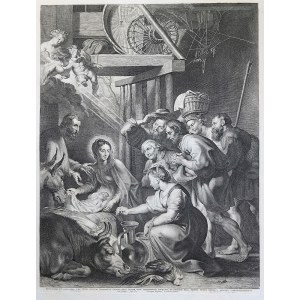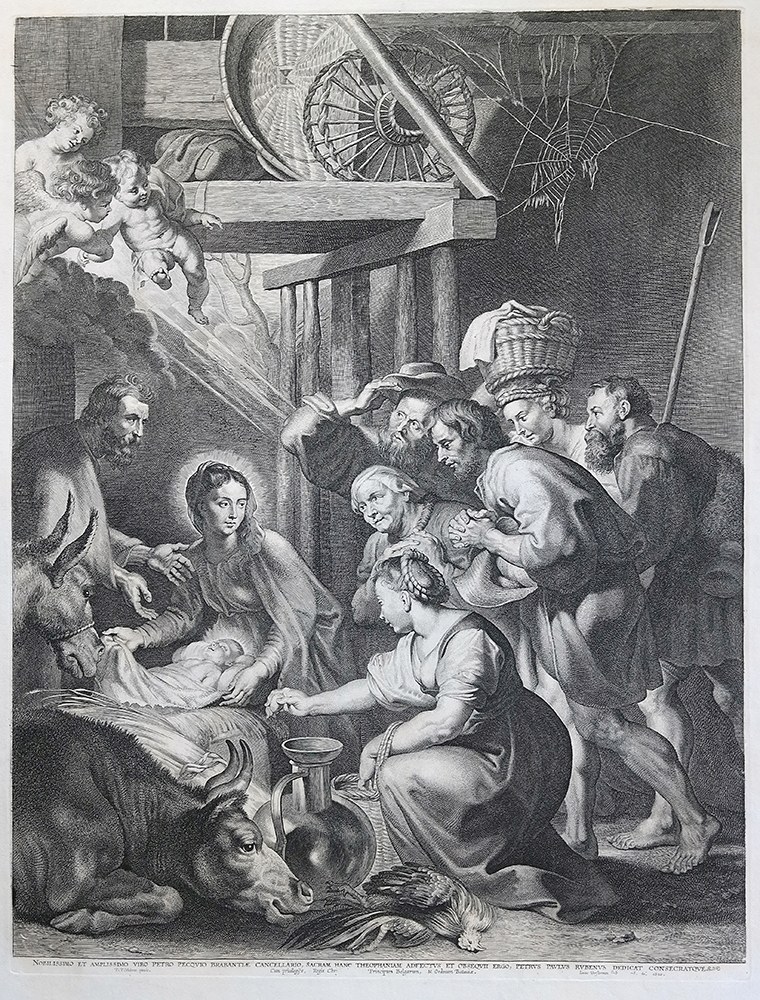
copperplate/ribbed paper, pasted on sheet of paper, 68.8 x 53.5 cm, plate 58.7 x 44.6 cm,; dedication directly below composition: NOBILISSIMO ET AMPLISSIMO VIRO PETRO PECQVIO BRABANTIÆ CANCELLARIO, SACRAM HANC THEOPHANIAM ADFECTVS ET OBSEQVII ERGO, PETRVS PAVLVS RVBENVS DEDICAT CONSECRATQVE; on the left-hand side signature: P. P. Rubens pinxit.; in the middle publisher's privilege: Cum privilegijs, Regis Christianissimi, Principum Belgarum, & Ordinum Batauiæ. ; on the right the signature of the engraver: Lucas Vorsterman sculp. et excud. An.° 1620.
very good condition
LITERATURE:
- Hollstein's Dutch and Flemish Etchings, Engravings and Woodcuts, ca. 1450-1700, vol. XLIII, Roosendaal 1993, p.14, item 6; Rubens' works in Dutch graphics of the 17th century from the Graphic Collections of the Library of the Polish Academy of Sciences in Cracow, Łódź 1976, pp.76-77, cat. 192; https://www.britishmuseum.org/collection/object/P_R-3-39 (accessed 28.02.2025)
This engraving is an example of the excellent technique of the engraver, who managed to bring out the unique chiaroscuro effects of the Rubensian nocturne. It appears in one condition referred to in the literature as avec la lettre. Lucas Vosterman the Elder was an illustrator, engraver and publisher. He was considered one of the best engravers working for Rubens. He broke off this collaboration in 1622 and set up his own studio, obtaining the privilege of the Archduchess Isabella of Austria to publish engravings for six years. In 1624, he went to London and then stayed in Paris. He returned to Antwerp in 1630 and was still to work for Rubens around 1638. His pupils included his son Lucas Vorsterman II and Paul Pontius.
P.P. Rubens' painting Adoration of the Shepherds is in the collection of the Musée des Beaux-Arts in Rouen. The preparatory drawing for the engraving, retouched by Rubens, is kept in the Louvre, while the matrix itself is in the Stedelijk Prentenkabinet at the Plantin-Moretus Museum in Antwerp.