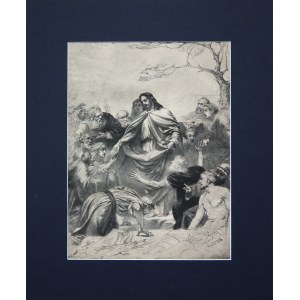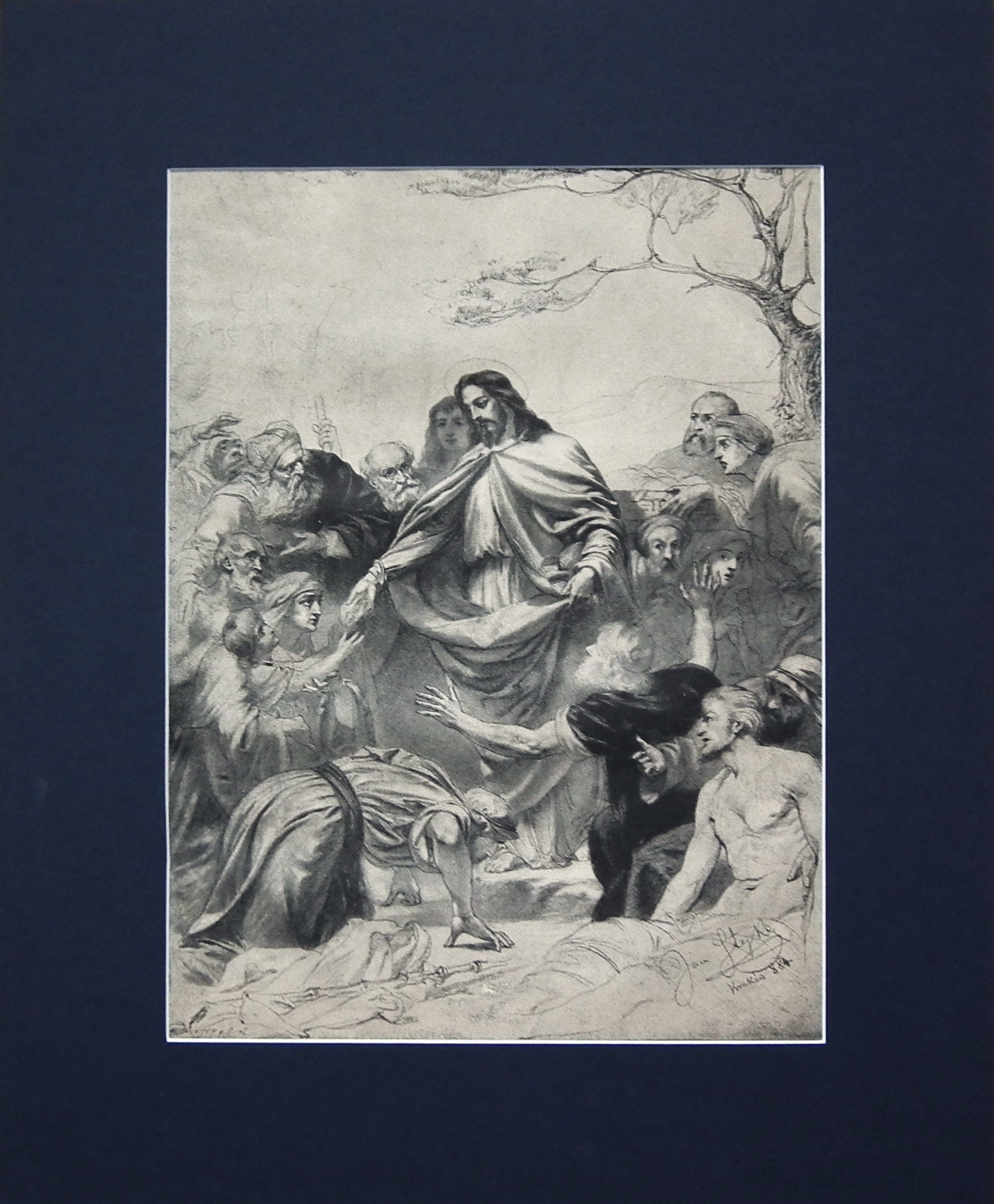
Rotogravure, paper, 30 x 23 cm in light passe-partout, signed and dated on panel p.d. "Jan Styka Kraków1884".
Jan Styka (born April 8, 1858 in Lviv, died April 28, 1925 in Rome) - Polish painter, book illustrator. He studied at the Academy of Fine Arts in Vienna, later in Rome, Paris, Krakow (under Jan Matejko). After his studies he settled in Lviv, where he had a studio. From 1888 to 1890 he lived in Kielce in a palace on Karsch Hill. From 1900 he settled in Paris, and from 1910 in Italy (on the island of Capri). Together with the Polish pilgrimage, he was in audience with the Pope on April 11, Holy Saturday. On the morning of April 28, 1925, he was found dead in bed. He painted historical, religious and battle paintings. He painted four panoramas:
1894 - together with Wojciech Kossak, the well-known Panorama of Raclawice originally exhibited in Lviv, now in Wroclaw,
1897 - Panorama of Transylvania (painting also called Bem - Petőfi) - survived in fragments. Found and identified parts are in Poland (including Tarnow)[3], USA, UK,
1896 - a religious-themed panorama entitled Golgotha (also known in English as "The Crucifixion" - Crucifixion) considered the largest religious-themed painting in the world. It is now in Forest Lawn Memorial Park, Glendale, near Los Angeles, California, and the panorama "The Martyrdom of Christians in Nero's Circus."