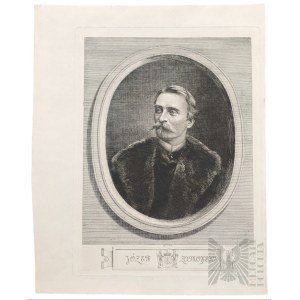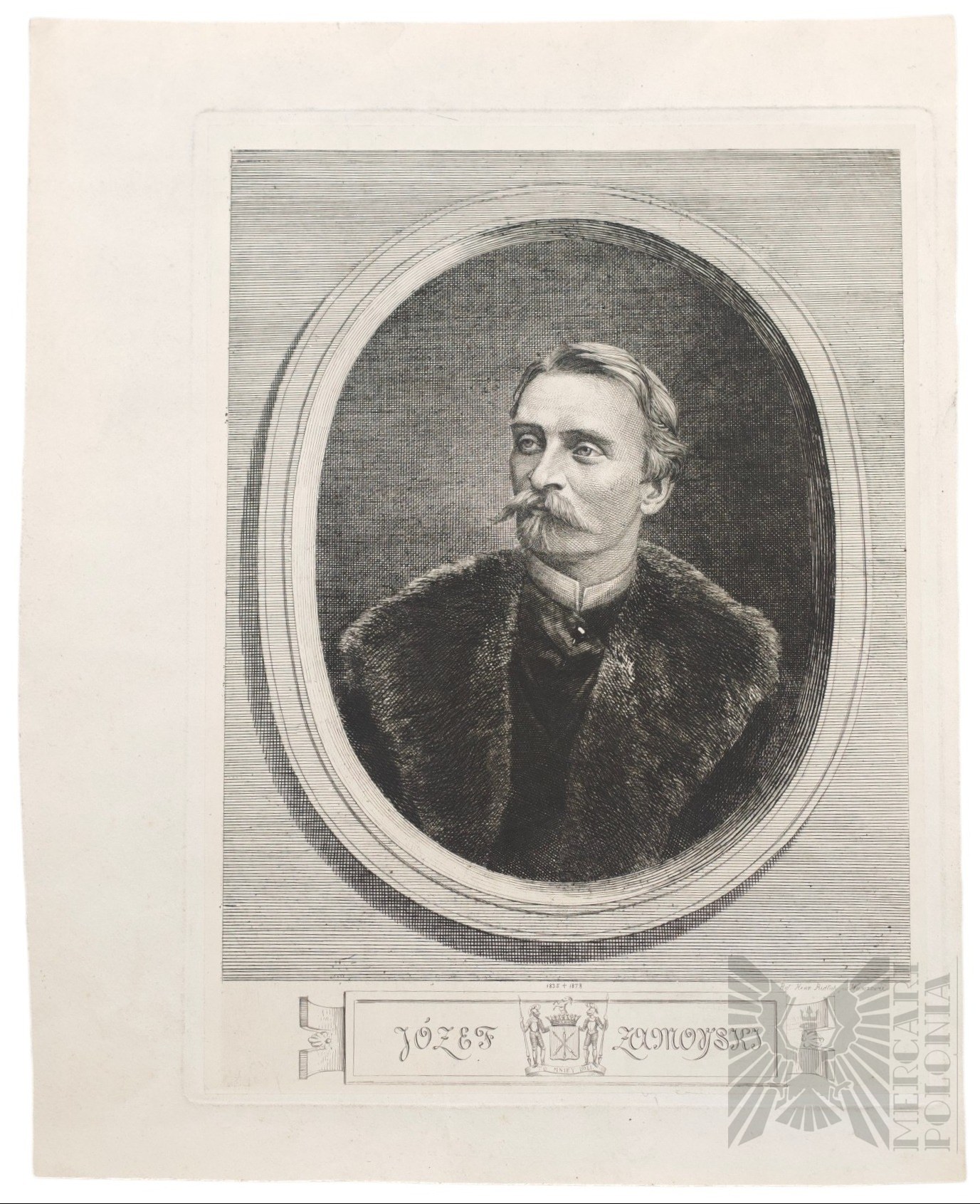
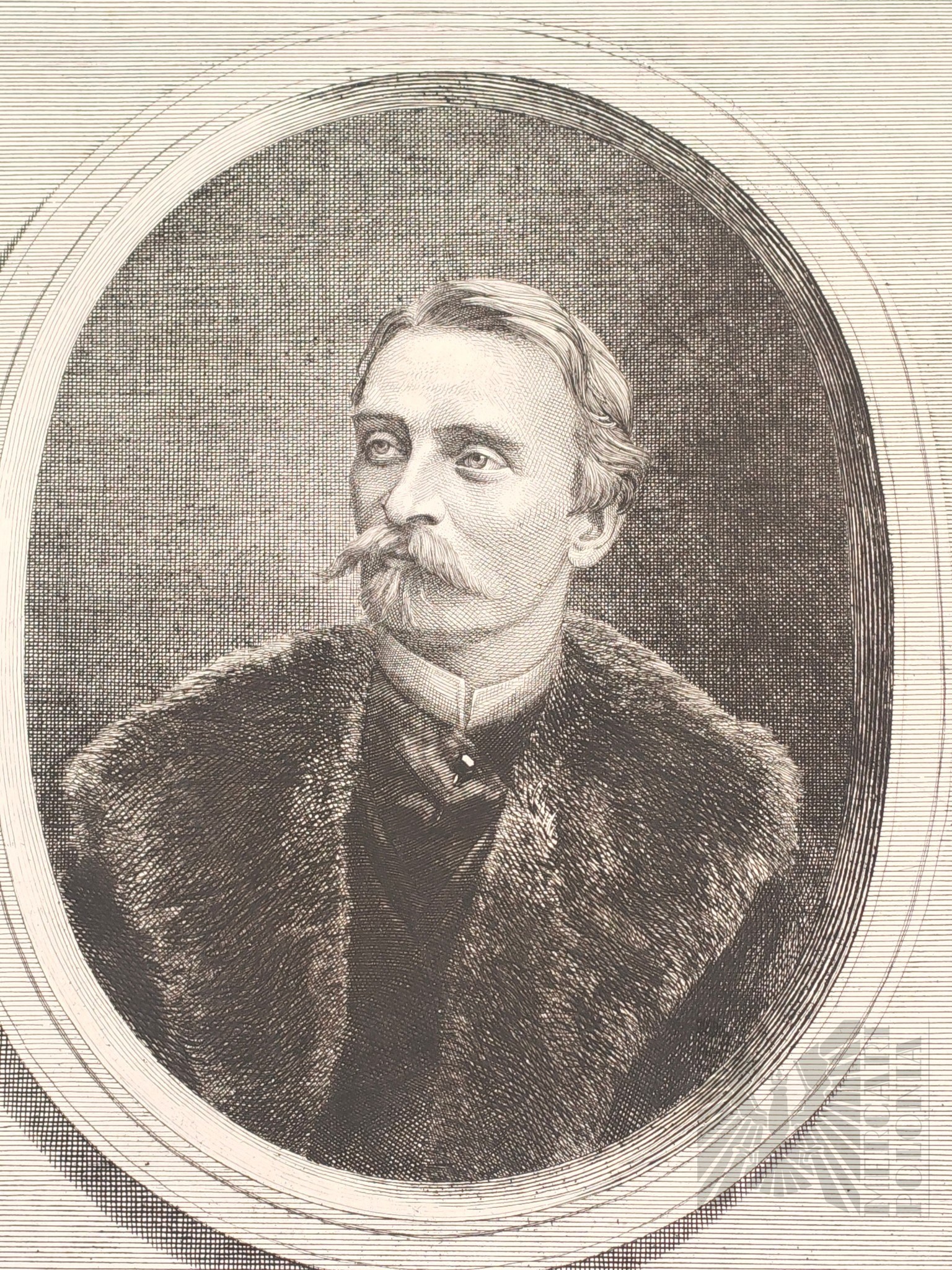
Portrait of Count Józef Zamojski (1835–1878), son of Konstanty Zamojski; below the portrait is the Zamojski-Jelita coat of arms with the motto “To mniey boli.” An engraving by the master engraver Henryk Redlich, created after Józef Zamojski’s death. Signed in the lower right corner. An identical engraving is on display at the Zamojski Museum in Kozłówka.
Paper
Dimensions: 33.5 x 26–27 cm; print size: 28 x 20.5 cm
Condition as shown in the photos.
Henryk Redlich (1838–1884)—a Polish printmaker, draftsman, and illustrator, primarily associated with Warsaw, and one of the most important figures in illustrative printmaking in Poland during the second half of the 19th century. He studied at the School of Fine Arts in Warsaw, where he acquired a solid foundation in drawing and composition. He then honed his skills abroad, including in Paris, which was at the time one of Europe’s most important artistic centers. Redlich specialized in press and book graphics—he created illustrations for magazines, literary works, and popular publications. He collaborated with the Warsaw press, creating engravings depicting genre scenes, social events, as well as cityscapes and folk types. His works were characterized by attention to detail, a realistic approach to the subject, and an ability to capture the mood of the scenes he depicted. He was active in Warsaw’s artistic circles, belonging to a generation of artists who—like the representatives of Positivist literature—contributed to documenting and popularizing social life during the period of the Partitions. His work also had cognitive and educational value. He died prematurely in 1884. He left behind numerous illustrations and engravings, which today serve as a valuable iconographic source for the history of 19th-century Poland and bear witness to the development of commercial art during that period.
Redlich’s body of work also includes a portrait of Józef Zamojski; this portrait is part of the 19th-century practice of disseminating images of members of the social and political elite. Redlich’s portrait of Zamojski depicts him as a representative of the aristocracy and landed gentry—emphasizing the model’s dignity, solemnity, and social status. Such depictions served not only a documentary purpose but also a prestigious and educational one, introducing the audience to figures important to public life under the partitions.
“Józef Zamoyski was born on May 4, 1835, in Klemensów. He was the youngest son of Konstanty Zamoyski, the 13th heir to the Zamość estate, and Aniela née Sapieha. He graduated from Burry Saint Edmonds College in East England, and after returning to Poland, he refined his command of the Polish language. Above all, however, he received his education in the chancellery of the Zamość estate. He soon began managing his mother’s estates on his own. These were the Sielec estate in the Pruzhany District and the Jundziłłowice estate in the Słonim District. In 1856, he left for Italy and then for Paris to study law. He later settled permanently in Poland. For a time, he served as head of the administration of the Zamość entailed estate, but he resigned from this position in 1868 and devoted himself to managing his own estate. In 1866, Józef Zamoyski purchased the estate in Stara Wieś in the Nowomynsk County [today, this area is part of the village of Kołbiel in the Otwock County]. There, he built a beautiful Neo-Renaissance palace surrounded by a park, designed by Leandro Marconi. He also established a model farm covering an area of over 2,000 hectares. Józef Zamoyski was held in high esteem and respect among the peasants. Józef Zamoyski was also a breeder of excellent racehorses, and from 1864 to 1867 he served as president of the Warsaw Racing Society. He also sought to support domestic industry and the economy. He was active in circles of the aristocracy, entrepreneurs, and financiers. “He supported the Warsaw sewer system project, as well as all undertakings aimed at the common good.” One of his most significant achievements was the establishment, together with Leopold Kronenberg and Prince Jan T. Lubomirski, of the Credit Society of the Capital City of Warsaw. Józef Zamoyski became president of this Society. He was also vice president of the Commercial Bank, founded by Leopold Kronenberg. He took an active part in organizing the Lilpop, Rau, and Loewenstein Industrial Society. He obtained a concession to build the Vistula Railway and served as manager and one of the shareholders of the Cotton Goods Factory Company in Zawiercie. Józef Zamoyski’s involvement also extended to the spheres of culture and education. In 1875, together with Jan Lubomirski, brothers Ludwik and Jakub Natanson, and K. Dietrich (the Hielle and Dietrich trading house), he helped establish the Museum of Industry and Agriculture in Warsaw. He also collaborated—among others—with Jan Lubomirski, Ludwik Krasiński, and Leopold Kronenberg on the editing of the *Encyclopedia of Agriculture and Related Topics*, published in Warsaw in the 1870s. Józef Zamoyski died in Warsaw on October 23, 1878, at the age of 43, following a brief but severe illness. The count’s body was transported to Zamość by rail—a railway line that had been built thanks to his efforts. He was buried in the family tomb at the Zamość Collegiate Church” (biography of Józef Zamoyski, source: the Zamoyski Museum in Kozłówka).