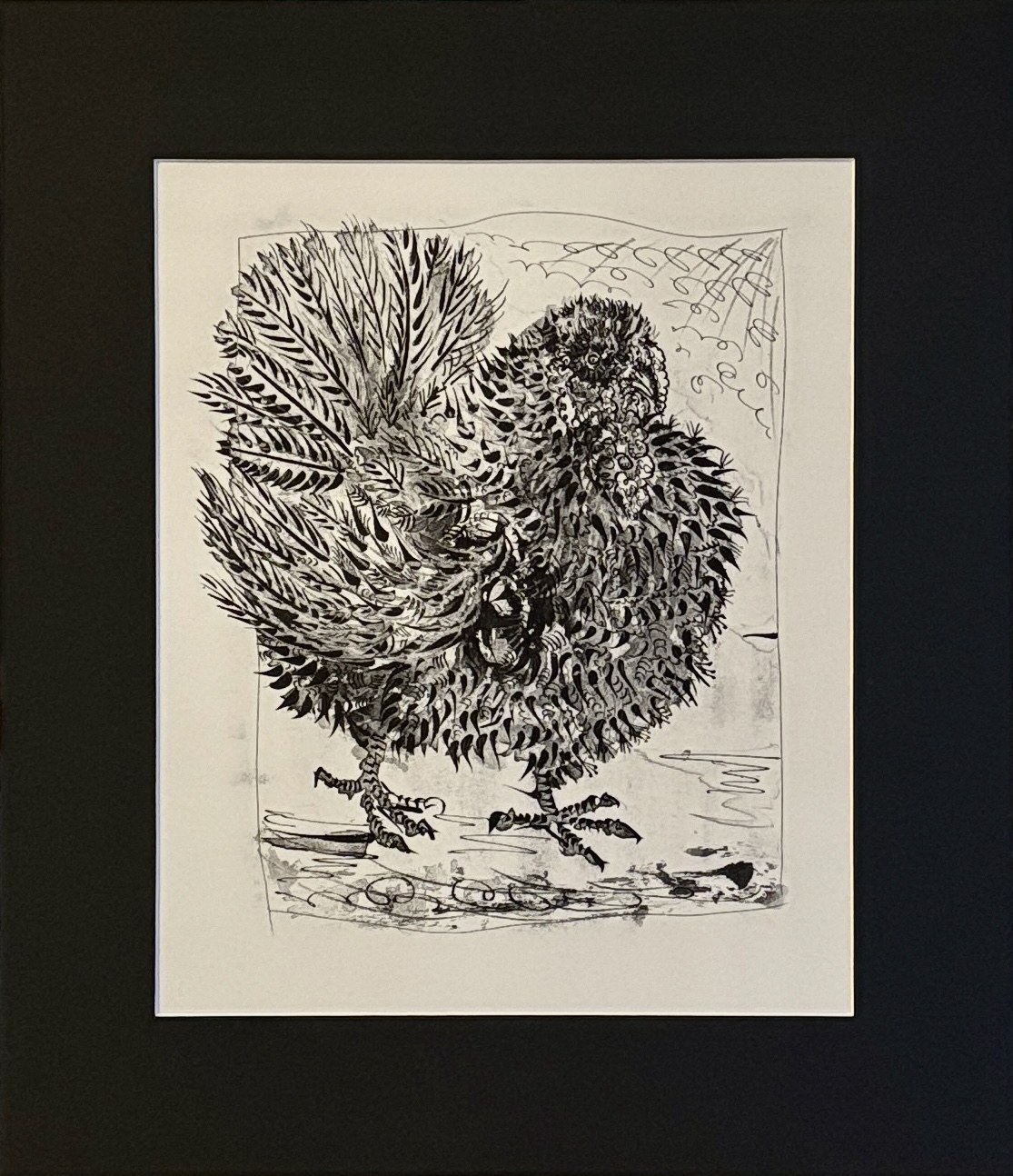
Lithograph; Casteljoux paper (350g); 30 x 24 cm (inside the mat), which measures 37 x 30 cm;
In 1931, the famous art dealer Ambroise Vollard suggested—and in 1936 commissioned—that Picasso illustrate Georges-Louis Leclerc, Count de Buffon’s *History of Nature, General and Particular* (1707–1788), originally published in forty-four volumes between 1745 and 1804. Picasso, who was an animal lover, began creating engravings illustrating excerpts from Buffon’s *Natural History* in Roger Lacourière’s printmaking studio. This was the first time Picasso used the sugar-etching technique, which allowed him to achieve a wider range of grays. Following the publisher’s sudden death in a car accident in 1939, these 31 engravings were not published in their entirety until 1942, in a print run of 226 copies, thanks to his successor, Martin Fabiani, and Lacourière’s idea to use paper left over from the printing of the “Suite Vollard” for the Buffon edition due to wartime paper shortages.
Picasso chose the animals that caught his eye and illustrated them according to his own ideas. He worked primarily in the aquatint technique, which he had been perfecting over the previous two years (this technique first appears on a plate from January 1934, “Femme nue assise et trois têtes barbues,” Bloch 216).
The animals Picasso depicted in his plates for *Eaux-fortes originals pour les textes de Buffon* remain among the finest achievements in the sugar-etching technique in the history of printmaking. Equally important is that “these animals possess great charm: among them is a comical, dashing ostrich, a friendly monkey holding out its paw, a ram posing with great delicacy, and a cat that seems almost to be purring” (Wye, p. 87). Picasso’s animals delighted the audience at the “Buffon–Picasso” exhibition so much that this book, despite the war, sold out very quickly.
A second edition was not produced until the 1970s using the lithography technique, with the permission and under license from the Marina Picasso Foundation, published by Edito Service, Geneva, Switzerland; the lithograph in question comes from this edition.
The binding shown in the images is for illustrative purposes only and does not constitute a commercial offer.
Bibliography:
- Brigitte Baer, *Picasso the Printmaker: Graphics from the Marina Picasso Collection*, Dallas Museum of Art, 1983, p. 102
- Deborah Wye, “A Picasso Portfolio: Prints from the Museum of Modern Art, New York,” 2010, p. 87
- Gary Tinterow, “Ambroise Vollard, Patron of the Arts. New York,” Metropolitan Museum of Art, 2006, p. 113).