


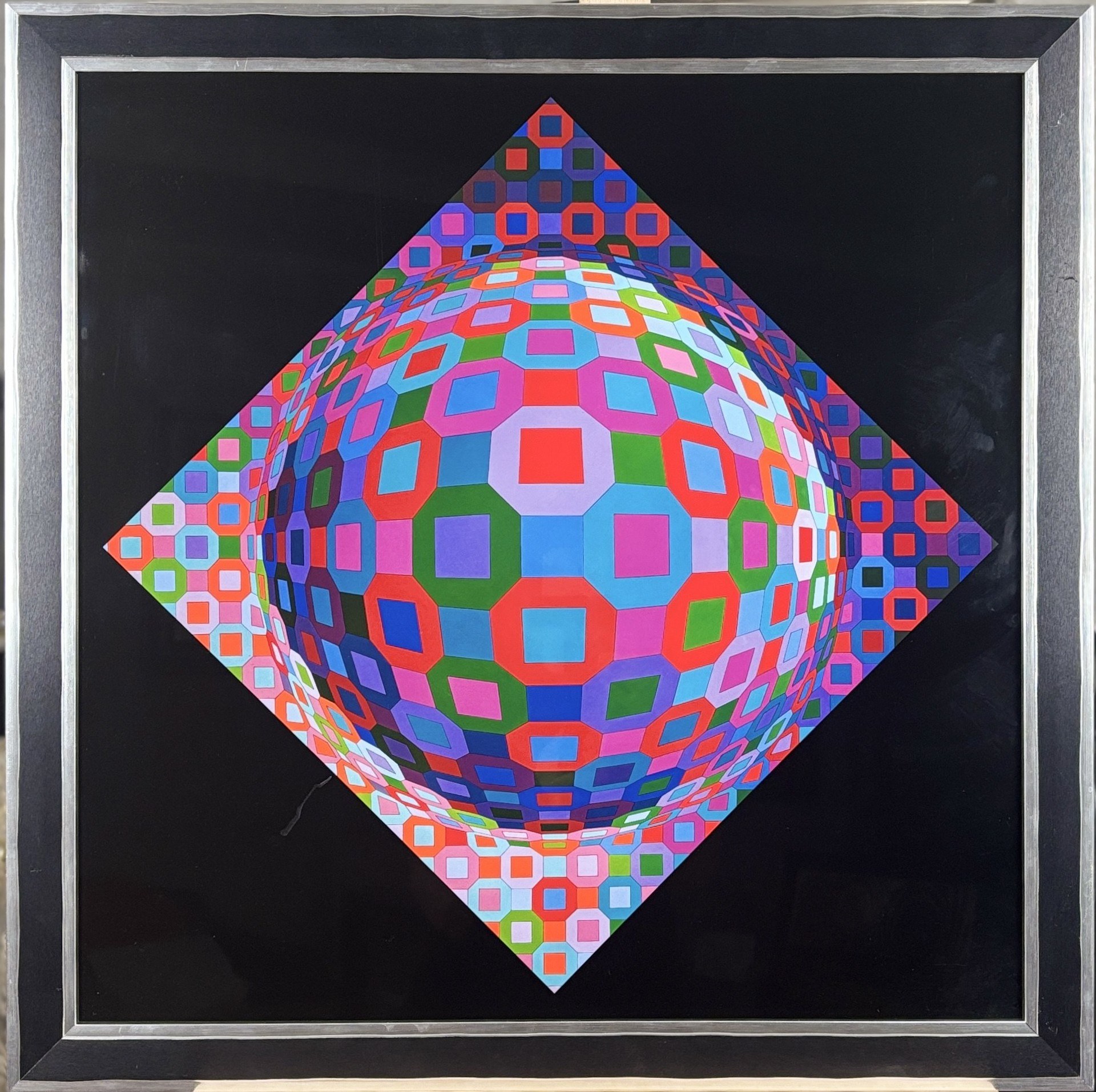
Silkscreen print on glossy stock paper, framed in a 62 x 62 cm frame. Publisher: Editions du Griffon, Neuchâtel, Switzerland (stamp on the reverse).
Editions du Griffon (based in Neuchâtel, Switzerland), founded by Marcel Joray, was Vasarely’s primary and official publisher in the 1970s. Their relationship was not purely business—Joray and Vasarely were close friends, and the artist personally oversaw the printing process, the selection of paper, and the color scheme.
In the art world, these works are recognized as “official editions.” They are not contemporary reproductions or posters from a print shop, but works created during the artist’s lifetime with his active collaboration.
*Planetary* is an example of Victor Vasarely’s mature work; he is widely regarded as the father of Op Art (optical art), and this piece embodies the essence of his exploration of the illusion of space on a flat surface. It was created at a time when Vasarely was at the height of his fame. His style dominated the design, fashion, and even architecture of the era. It was then that his works became a symbol of modernity and the “space age.”
Although the painting is static, it gives the impression that the center of the composition is “swelling” or pushing out the surface of the canvas. Vasarely achieved this by deforming a regular geometric grid. This is an extension of his famous *Planetaire* series, in which the artist experimented with curving two-dimensional structures. By mathematically narrowing and widening the grid lines, he forces our brains to interpret the flat canvas as a convex sphere that “pulsates” before our eyes.
Vasarely believed that art should be understandable to everyone, regardless of culture or education. He created the so-called “alphabet plastique”—a system of color units in which shape and color are inseparable, where squares and circles in various shades form dynamic structures. Victor Vasarely’s works are highly regarded and have had a lasting influence on contemporary art, graphic design, and visual culture. Vasarely is often emulated—both in art and in commercial applications.
Contemporary artists inspired by Vasarely explore geometric forms, optical illusions, and color interactions in their work. In particular, artists associated with Op Art and postmodernism continue his exploration of spatial illusions. Op-art patterns inspired by Vasarely appear in advertisements, animations, set designs, and digital graphics. His style influences applied design, especially in fields such as generative art, where algorithms create patterns reminiscent of his works.










Viimeksi katsotut
Kirjaudu sisään nähdäksesi kohdeluettelon
Suosikit
Kirjaudu sisään nähdäksesi kohdeluettelon