


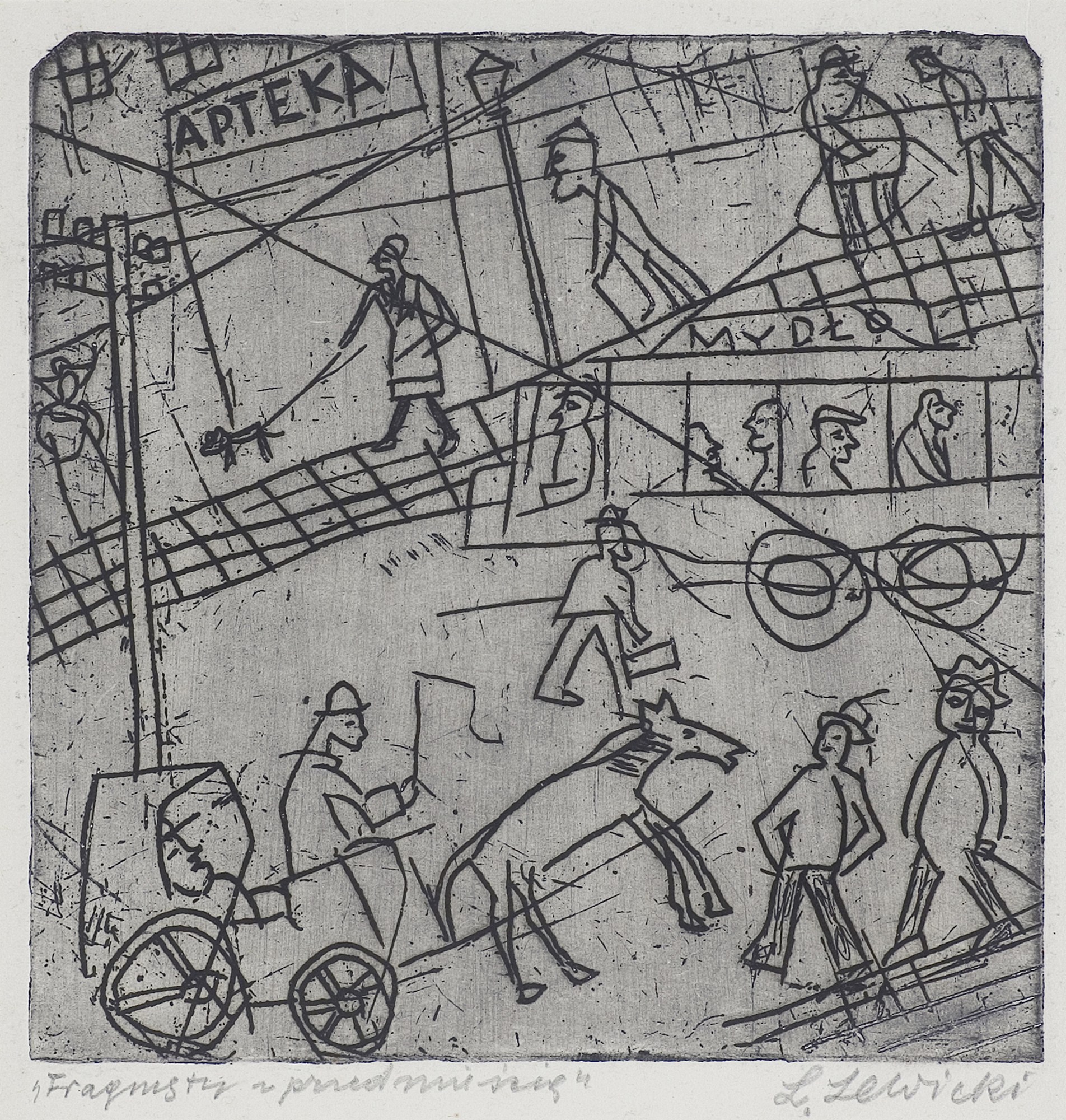
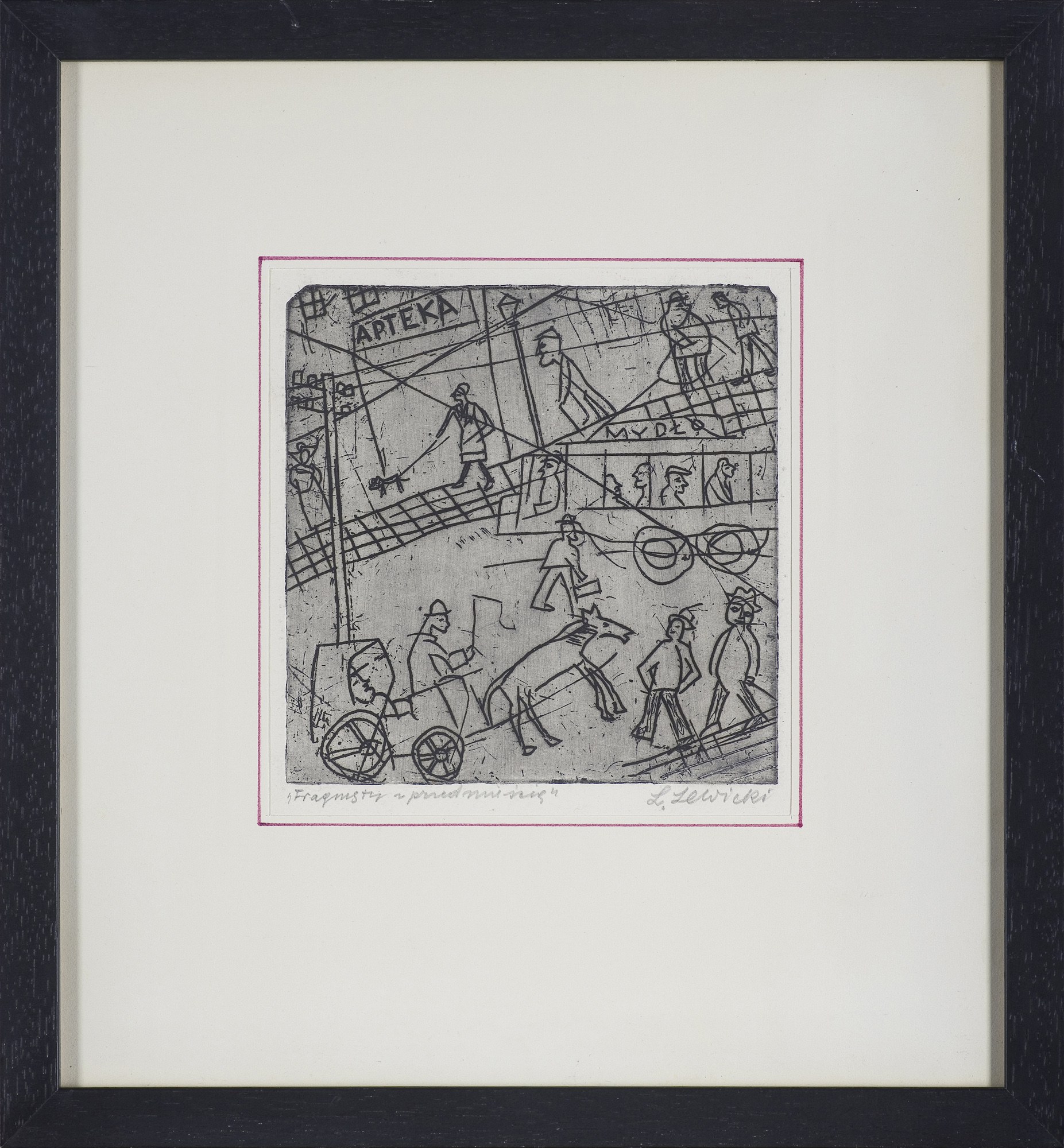
13.7 x 13.7cm - etching, dry needle toned, paper
Other titles: Suburb; Traffic; Street in the suburb.
signed in lead under the engraving l.: "Fragments from the suburb", p.: L. Lewicki
on the reverse, dedication on g.: to Professor Dr. J. Starzyński | L. Lewicki
Work from the period of the artist's studies at the Academy of Fine Arts in Cracow. Mentioned and reproduced in:
- Illustration / Figuration, National Museum in Cracow, VII International Biennale of Graphics in Cracow. Exhibition Catalogue, Cracow 1978, p. nlb., cat. 593, il. 92
- Artistic avant-garde from the circle of KPP - exhibition of the Cracow Group 1932-1937. catalog - part I, Palace of Art, Cracow V-VI 1979, p. 20, cat. 177.
- Leopold Lewicki. Exhibition of paintings and prints. From the Collections of Felicja and Bogdan Kędziorek, Nautilus Antiquarian Salon, Connaisseur Salon of Works of Art, Kraków 9-23 XI 2001; followed by a traveling exhibition: Czas Gallery, Bedzin 24 XI - 4 XII 2001, Art. New Media Gallery, Warsaw 5-19 I 2002, Zamek Cultural Center, Poznań 8-24 II 2002, p. 11, cat. 58, il. 43; ibid. reference: Leopold Lewicki and the Krakow Group, Krakow 1991, il. 26; Krzysztofory, Kraków IV-V 1992; University of Silesia, Cieszyn VI 1992
- Ukrainskyj awangard 1910-1930 rokiw. Albom, published by Mystectwo, Kyiv 1996, il. 333
Leopold Levitsky studied at the Academy of Fine Arts in Cracow from 1925 to 1932, and most of his output in the field of printmaking in metal techniques comes from these years (later he practiced linocut and woodcut). He was a member of the first "Cracow Group" (1933-1937), sympathizing with the communists. He was repressed by the police for these associations and participation in demonstrations. Together with other members of the group (including Maria Jarema, Stanislaw Osostowicz, Jonasz Stern), he co-founded the last generation of the Polish avant-garde before World War II. In addition to social issues, the group's explorations were directed towards a peculiar kind of brutal realism, its members independently arrived at abstraction based on expressionism. Levitsky spent the years of World War II in Chortkiv (1939-1941) and in the Samarkand region, where he worked as a teacher and served in a construction battalion (1941-1944). From 1944 he lived permanently in Lviv. He was active in the Artists' Union there. In 1970 he was awarded the title of Distinguished Artist of the Ukrainian SSR. After the war, he created in the convention of socialist realism in force in the USSR. He practiced easel and decorative painting, sculpture, printmaking and applied graphics (book graphics).











Viimeksi katsotut
Kirjaudu sisään nähdäksesi kohdeluettelon
Suosikit
Kirjaudu sisään nähdäksesi kohdeluettelon