


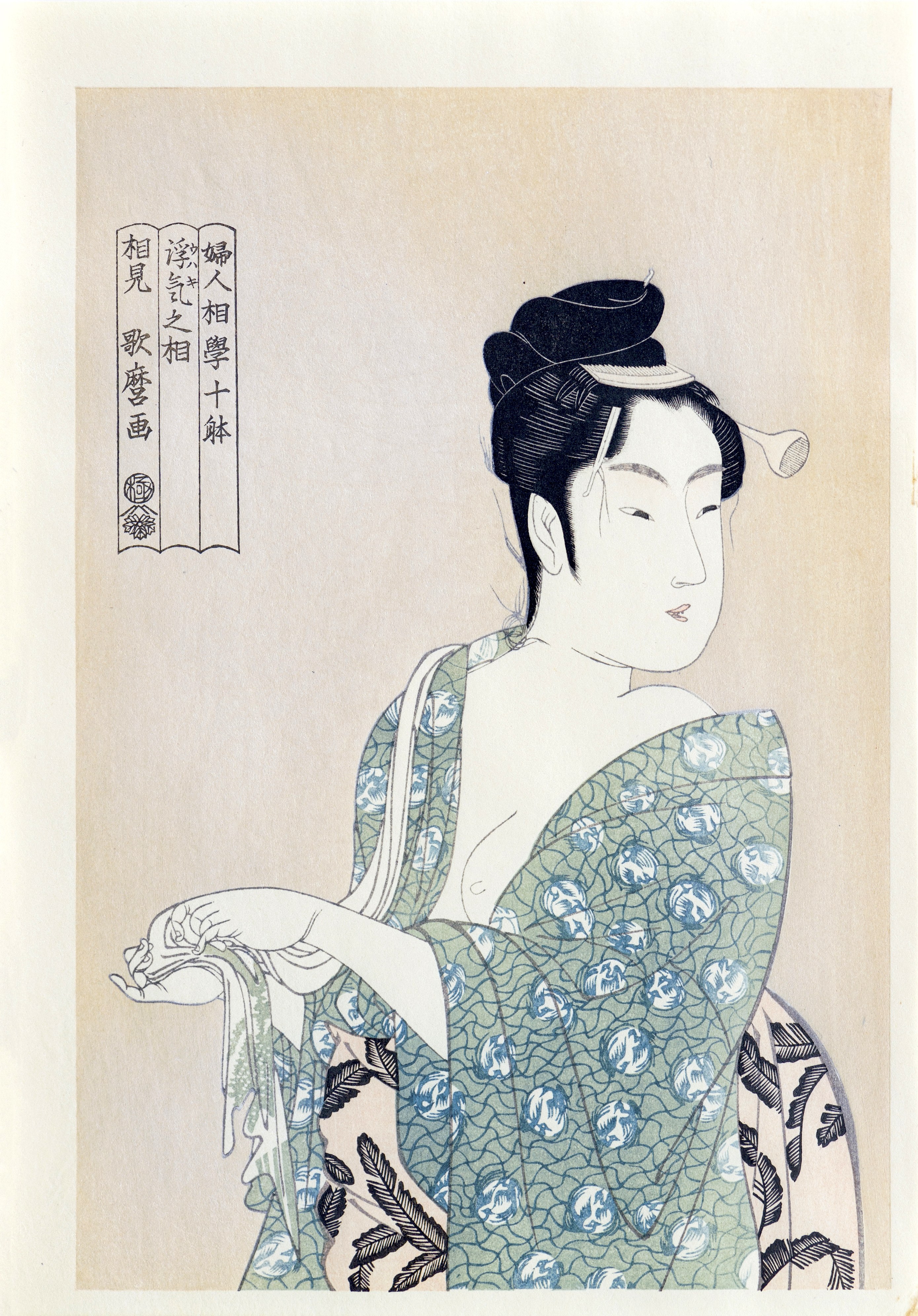
color woodcut, ink, paper, 32x22.5 cm, signed by the artist, pearlescent mica in the background
The woodcut depicts a young woman just out of the bath, drying her hands with a towel. The beauty is wearing a loose, summer kimono (yukata) with a dynamic wave pattern. Her hair is pinned up in a shell-like bun and secured with a decorative hairpin. Her exposed décolletage, flirtatious gaze, and slight smile embody the contemporary image of a playful woman eager to flirt. The original editions, like this reprint, were printed using powdered silver mica in the background, which gave the composition a distinctive, shimmering luster.
Utamaro is often referred to as the artist without a biography. The best source of information about his life is his work and his extensive artistic legacy, as he left behind approximately three thousand woodblock prints. Utamaro was associated with the artistic and literary circles of Yoshiwara, a popular entertainment district in Edo. He moved in the company of the greatest writers, poets, artists, and publishers of his time. He was born in 1753 and, at the age of seventeen, began studying in Toriyama Sekien’s studio, while simultaneously creating his first works. In 1780, he met the publisher Tsutaya Juzaburo, one of the most influential figures in Edo at the time. He moved into Tsutaya’s house, located at the entrance to Yoshiwara, where he met Tori Kiyonaga, who had a profound influence on the maturing style of the young Utamaro. During this time, he began successfully designing books, primarily erotic ones. In 1789, a ban was imposed on the publication of illustrated books and works critical of the establishment, which led him to focus his artistic interests strongly on ukiyo-e woodblock prints. Between 1791 and 1797, he created his famous series of woodblock prints featuring portrait studies of women, scenes from the lives of Yoshiwara courtesans, and works on romantic themes drawn from classical poetry. In 1804, Utamaro broke the law and violated a publication ban, for which he was sentenced to three days in the dungeon and two months in chains. He died in 1806.
By the end of the 18th century, Utamaro had become one of the most outstanding woodblock print artists in Edo. He created an idealized image of the Japanese woman—primarily the courtesan and prostitute—and elevated her to the status of a goddess. He developed an easily recognizable style, unique to himself, of depicting female figures dressed in ornate kimonos with intricately styled hair. It is widely believed that he most fully expressed the essence of femininity in Japanese culture. His art is a great celebration of intimacy.
From the early 20th century onward, the Yuyudo publishing house distinguished itself as one of the finest publishers in Japan. It adhered to the same rigorous standards as 19th-century publishers. In the 1950s, as interest in Edo-period woodblock prints resurged, Yuyudo launched a project to reprint the works of the great masters from the golden age of ukiyo-e. To this end, they hired the world’s finest printers and woodcarvers. The resulting works are among the highest-quality editions ever produced. The publishing house ceased operations in the 1980s.










