


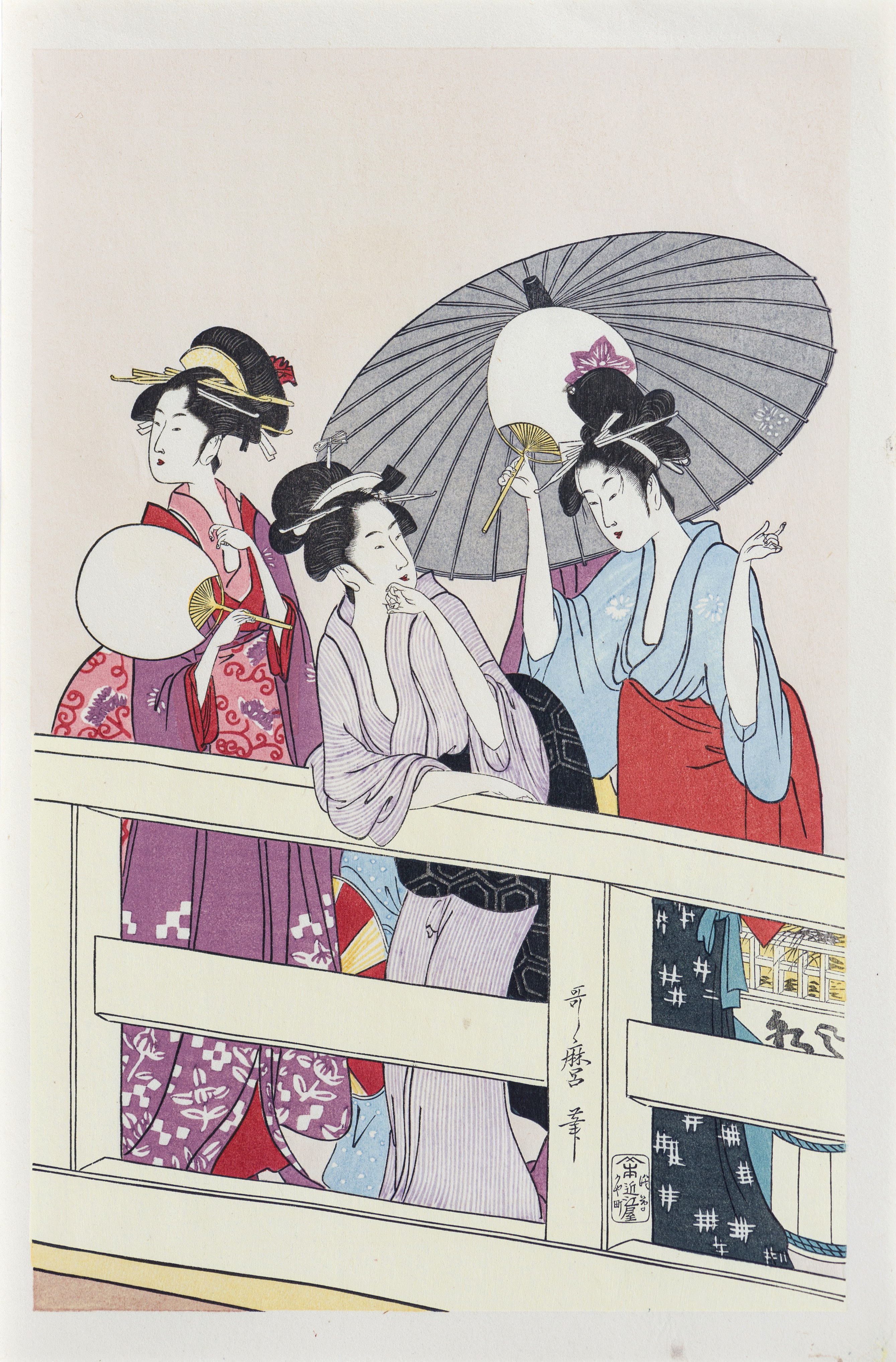
color woodcut, ink on paper, 30x20 cm, signed by the artist
Utamaro is known as the artist without a biography. The best source of information about his life is his work and his extensive artistic output, as he left behind approximately three thousand woodblock prints. Utamaro was associated with the artistic and literary circles of Yoshiwara, a popular entertainment district in Edo. He moved in the company of the greatest writers, poets, artists, and publishers of his time. He was born in 1753 and, at the age of seventeen, began studying in the studio of Toriyama Sekien, while simultaneously creating his first works. In 1780, he met the publisher Tsutaya Juzaburo, one of the most influential figures in Edo at the time. He moved into the publisher’s house, located at the entrance to Yoshiwara, where he met Tori Kiyonaga, who had a profound influence on the maturing style of the young Utamaro. During this time, he began successfully designing books, primarily erotic ones. In 1789, a ban was imposed on the publication of illustrated books and those critical of the establishment, which led him to focus his artistic interests strongly on ukiyo-e woodblock prints. Between 1791 and 1797, he created his famous series of woodblock prints featuring portrait studies of women, scenes from the lives of Yoshiwara courtesans, and works on romantic themes drawn from classical poetry. In 1804, Utamaro broke the law and violated a publication ban, for which he was sentenced to three days in the dungeon and two months in chains. He died in 1806.
By the end of the 18th century, Utamaro had become one of the most distinguished woodblock print artists in Edo. He created an ideal of the Japanese woman—primarily the courtesan and prostitute—and elevated her to the status of a goddess. He developed an easily recognizable style, unique to himself, of depicting female figures dressed in ornate kimonos with intricately styled hair. It is widely believed that he most fully expressed the essence of femininity in Japanese culture. His art is a great celebration of intimacy.
In the second half of the 20th century, Japanese artists and publishers collaborated to reproduce the famous woodblock prints for interested collectors seeking rare designs. New blocks were created, and the prints were painstakingly printed by artisans using the same method as the 19th-century originals—one block for each color. These woodblock print reissues offer an opportunity to collect and enjoy the famous designs of renowned Japanese artists.










