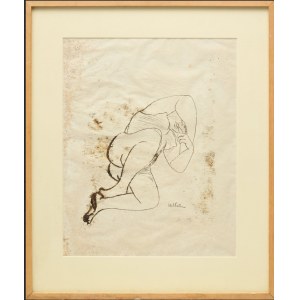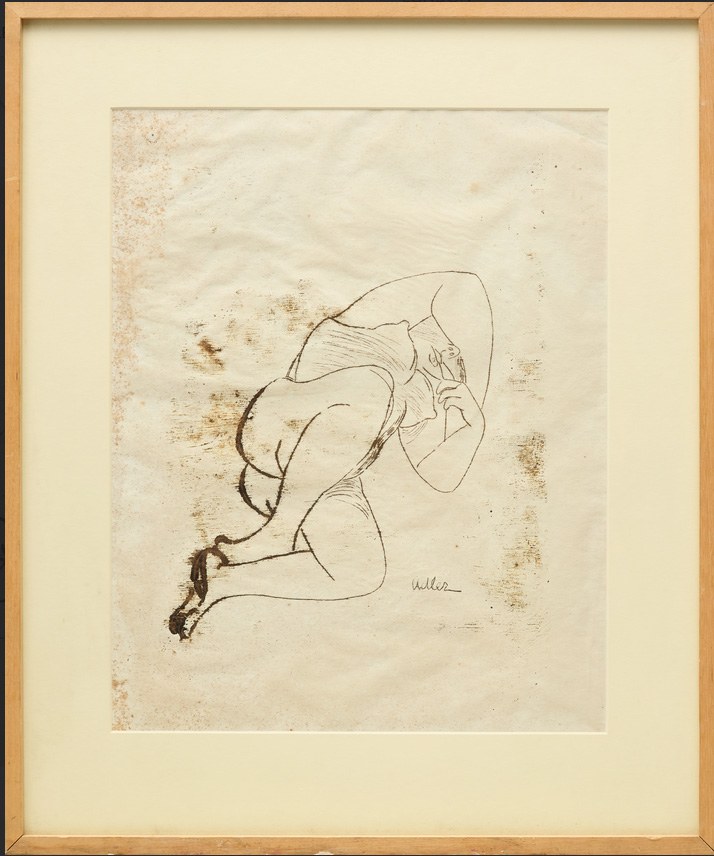
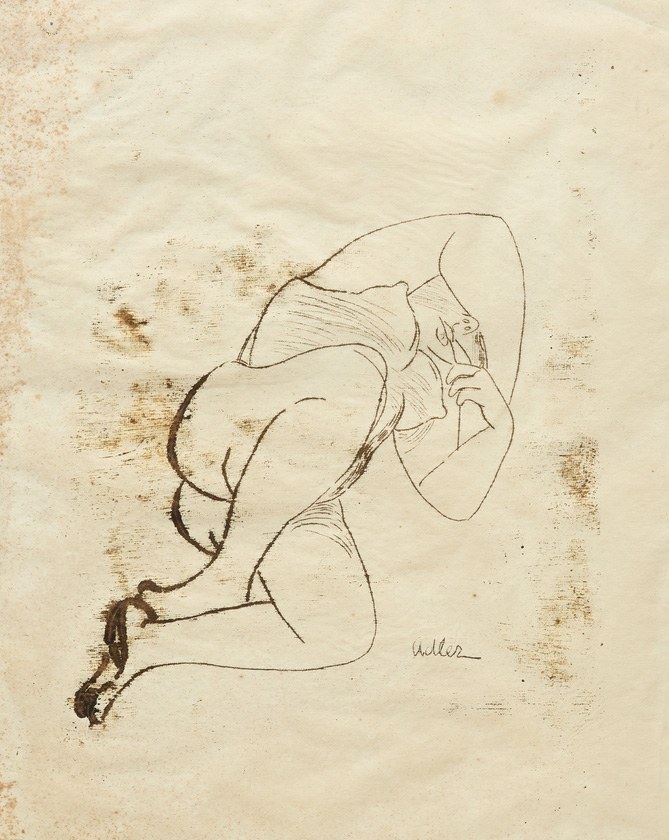
Jankel Adler (1895-1949), Lying figure, opus 117, ca. 1942,
Drawing (Monotype?) on paper, signed in lower right corner: "Adler",
Dimensions: 50.5 × 40 cm, 70 x 58 cm (with frame)
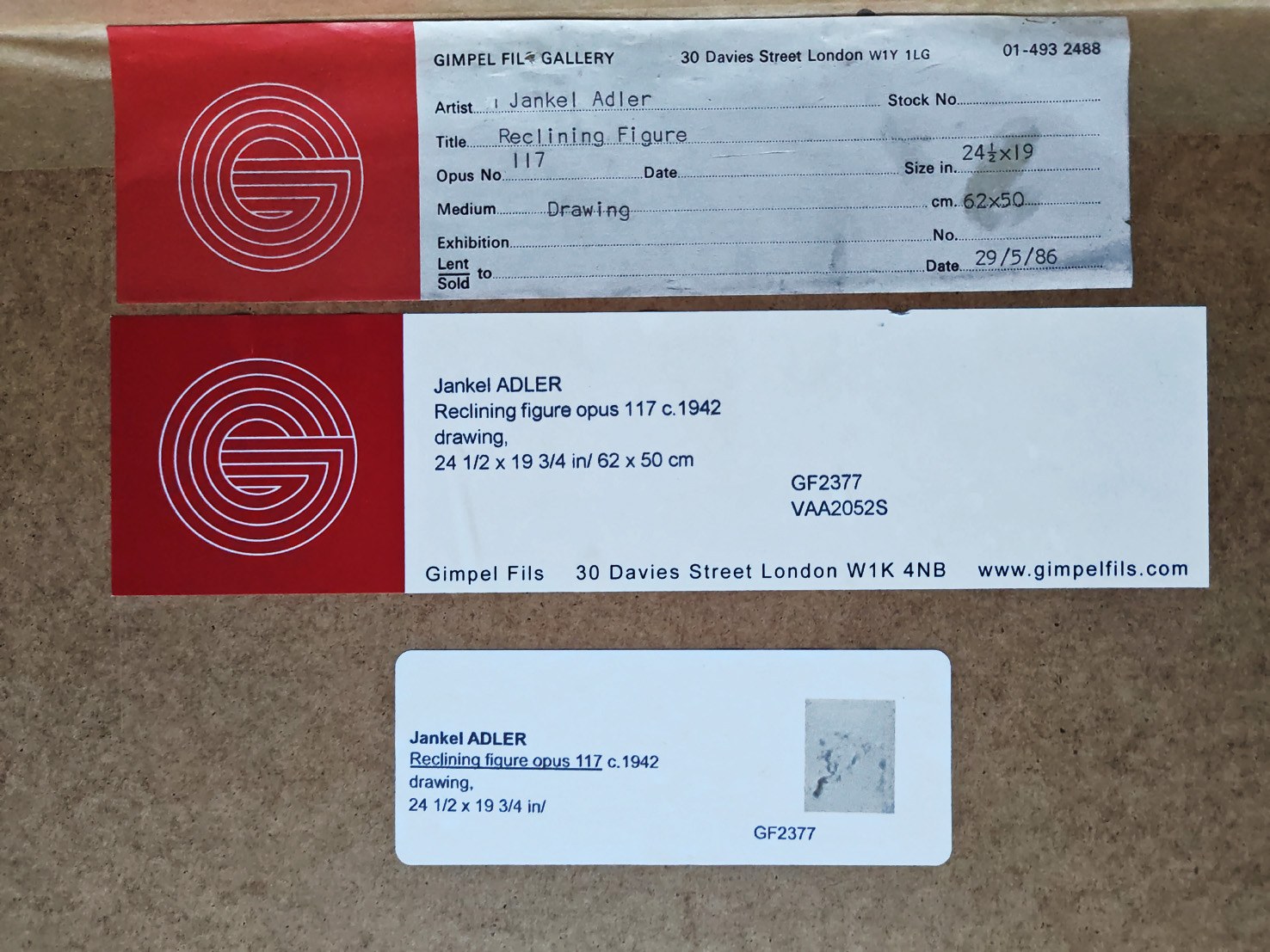
Provenance: Gimpel Fils, London, Inv. no. GF2377 (according to labels on back of frame).
A delicate, linear image of a female nude shown in a contracted position, with her hand near her face and her arm outlining a wide, elliptical arc. Adler builds the composition with an economical, "spidery" line, leaving expansive fields of white that "breathe" between sparse accents of modeling. The use of the graphic technique of transferring the drawing - characteristic of the artist's war years - gives the work a softness of contour and subtle dirtiness of the background, acting as traces of memory. "Opus 117" situates the work among Adler's abstract figurations from the first half of the 1940s, when - already in exile in Great Britain - he developed his own idiom combining synthetic form, lyrical gesture and emotional restraint. The presented sheet perfectly illustrates this influential stage: it was at this time that the artist influenced a whole group of Scottish-British artists (including Robert Colquhoun, Robert MacBryde, John Shelton), and his linear, intimate record of the body - surprisingly relevant today - is sometimes evoked in the context of later drawing sensibilities akin to, for example, Tracey Emin. The work's credible provenance from Gimpel Fils (one of London's key postwar galleries) underscores its collector status.
Jankel (Jankiel) Adler - painter and printmaker of Jewish origin, born in Tuszyn in 1895, died in Aldbourne (UK) in 1949. Co-founder of the Lodz-based Jung Yiddish group, from 1922 he was active mainly in Germany (including Düsseldorf, close to the circle of Paul Klee). The Nazi "Degenerate Art" campaign affected his oeuvre; in 1937 he emigrated to the West, and during the war he stayed in Scotland and England, where he became associated with the London milieu and exerted a strong influence on younger British artists. After the war, he exhibited at Gimpel Fils, among others. Adler's work, ranging from geometrizing abstraction to lyrical figuration, is among the most important phenomena in Polish and European art of the 20th century.