


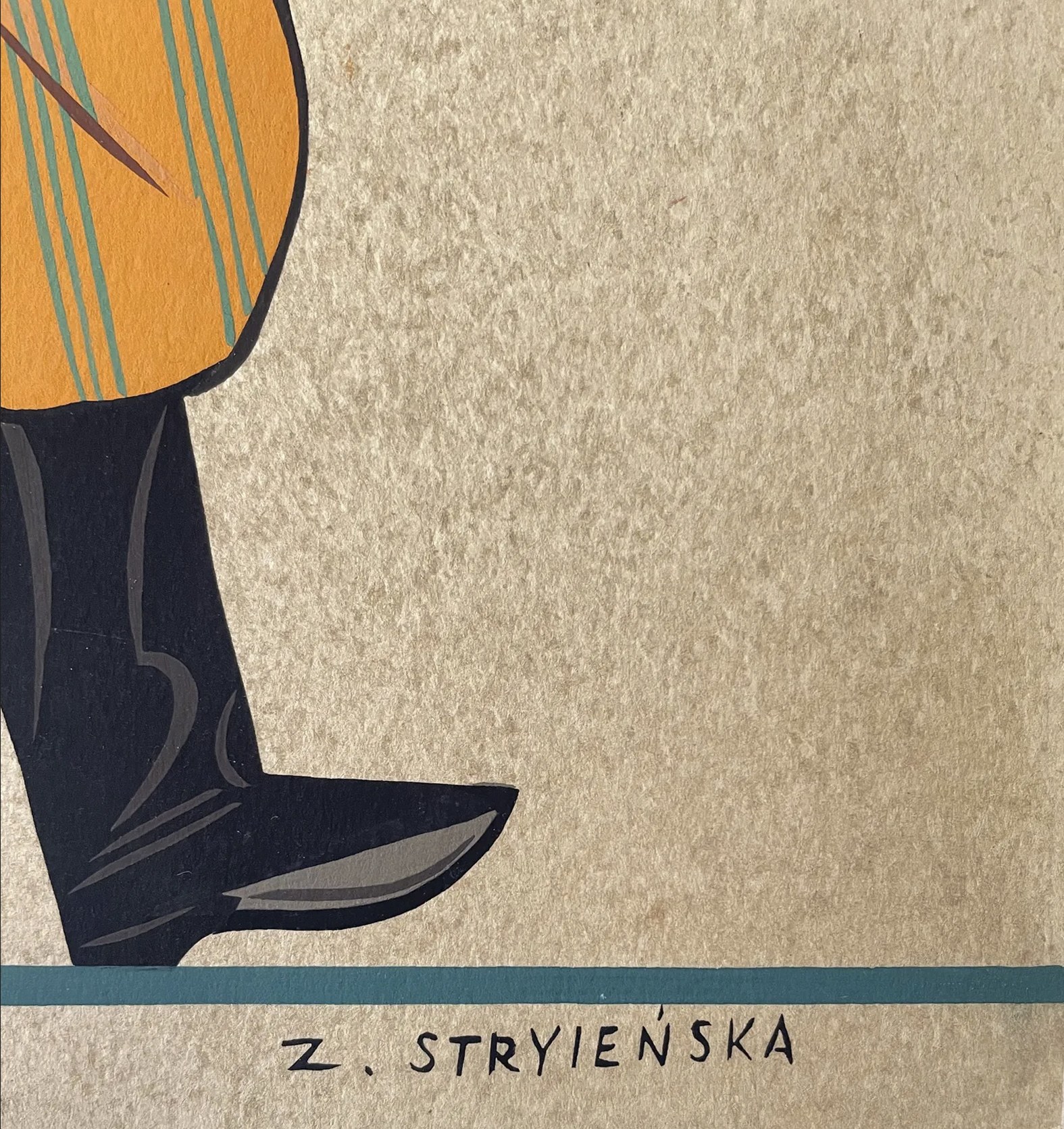
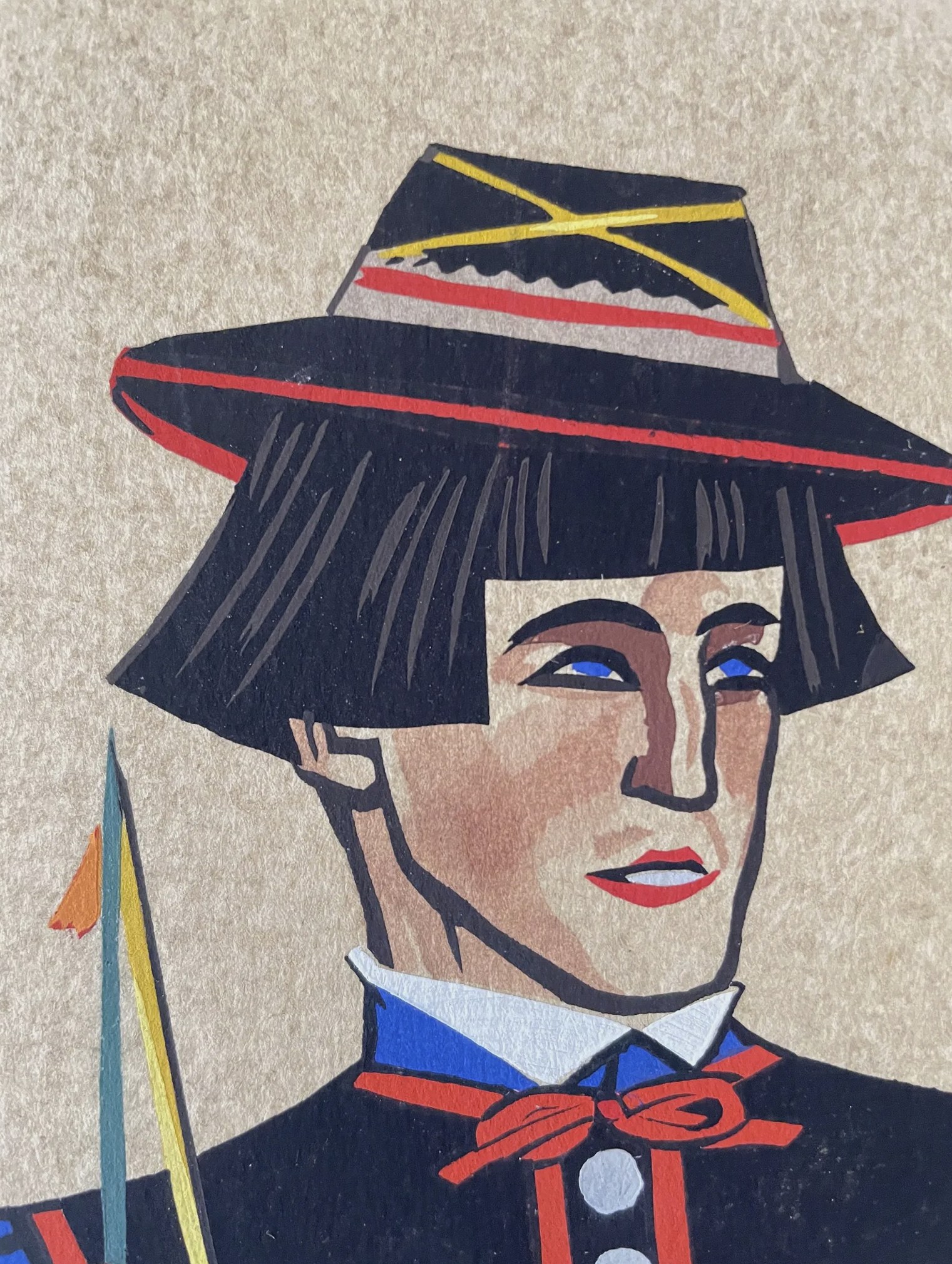
Pochoir hand-colored with gouache/paper
Dimensions: 50 x 39.5 cm (sheet)
Signed p.d.: 'Z. STRYJEŃSKA'
The work comes from the portfolio: "Z. Stryjeńska, Polish Peasants' Costumes. With introducion and notes by Thadee Seweryn, Curator of Ethnographical Museum in Cracow, Nice 1939. Published by C. Szwedzicki"
Literature
Zofia Stryjeńska 1891-1976, catalog of the exhibition at the National Museum in Cracow, scientific editor Świetosław Lenartowicz, Cracow 2008, cat. no. VI.4 (il. selected boards), p. 359
Świetosław Lenartowicz, On the Polish Peasants' Costumes portfolio, ibid, pp. 265-6
Justyna Slomska, On folklore, ibid, pp. 262-264
Zofia Stryjeńska (1891-1976) - one of the most outstanding Polish artists of the first half of the 20th century. Born in Krakow, she became famous as a painter, illustrator and designer. In 1909 she enrolled in Maria Niedzielska's painting school, and two years later, disguised as a boy under the name Tadeusz Grzymała, she took up painting studies in Munich (where women were denied entry). After returning to Cracow in 1918, she joined the Cracow Workshops as a toy designer and graphic artist.
From 1921 to 1927 she lived in Zakopane, where her husband, Karol Stryjeński, served as director of the Wood Industry School. After their divorce, she moved to Warsaw, gaining a reputation and fulfilling orders from the Ministry of Foreign Affairs, including a kilim for Emperor Hirohito of Japan. She worked on the decoration of the interiors of the Polish passenger ships "Batory" and "Pilsudski," and her frescoes decorated the Technical and Industrial Museum in Cracow, as well as the halls of the Wawel Castle and Fukier's winery in Warsaw.
As a member of the Association of Polish Artists "Rhythm", she took part in the International Exhibition of Decorative Arts in Paris in 1925, decorating the main hall of the Polish pavilion with panneaux "Ritual Year in Poland". Her works were presented at numerous national and international exhibitions, including the Venice Biennale (1920, 1930, 1932), where she won a gold medal in 1932, and the General National Exhibition in Poznań (1929), where she received a grand gold medal for book illustrations.
Stryjeńska's work, published in the form of volumes, albums and postcards, drew inspiration from Polish folklore, as exemplified by "Polish Dances," "Pascha," "Piasts" and "Polish Rituals," among others.











Viimeksi katsotut
Kirjaudu sisään nähdäksesi kohdeluettelon
Suosikit
Kirjaudu sisään nähdäksesi kohdeluettelon