


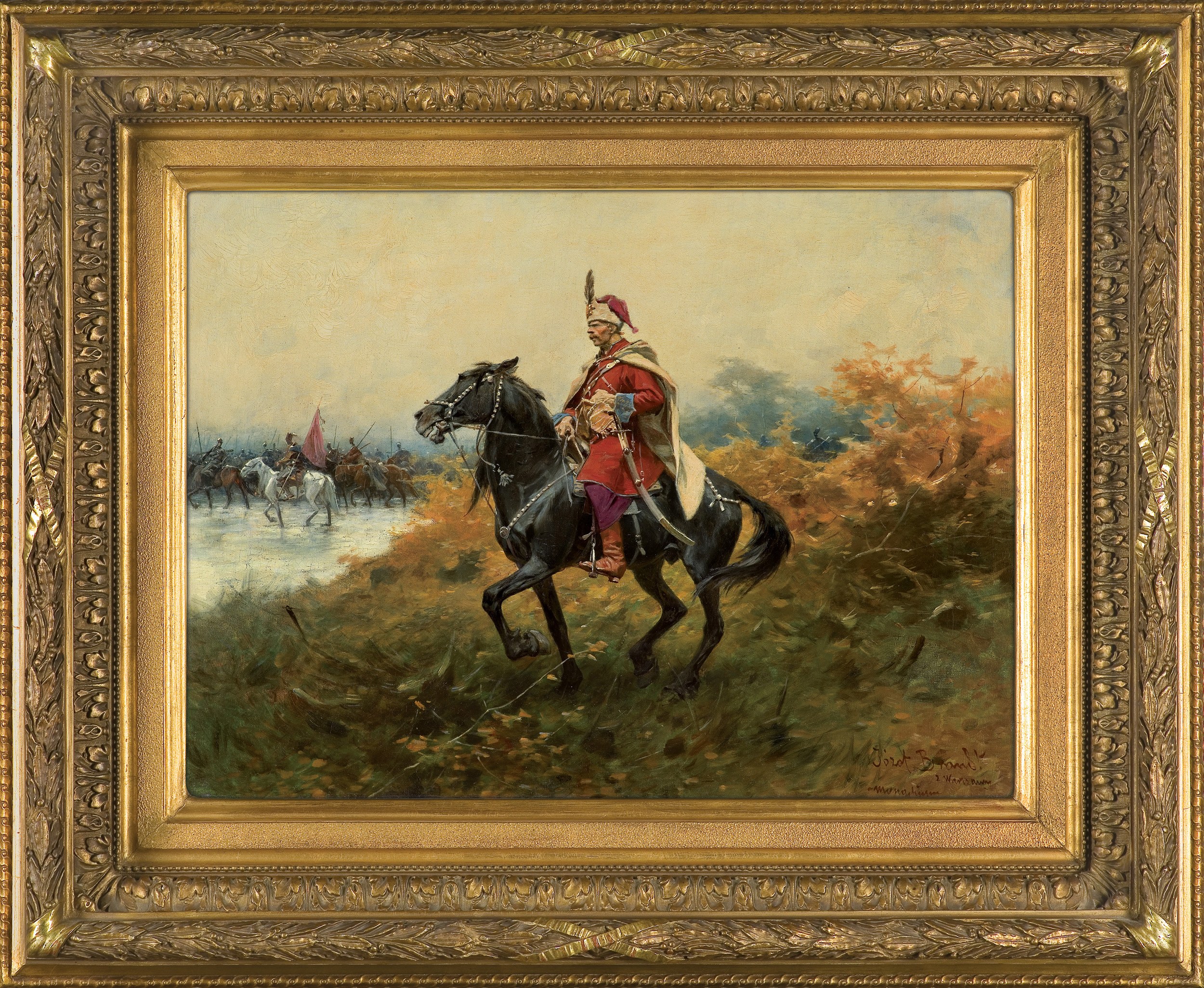

45,6 x 60,7cm - oil, canvas
Also known under the title At the ford
signed p.d.: Józef Brandt | from Warsaw | Munich
On the back, on the loom, three small stickers with numbers inscribed in ink: 328, 472, 29[.]; on the lower loom strip, dimensions (in black marker): 45.5 x 60.5 cm; in the l.d. corner of the loom an illegible circular stamp; in addition, on the upper slat of the frame an Agra-Art auction sticker dated 2007.
Provenance:
- in the 1980s and early 1990s, collection of Stanislaw Jordanowski (1914-1993), president of the Jozef Pilsudski Institute in New York;
- private collection USA;
- Private collection, Poland; purchased at Agra-Art auction on December 9, 2007.
Image reproduced in:
- S. Jordanowski, Vademecum of Polish Painting, New York 1988, p. 252, fig. 26;
- S. Jordanowski, Vademecum malarstwa polskiego w USA, Wroclaw 1996, p. 47, il. 27 on p. 48 (title U brodu);
- E. Micke-Broniarek, Genre themes in Józef Brandt's painting /Genre themes in Józef Brandt's painting [in:] Józef Brandt (1841-1915). Between Munich and Orońsko /Between Munich and Orońsko, ed. by M.Bartoszek, Orońsko 2015, p. 19, il. on pp. 20, 118;
- Józef Brandt 1841-1915, National Museum in Warsaw 2018, scholarly ed. by E. Micke-Broniarek, vol. 2, section I. Painting, p. 270, cat. no. I.228.
From the Wild Fields is a painting depicting a scene, characteristic of the mature period of Jozef Brandt's oeuvre, with an armed horseman shown against a landscape with troops of the army visible in the distance. As always, in the paintings of the Munich master, one can observe extraordinary precision in the elaboration of both historical costume and armament. The presented canvas joins a larger set of works by the artist with - captured in the foreground - mounted soldiers of various weapons and colors depicted either against the background of an encampment or against the backdrop of army units stretching across the plain fields. One can cite many examples of similar compositional solutions enclosed in a seemingly "random frame", with figures and horses extending beyond the borders of the canvas. Examples include the works presented at our auctions Ensign, Fusilier, or Royal Ensign.
Brandt's paintings are characterized by a unique combination of realism, dynamism and attention to historical detail. The artist always paid great attention to the faithful reproduction of all realities, when painting he used authentic props. He was a collector-collector, having amassed a wealth of Polish and Oriental paraphernalia to help him paint. In his Munich studio, called "East", there was, among other things, a Turkish tent, various weapons, rows of horses, saddles, chaps, kilims, Eastern musical instruments and various other antique objects.
From the Wild Fields draws attention to the realistic precision in the elaboration of historical costume and weaponry. In the painting, the foreground rider is shown on a black horse. He holds the reins drawn in his right hand, while his left hand is tucked behind an ornamental belt. At his side is visible, suspended from a rapier, an Eastern-type saber.
Brandt's oeuvre focuses almost exclusively on historical and military subjects, with a marked predilection for the 17th century, the heyday of the First Republic, especially in its eastern borderlands. These paintings, glorified the strength of the chivalrous spirit and heroism. The artist passionately depicted scenes from the Cossack, Turkish and Swedish wars. Although he was a master of dynamic compositions, and the horses and riders on his canvases were often captured in violent foreshortening and thrilling poses, the artist was also famous for his more static horse portraits. He made excellent use of light and color, often using vivid, saturated hues that emphasized the picturesqueness of the scenes. In his depictions of the steppe, he was able to capture the fleeting aura of light and color that depended on the time of day and year.
Although Jozef Brandt created mainly in Munich and for a Western European clientele, he remained deeply connected to Polish culture and history, which made his style recognizable and valued not only in Poland, but also internationally.
Józef Brandt (Szczebrzeszyn 1841 - Radom 1915) was one of the most outstanding Polish battle painters. He began his painting studies in Warsaw under the tutelage of Juliusz Kossak. In 1858-1860 he was in Paris, where he took up engineering studies. However, he soon abandoned them in favor of painting and trained in the studio of Leon Cogniet. After returning to Poland, he made his debut in 1861 at an exhibition at Warsaw's TZSP. From 1863 he continued his studies at the Munich Academy of Fine Arts under Franz Adam. In 1870 he opened his own atelier in Munich and soon became the leader, the "general" of the Polish art colony there and a teacher of many painters. After 1877, he spent the summer months in Oronsko, inviting a group of his students for plein-air sessions.
He became an honorary professor at the Academy in Munich (1878), a member of the Academy in Berlin (1877) and Prague (1900). Decorated with high orders, awarded medals and prizes at international exhibitions, he enjoyed a truly European fame. Living and creating outside the country, he always clearly emphasized his Polishness; expressing it, for example, by signing his paintings Jozef Brandt of Warsaw.
He painted battles, skirmishes, drive-ins - episodes from the history of the Polish borderland wars and the Swedish wars of the 17th century, as well as genre scenes - horsemen, hunting, fairs. His colorful, full of movement and workshop-perfect paintings were widely admired as the best example of the then highly regarded "Polish school." But while the German or French viewer saw in them primarily the exoticism and colors of the Orient, for Poles they were canvases "real, natural, familiar like excerpts from the diaries of Pasek or Rzewuski, transposed into colors and lines."













Viimeksi katsotut
Kirjaudu sisään nähdäksesi kohdeluettelon
Suosikit
Kirjaudu sisään nähdäksesi kohdeluettelon