


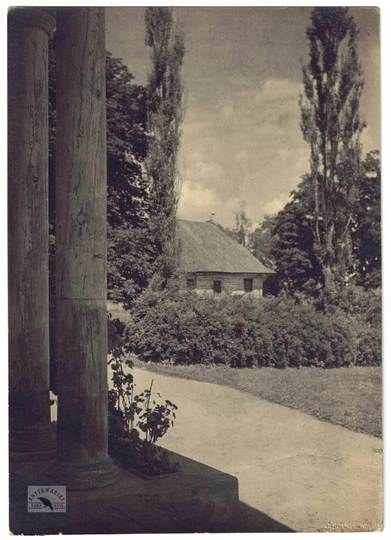
[CZOMBRÓW – the Karpowicz manor complex – panoramic photograph]. [1930]. Photograph, size 16.1 x 11.4 cm, by Jan Bułhak.
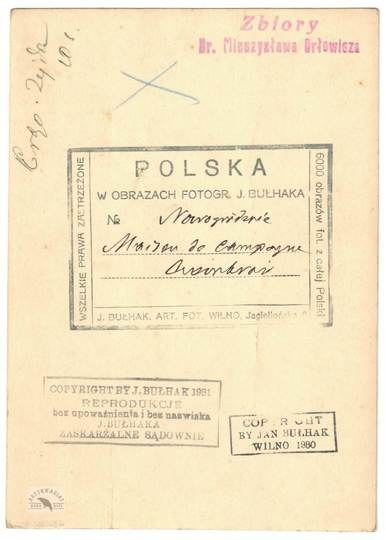
A view of a section of the buildings as seen from behind the columns of the Karpowicz manor in Czombrow near Nowogródek, which was most likely the inspiration for Soplicowo in Adam Mickiewicz’s *Pan Tadeusz*. In the lower right corner, a stamp reads: “J. Bułhak Vilnius.” The photograph is part of the author’s series “Poland in the Images of Photographer J. Bułhak.” On the reverse, among other things, a stamp reads: “Poland in Images by Photographer J. Bułhak. No. Nowogródzkie Maison de Campagne Czombrów [written in ink]. J. Bułhak. Photographer, Vilnius, 8 Jagiellońska St.”, “Collection of Dr. Mieczysław Orłowicz.” In good condition.
J. Bułhak (1876–1950)—an outstanding Polish photographer, the doyen of Polish photography, a philosopher and theorist, founder of the Vilnius Photo Club in 1927, and a co-founder of the ZPAF after World War II. He established his first studio at the urging of Ferdynand Ruszczyc. For a time, he worked at Hugo Erfurt’s studio in Dresden. His first works in Vilnius were created between 1912 and 1919 and were devoted mainly to landscapes and monumental architecture. It was precisely these themes that became central to his work, and he focused primarily on them for the rest of his life. He was a pioneer of landscape photography. His collection of approximately 10,000 photographs, titled “Poland in Photographic Landscapes,” and his photo archive of Polish and foreign images were destroyed by fire in Vilnius in 1944. After the war, through 1946, he took approximately 1,000 photographs documenting the destruction and reconstruction of Warsaw and approximately 2,000 photographs from the Eastern Territories. He published numerous albums, portfolios, and postcards featuring photographs, mainly from the Eastern Borderlands and especially those depicting the Vilnius region. He was also the author of many textbooks on the aesthetics and techniques of photography and regional studies, as well as the initiator of historical research on photography.











Viimeksi katsotut
Kirjaudu sisään nähdäksesi kohdeluettelon
Suosikit
Kirjaudu sisään nähdäksesi kohdeluettelon